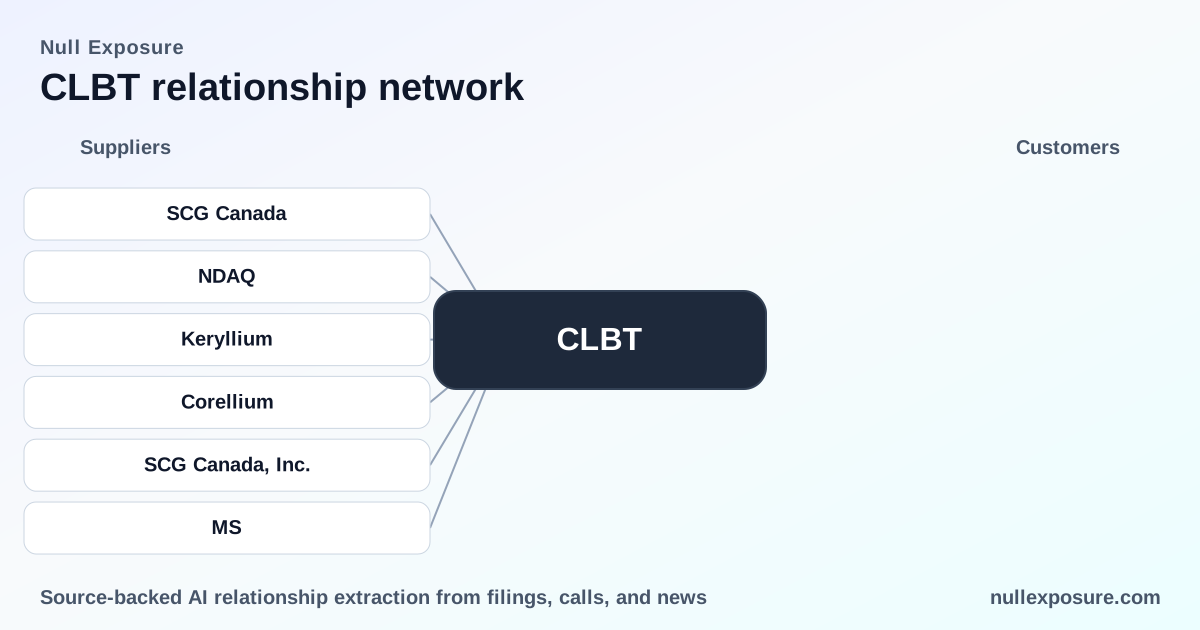
Cellebrite DI (CLBT) — supplier relationships that reshape digital-intel economics
Cellebrite DI sells software and services that extract, analyze and manage digital evidence for public- and private-sector investigations; it monetizes through a mix of recurring ARR, perpetual/license sales, and strategic acquisitions that expand product breadth and channel reach. Recent M&A and reseller actions convert specialized capability into near-term revenue lift and longer-term cross-sell opportunities, while insider selling and Rule 144 activity provide modest liquidity signals for shareholders. For a deeper supplier-risk and partner-play analysis, visit https://nullexposure.com/ to see the full research pack.
Why these supplier relationships matter to investors
Cellebrite’s growth profile is increasingly inorganic: the company has completed multiple tuck-ins (Corellium, Keryllium, SCG Canada) and added reseller arrangements to accelerate commercial adoption. With FY2025 revenue of $475.7m and an EBITDA of $78.3m, management is leveraging acquisitions to increase addressable market and defend a premium multiple (trailing P/E 46.45, EV/EBITDA ~30.8). These supplier and partner moves influence three investor-relevant dimensions:
- Revenue mix: acquisitions convert nascent ARR into higher-yielding recurring revenue and product attach opportunities.
- Product defensibility: virtualization and drone-forensics capabilities broaden technical barriers to entry.
- Channel scale: reseller agreements shorten go-to-market cycles for new technology nodes.
If you evaluate supplier risk and partner economics, start here for a concise, transaction-level read: https://nullexposure.com/.
Supplier relationships and what they contribute (one-by-one)
SCG Canada — drone and UAV forensics
Cellebrite completed the acquisition of SCG Canada, Inc., which supplies handheld forensic tools able to access more than 80 common UAV models; management estimated the transaction consideration in the $15–$20 million range and described the target’s current ARR as low single-digit millions with significant growth potential, with the deal expected to close by end of Q1 2026. According to company disclosures discussed on the Q4 2025 earnings call transcript reported in March 2026, SCG adds immediate drone-forensics capability and incremental ARR with clear unit economics upside (The Globe and Mail / StockTitan, FY2026).
Keryllium — ARM virtualization and reseller path
Cellebrite completed the acquisition of Keryllium and subsequently executed a reseller agreement after closing; management acknowledged the transaction took longer than expected to fully close but that the reseller cadence is now established, enabling integration of ARM virtualization into Cellebrite’s investigative stack. Remarks about the timing and reseller deal were made on the Q4 2025 earnings call and reported in March 2026, signaling a technology-led tuck-in turned channel-enabled growth lever (The Globe and Mail / InsiderMonkey, FY2026).
Corellium — virtualization and AI talent
The Corellium acquisition closed in December 2025 and was presented as a strategic bolt-on that brings advanced ARM-based virtualization and technical talent to strengthen Cellebrite’s AI-powered digital-investigation platform. A GlobeNewswire release and coverage in late 2025 framed Corellium as a material technology capability that elevates product differentiation; management referenced the acquisition in FY2025 materials and in Q4 commentary summarized in early 2026. Corellium broadens Cellebrite’s technical moat and supports higher-margin forensic offerings (GlobeNewswire; SimplyWallSt coverage, FY2025–FY2026).
Nasdaq (Rule 144 filing for an insider sale) — liquidity and insider movement
Marcus Jewell filed a Rule 144 notice to sell 13,276 ordinary shares of Cellebrite DI on or about February 17, 2026, with trading to be executed through Morgan Stanley Smith Barney LLC according to the SEC filing summarized in March 2026. That filing was reported via a SEC aggregation service, and it indicates a small insider liquidity event that is not large enough to change ownership dynamics but is relevant for governance and float considerations (StockTitan/SEC filing, FY2026).
Morgan Stanley Smith Barney LLC — transactional broker on Rule 144 execution
Morgan Stanley Smith Barney LLC was identified as the executing broker for the Rule 144 sale referenced above; the role is strictly transactional and reflects standard brokerage handling of an insider disposition. The broker participation was disclosed in the same SEC filing synopsis in March 2026 and provides routine execution capacity rather than a commercial partnership signal (StockTitan/SEC filing, FY2026).
How these relationships change operating model signals
Cellebrite’s contracting posture is proactive and acquisition-driven: management is deploying capital to buy specialized capabilities and immediately folding them into its go-to-market under reseller or channel arrangements. Concentration risk softens as the product set expands from handset and cloud forensics into virtualization and UAV sources, increasing end-market criticality for law-enforcement and national-security customers. Maturity signals are mixed: core revenue is established (FY2025 revenue ~$475.7m) while many acquired assets contribute small but strategically important ARR initially, creating near-term integration risk and medium-term margin upside as these revenues scale and cross-sell.
- Contracting posture: acquisitive and integrative, using reseller agreements to accelerate commercial conversion.
- Concentration: product concentration reduced by adding virtualization and drone-forensics, diversifying technical dependency nodes.
- Criticality: solutions remain mission-critical to public-sector customers, which supports pricing power and recurring revenue durability.
- Maturity: enterprise-level financials with growth augmented by small strategic acquisitions rather than purely organic scale.
No constraints were reported in the supplier-relationship feed; that absence itself is a company-level signal indicating no explicit supplier constraints surfaced in these documents.
Investment implications and risk framework
Cellebrite trades at a premium multiple that reflects its unique market position and margin potential post-integration. Key positive drivers are expanded addressable market (drone forensics, virtualization), talent accretion, and reseller-led go-to-market acceleration. Primary risks are integration execution, the pace at which small acquired ARR converts to meaningful recurring revenue, and the valuation premium versus legacy software peers (EV/EBITDA ~30.8).
Operational diligence for investors should focus on:
- Integration KPIs for Corellium, Keryllium and SCG Canada: time-to-revenue, churn, and channel activation metrics.
- Margin trajectory as one-time acquisition costs normalize and higher-margin offerings scale.
- Governance and insider activity: small Rule 144 sales are notable but not dispositive.
For a practical assessment of supplier-level exposure and to track future filings and transcripts, consult our research hub at https://nullexposure.com/.
Final take
Cellebrite is executing a coherent buy-and-build strategy to fortify product differentiation and accelerate recurring revenue mix; the recent Corellium, Keryllium and SCG Canada transactions transform niche technical assets into commercial levers. For investors and operators, the focus is integration velocity and measurable ARR expansion — these determine whether the premium multiple is justified. If you evaluate supplier concentration, partner economics, or need a consolidated view of these relationships, start with our coverage at https://nullexposure.com/.