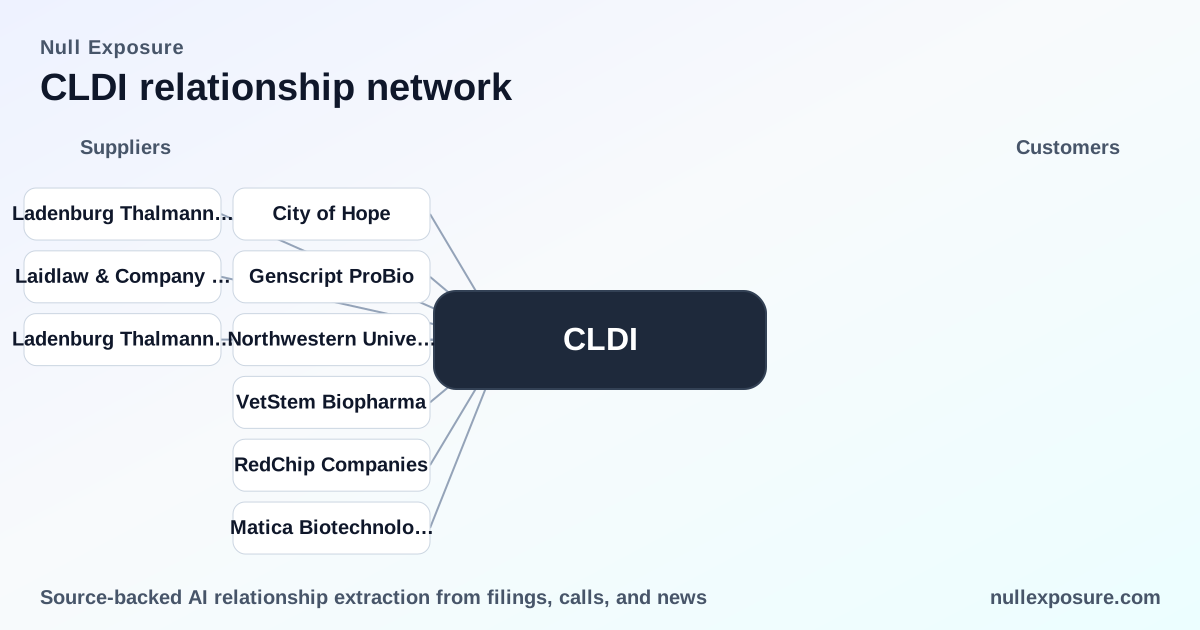
Calidi Biotherapeutics (CLDI): a supplier map for investors and operators
Calidi Biotherapeutics develops cell- and virus-based immunotherapies and currently monetizes through clinical-stage IP development, licensing pathways and capital raises rather than product sales. Its operating model is built around externally sourced biological banks and contract manufacturing for investigational candidates, with capital markets activity (placement agents and underwriters) financing near-term development. For investors evaluating counterparty risk, the supplier list highlights concentrated manufacturing exposure in APAC, academic licensing that underpins core IP, and active use of investor relations and placement agents to fund operations.
For a consolidated supplier risk view and ongoing monitoring, visit https://nullexposure.com/ for more.
The supplier roster — who does what, in plain English
Below are every supplier and service relationship identified in Calidi’s public filings and press coverage, each summarized in one or two sentences with a source reference.
-
City of Hope — Calidi procured a neural stem cell bank used for its CLD-101 candidate and had City of Hope manufacture an extended master virus bank for its NeuroNova oncolytic virus. This is documented in Calidi’s FY2024 Form 10‑K.
Source: Calidi Form 10‑K, FY2024. -
Genscript ProBio (China) — Calidi contracts Genscript ProBio in China to manufacture the CALI1 virus strain used in CLD-201 and explicitly cites Genscript as the contract manufacturer of the CAL1 oncolytic vaccinia virus. This manufacturing relationship is described in the FY2024 Form 10‑K.
Source: Calidi Form 10‑K, FY2024. -
Northwestern University — Northwestern supplied the master virus seed for the NeuroNova oncolytic virus (CRAd-S-pk7) and granted Calidi a license that includes a twelve‑year exclusivity for commercial development of NSC-CRAd-S-pk7 and a right of reference to Northwestern’s IND. This appears in Calidi’s licensing disclosures in the FY2024 filing.
Source: Calidi Form 10‑K, FY2024. -
VetStem Biopharma — VetStem produced the AAA cell bank VP-001 used for the CLD-201 candidate, making VetStem a supplier of a key biological starting material. The arrangement is noted in the FY2024 Form 10‑K.
Source: Calidi Form 10‑K, FY2024. -
RedChip Companies — RedChip Companies acts as an investor relations / media client service for Calidi, with multiple press releases identifying CLDI as a RedChip client for investor interviews and web events in 2025–2026. This is reflected in several press releases and news items.
Source: Multiple press releases (various local news sites), FY2025–FY2026. -
Matica Biotechnology, Inc. (Matica Bio) — Matica Bio entered into a CDMO partnership to provide analytical development, process development and GMP manufacturing support to advance Calidi’s CLD-401 toward an IND, per a PR Newswire release in 2025.
Source: PR Newswire, 2025. -
Ladenburg Thalmann & Co. Inc. — Ladenburg has acted as placement agent and, in later offerings, as the sole book‑running manager for Calidi capital raises in 2025–2026, supporting registered direct offerings and private placements. Public filings and press coverage note Ladenburg’s role in financing transactions.
Source: GlobeNewswire and other press coverage, FY2025–FY2026. -
Laidlaw & Company (U.K.) Ltd. — Laidlaw served as a co‑manager on at least one capital markets offering, according to press reports tied to Calidi’s 2025 financing activity.
Source: Press coverage (Finance/Yahoo), FY2025.
What the supplier mix reveals about Calidi’s operating constraints
The supplier evidence in filings and public announcements signals a business model with several defining constraints:
-
Concentrated manufacturing exposure in APAC. Calidi explicitly outsources critical viral manufacturing to Genscript ProBio in China, creating country-level operational and regulatory concentration that is directly material to the CAL1 program. This is a company-level risk and is noted in the FY2024 filing.
Source: Calidi Form 10‑K, FY2024. -
Licensing-dependent IP foundation. The Northwestern license provides exclusivity and a right of reference to an IND, anchoring Calidi’s NeuroNova program to academic-origin rights and creating dependency on negotiated license terms and field definitions. The Northwestern Agreement is disclosed in the FY2024 filing.
Source: Calidi Form 10‑K, FY2024. -
Manufacturer relationships are operationally critical but not long-term guaranteed. Calidi states that it currently does not have long-term supply arrangements with CMOs while also reporting active CMO commitments and incurred manufacturing spend, which produces a mixed contracting posture: substantive short-to-mid term commitments but limited long-term guaranteed supply. This is a company-level signal from the FY2024 filing.
-
Materiality and regulatory sensitivity around certain suppliers. The filing cautions that if Genscript ProBio were to be defined as problematic by U.S. authorities, Calidi’s ability to contract manufacture CAL1 could be adversely affected — an explicit materiality flag tied to Genscript.
Source: Calidi Form 10‑K, FY2024. -
Active stage and moderate spend profile. Calidi reports aggregate manufacturing and supplier commitments of roughly $7.0–$7.3 million (with incurred amounts near $6–7 million) and also cites smaller program-level commitments (~$0.3 million), indicating clinical-stage spend concentration rather than large commercial-scale outlays. This positions current supplier relationships as mission-critical to trials but not yet scale-manufacturing relationships.
Source: Calidi Form 10‑K, FY2024. -
External capital providers and IR firms are integral to monetization. Placement agents and PR/IR firms (Ladenburg, Laidlaw, RedChip) are named repeatedly in financing and investor events, which underlines a financing-driven monetization strategy while product revenues remain at zero. Press coverage documents these roles in 2025–2026.
If you want an investor-grade supplier risk dashboard constructed from these signals, start here: https://nullexposure.com/.
Investment implications — what operators and investors should monitor
- Operational continuity: Prioritize tracking Genscript ProBio’s regulatory status and export controls given APAC concentration and the filing’s explicit materiality warning.
- License terms and IP clarity: Monitor milestones, exclusivity windows and any Northwestern communications that could alter the company’s right of reference or licensing scope.
- Financing cadence: Calidi’s reliance on placement agents and underwriters (Ladenburg, Laidlaw) for recurring capital raises is a primary driver of short-term viability; underwriter appetite is a leading indicator of runway.
- Manufacturing maturity: The Matica CDMO agreement for CLD-401 signals an effort to diversify manufacturing partners and de‑risk IND filing readiness; progress here reduces single‑vendor dependency.
- Clinical sourcing reliability: City of Hope and VetStem supply foundational biological banks; any disruption to academic or vet‑bio supply lines would directly affect trial material availability.
A concise checklist for operational due diligence: regulatory status of APAC CMOs, license milestone schedule and covenants, current cash/runway tied to recent placements, and evidence of long-term manufacturing contracts or qualification of alternate CDMOs.
For tailored counterparty risk analytics on Calidi’s suppliers, see https://nullexposure.com/ for a deeper dive.
Bottom line
Calidi’s supplier ecosystem is compact and strategically aligned to its clinical-stage priorities, but concentrated in APAC manufacturing and dependent on academic licensing and capital markets activity. That mix produces operational leverage if CDMO and license relationships remain steady, and downside sensitivity if APAC manufacturing or key academic licenses face disruption. Investors and operators should treat Genscript ProBio, Northwestern, City of Hope and the financing intermediaries as primary nodes for ongoing monitoring.
For continuous supplier monitoring and alerts tied to Calidi’s counterparties, visit https://nullexposure.com/ and set up tracking for CLDI.