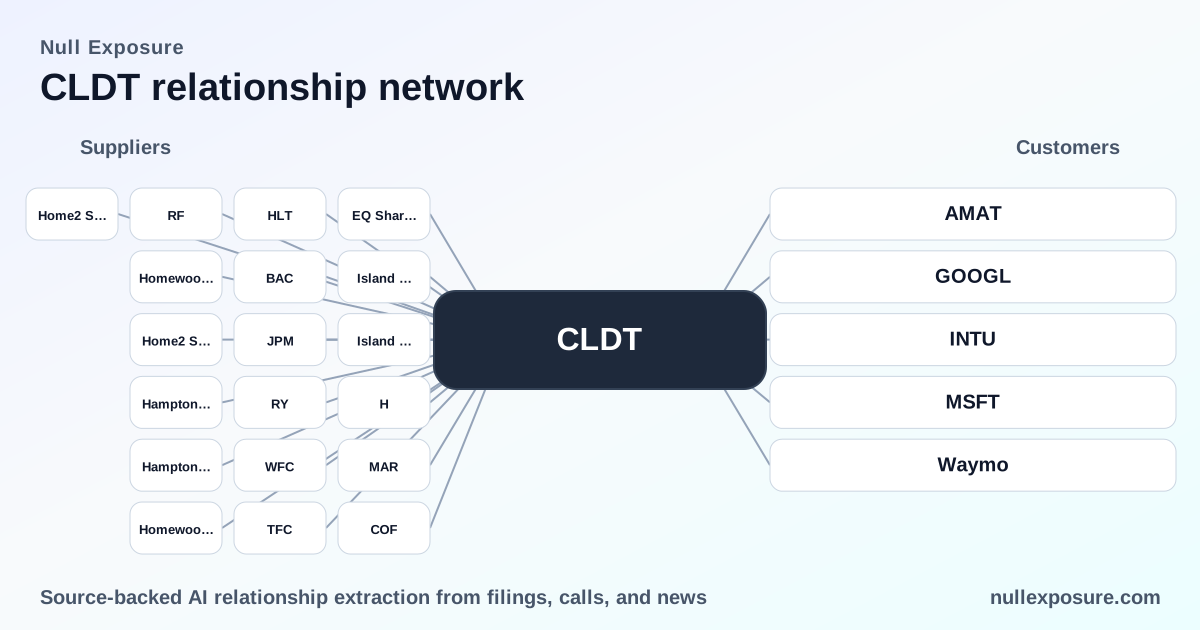
Chatham Lodging Trust (CLDT): Supplier relationships that underpin an asset-light hotel REIT
Chatham Lodging Trust operates as a publicly traded, self-listed hotel REIT that owns primarily upscale extended-stay and select-service hotels and monetizes through property ownership, franchise/licensing arrangements and management agreements that generate predictable room revenue and fee income while leveraging brand distribution. The company extracts cash flow via room revenue (passed through franchise/licensing fees and management fees) and capital recycling (select acquisitions and refinancings), with recent activity including a small accretive portfolio purchase and a broadened unsecured credit facility to support growth.
If you want a centralized view of CLDT’s supplier relationships and how they drive cash flow and operational risk, start here: https://nullexposure.com/
Operational snapshot and investment thesis
- Asset-light operating posture: CLDT relies on branded franchise/licensing and third-party management to operate hotels rather than running an integrated hotel operating company. This keeps operating leverage lower and capital intensive activities primarily at the property level.
- Fee-driven economics: Base management fees (a percentage of gross room revenue) and incentive management fees (tied to net operating income above thresholds) align hotel operator incentives with shareholder returns.
- Concentration and governance: A single manager—Island Hospitality Management (IHM)—runs all hotels, and IHM’s connection to the CEO concentrates operational control. That concentration is a material supplier risk and an execution lever at the same time.
Learn more about supplier exposure and models at https://nullexposure.com/ — valuable if you evaluate counterparty concentration or contract risk.
What the constraints tell investors about CLDT’s operating model
- Long-term contracting posture is embedded. Management agreements cited have initial terms of five years with automatic renewals and other property agreements have initial terms of 10–30 years (weighted-average expiration May 2035), signaling multi-year operational stability and limited near-term renegotiation risk where contracts exist.
- Fees are usage-based and incentive-aligned. Base management fees are calculated as a percentage of gross room revenue and incentive fees link a manager’s payout to hotel-level performance (with specified caps). This creates revenue volatility tied to occupancy and ADR but aligns manager incentives with asset performance.
- Brand licensing is core to distribution. Hotels operate under a mix of premium brands—Marriott, Hilton and Hyatt among them—so franchise/licensing obligations are a recurring operating line and a distribution enabler.
- Service-provider dependency is high. The TRS lessees use third-party management companies for day-to-day operations; combined with the IHM concentration this raises operational single-point-of-failure risk.
- Spend scale is meaningful but not enormous. Management fees ran at approximately $10–11 million annually (2022–2024), which places supplier spend in the $10m–$100m band and makes these fees a material recurring expense for CLDT.
Supplier relationships — the full list and what each relationship means for investors
Below I cover every relationship item pulled from public reporting and media—each entry is a concise, plain-English note and a direct source reference.
Island Hospitality Management / Island Hospitality Management, LLC
Island Hospitality Management is the third‑party manager that runs CLDT’s hotels; company filings state IHM (100% owned by CEO Jeffrey Fisher) managed all hotels as of Dec 31, 2024 and many management agreements include multi‑year initial terms and auto‑renewals. Source: TradingView summary of CLDT SEC 10‑K (FY2026) and HospitalityNet (FY2022).
EQ Shareholder Services
EQ Shareholder Services acts as the dividend paying agent for CLDT distributions and will issue Form 1099‑DIV to shareholders per the trust’s 2025 dividend tax classification announcement. Source: Travel and Tour World (Mar 2026).
Marriott / Residence Inn by Marriott / Courtyard by Marriott / SpringHill Suites (branded references)
Marriott‑flagged properties form a significant portion of CLDT’s portfolio (Residence Inn and Courtyard brands cited), meaning CLDT pays franchise/licensing fees and relies on Marriott distribution and standards for those assets. Source: TradingView SEC 10‑K summary (FY2026) and Ad‑hoc News (FY2026).
Hilton / Homewood Suites by Hilton / Hampton Inn / Hampton Inn & Suites / Home2 Suites by Hilton / Homewood Suites / Home2 Suites (branded variations)
CLDT’s recent acquisition included six Hilton‑branded hotels (two Homewood Suites, two Hampton Inn & Suites, and two Home2 Suites) for $92 million; Hilton flags and brand standards are core to those assets’ distribution and franchise fee obligations. Source: HotelManagement‑Network and Pulse2 coverage of the $92m acquisition (FY2026).
Hyatt / Hyatt Place (brand mention)
CLDT holds assets under Hyatt brands (e.g., Hyatt Place), implying franchise/license relationships and brand distribution reliance similar to Marriott and Hilton properties. Source: Ad‑hoc News overview of CLDT (FY2026).
Bank lenders and arrangers: Bank of America Securities, Inc.; Wells Fargo Securities, LLC; Capital One, National Association; Regions Capital Markets; Truist Securities Inc.; JPMorgan Chase Bank, N.A.; Royal Bank of Canada
These banks participated as joint lead arrangers and lenders on CLDT’s unsecured credit refinancing and upsized facility, underwriting liquidity and capital structure flexibility that supports acquisitions and refinancing activity. Source: StockTitan coverage of CLDT refinancing (FY2025).
Truist Securities Inc. / Regions Capital Markets (as arrangers)
Truist and Regions were named among joint lead arrangers for the unsecured credit, underscoring that CLDT draws on a syndicate of regional and national banks for capital markets execution. Source: StockTitan (FY2025).
JPMorgan Chase Bank, N.A. / Royal Bank of Canada (as syndicate lenders)
JPMorgan and RBC served as lenders in the facility, providing bilateral participation in CLDT’s credit; their involvement diversifies funding counterparties. Source: StockTitan (FY2025).
Hampton Inn and Suites (news variations)
Multiple press items refer to the Hampton flag across CLDT’s acquisitions and portfolio composition, reinforcing that select‑service flags like Hampton are a recurring franchise exposure. Source: TradingView Zacks (FY2026) and HotelManagement‑Network (FY2026).
Homewood Suites / Home2 Suites (news variations)
Repeated press and portfolio notes list Homewood and Home2 Suites among recent purchases and portfolio mix, confirming CLDT’s exposure to all‑suite extended‑stay and select‑service Hilton flags. Source: Pulse2 and HotelNewsResource (FY2026).
Residence Inn by Marriott (brand-specific reference)
Residence Inn is explicitly cited among the extended‑stay flags CLDT owns, aligning with the trust’s target niche. Source: TradingView SEC 10‑K summary (FY2026).
Operational takeaways and risk framing for investors
- Single‑manager concentration is the primary operational risk: IHM manages all hotels and is connected to CLDT’s CEO, so governance, conflict‑of‑interest management and contract renewals deserve active monitoring. (IHM management is explicitly described in company filings, FY2026).
- Brand licensing and usage-based fee structure align cost with revenue, but downside to occupancy or ADR shocks flows through quickly to incentive and base fee payments. Stress scenarios will compress fee income and increase sensitivity to RevPAR declines.
- Capital markets relationships are diversified across major banks, which supports liquidity flexibility but does not eliminate leverage or refinancing timing risk.
If you evaluate counterparty concentration or contract terms, review the filings and deal documents on CLDT’s financing and management agreements at https://nullexposure.com/ — the platform helps organize supplier risk for investors.
Bottom line: CLDT’s model is a blend of owned real estate with outsourced operations and brand licensing that creates stable, fee‑linked cash flows, but operational concentration in a single manager and reliance on franchise arrangements are material supplier risks. For investors and operators, the focus should be on contract expiration profiles, renewal mechanics with IHM and franchisors, and covenant headroom in the syndicated credit facility.
For a deeper supplier‑level diligence brief and contract exposure map, visit https://nullexposure.com/ — you’ll find structured summaries useful for investment committees and procurement reviews.