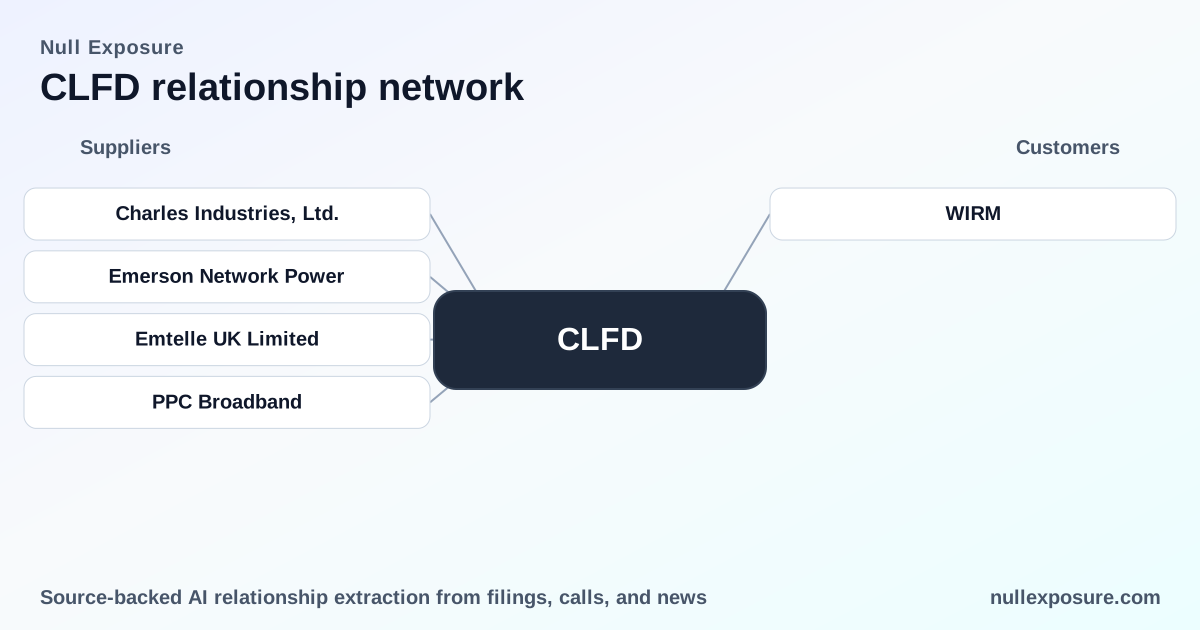
Clearfield (CLFD) — supplier relationships and what they mean for investors
Clearfield manufactures and sells passive fiber connectivity hardware to OEMs, enterprises and fiber-to-the-facility installers, monetizing through product sales of standard and custom enclosures, fiber management and patching systems, and related accessories. The business generates roughly $155 million in trailing revenue on a $402 million market capitalization, with gross margin support but pressured operating profitability, so supplier structure, competitive peers and manufacturing arrangements directly influence margins and time-to-market for new products. For a fast read on how these supplier relationships change the investment case, see NullExposure.
Why supplier structure is a strategic lens for Clearfield investors
Clearfield’s business is fundamentally manufacturing-led: it buys components, assembles hardware and sells into fiber buildouts where deployment schedules and uptime drive demand. Two company-level signals from the FY2025 filing frame the investment implications:
- Critical component dependence and supplier concentration — Clearfield states it purchases injection-molded parts and connectors from third parties, including single- or limited-source suppliers. This is a structural exposure that elevates procurement risk and creates potential for supplier-driven margin pressure or production disruption.
- Outsourced manufacturing services in Mexico — The company operates under a Maquiladora arrangement and contracts a firm to provide personnel and assembly services at its Mexico facility, indicating Clearfield relies on an external service provider for a significant share of final build and assembly work.
Both signals point to a contracting posture that is mixed: in-house design and assembly complemented by outsourced production and single-source components, producing a profile that is operationally efficient but sensitive to supplier reliability and labor arrangements.
For more supplier intelligence and mapping, consult NullExposure.
What the FY2025 10‑K explicitly lists as competitive relationships
Clearfield’s FY2025 10‑K calls out a set of peer vendors and competitors that intersect with its product lines. Each relationship below is described in plain language with the cited source.
Charles Industries, Ltd.
Charles Industries is listed as a competitor to Clearfield’s CraftSmart and FiberFlex active cabinet product lines; the filing groups Charles as a subsidiary of Amphenol in the competitive set. According to Clearfield’s FY2025 10‑K, these product overlaps indicate direct market competition for cabinet and active enclosure solutions.
Emerson Network Power (Vertiv)
Emerson Network Power (now under Vertiv) is also identified as a competitor to the CraftSmart and FiberFlex active cabinet lines, signaling that Clearfield competes against large, established players with broader power and cooling portfolios. The FY2025 10‑K explicitly names Emerson Network Power in that competitive context.
Emtelle UK Limited
Emtelle UK Limited is named alongside PPC Broadband as a competitor to Clearfield’s FieldShield product lines, placing Emtelle in the market for blown fiber and microduct solutions that serve similar last‑mile deployments. This competitive mention is in Clearfield’s FY2025 10‑K.
PPC Broadband (Belden, Inc. subsidiary)
PPC Broadband, a Belden subsidiary, is identified as a competitor to the FieldShield product family; the filing positions PPC as a rival in connectivity components and fiber management hardware. Clearfield’s FY2025 10‑K notes PPC Broadband specifically.
(Each relationship summary above is drawn from Clearfield’s FY2025 10‑K.)
How these relationships influence valuation drivers
Investors should translate the competitive and supplier disclosures into actionable risk/reward signals:
- Margin sensitivity: Competing with large incumbents such as Vertiv and Belden means Clearfield must preserve manufacturing cost advantages and product differentiation to defend gross margins against pricing pressure. With reported gross profit of roughly $53 million on $155 million revenue, procurement swings matter materially to EBITDA.
- Execution risk from supplier concentration: The company's disclosure of single- or limited-source suppliers for injection-molded parts and connectors is a direct lever on production continuity. A single supplier failure would impair assembly throughput quickly, given the Maquiladora arrangement for final build.
- Scale and go‑to‑market: Competitive mentions show Clearfield competes across cabinet and field‑deployable fiber protection systems, but larger competitors offer broader portfolios and service relationships that can win large, bundled contracts. Clearfield’s market capitalization of ~$402 million and revenue scale position it as a specialized, growth-stage supplier rather than a full-solution incumbent.
Mid-deal teams and procurement leads evaluate such exposures differently than pure equity analysts; for help mapping supplier concentration and contractual posture, visit NullExposure.
Practical implications for operators and procurement
Operators and investors should prioritize three actions informed by Clearfield’s disclosure:
- Audit single-source components: Require supplier traceability for critical injection-molded parts and connectors; demand contingency plans and dual‑sourcing timelines when onboarding Clearfield as a supplier.
- Understand the Maquiladora counterparty: Verify performance metrics, labor stability and contractual penalties for the Mexico-based service provider that completes final assembly, since this provider is material to fill rates and lead times.
- Benchmark against incumbents: When evaluating total cost of ownership, compare Clearfield product lifecycles and serviceability against competitors named in the 10‑K—Vertiv/Emerson, Belden/PPC and Amphenol/Charles—to price in bundling and aftermarket support differences.
Bottom line and next steps for investors
Clearfield is a focused supplier in fiber connectivity with meaningful exposure to supplier concentration and outsourced assembly, competing against large incumbents across its cabinet and FieldShield product lines. These structural characteristics are central to both upside (product-led growth, specialized margins) and downside (supplier disruption, competitive pricing pressure). The FY2025 10‑K gives a clear line of sight into those relationships and the company’s contracting model.
For a deeper supplier-risk assessment and relationship mapping tailored to portfolio due diligence, visit NullExposure.
Key takeaways:
- Supplier concentration is a material risk to continuity and margins.
- Maquiladora-based assembly is a core operational dependency requiring contract-level scrutiny.
- Competition from large, diversified incumbents constrains pricing power and elevates go‑to‑market requirements.
Questions about how these supplier relationships affect a specific investment thesis? Contact the research team or explore our analytic tools at NullExposure.