CollPlant (CLGN): Partner-driven bioprinting with high upside — and partner concentration risk
CollPlant Biotechnologies operates as a developer and commercializer of recombinant human collagen bioinks and related regenerative-medicine products, monetizing through joint development and commercialization partnerships with 3D-printer manufacturers, direct sales in medical aesthetics, and periodic capital raises. The company’s route to commercial scale is partner-led: bioink IP and preclinical product prototypes are positioned for market access through integrations with hardware vendors rather than through a large installed base of proprietary printers. For a closer look at supplier relationships and what they signal for investors, visit https://nullexposure.com/.
Why partnerships are the business — and why investors should care
CollPlant’s economics are structured around selling specialized bio-materials and capturing downstream value via co-developed implants and regulatory milestones. The public numbers underscore an early-stage commercial profile: market capitalization roughly $7.8 million, trailing twelve-month revenue of about $2.5 million, gross profit near $1.56 million, and negative operating margins (operating margin TTM about -45.6%). The balance of clinical work, partner engineering, and financing activity defines both runway and dilution risk.
- Contracting posture: CollPlant contracts into co-development and commercialization agreements with hardware vendors rather than building a standalone capital-goods franchise; this makes the company dependent on supplier engineering and commercialization commitments.
- Concentration: A small set of printer partners drive product feasibility and scale; partner performance therefore maps directly to CollPlant’s commercialization timeline.
- Criticality: Printer integrations are functionally critical—without validated printing platforms that can handle CollPlant’s bioinks at commercial sizes, the company cannot launch the regenerative implants it is developing.
- Maturity: The business is pre-commercial for several core implants and remains dependent on preclinical and regulatory progress, while aesthetic product revenue provides limited current cash flow.
If you want ongoing surveillance of supplier ties and capital events, see more at https://nullexposure.com/.
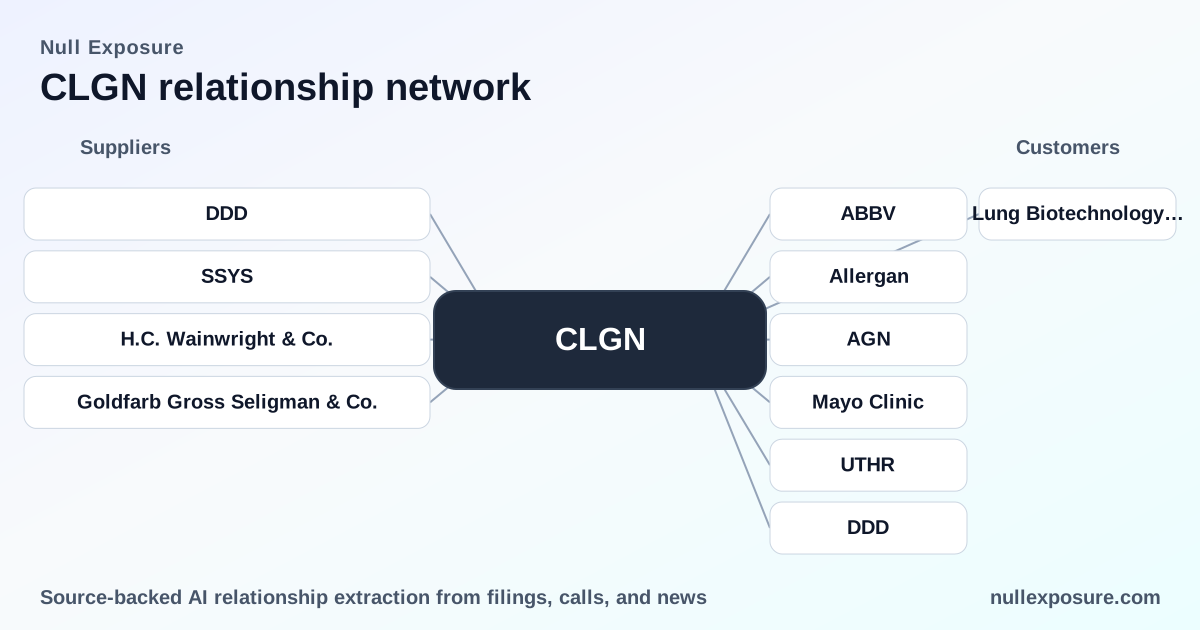
Who’s in CollPlant’s supplier ecosystem (what each relationship means)
3D Systems (DDD)
CollPlant entered an ongoing collaborative relationship with 3D Systems to explore integrated bioprinting solutions combining CollPlant’s bio-materials and 3D Systems’ printing platforms, and the arrangement evolved into a formal co-development agreement in or around 2021. According to a PR Newswire release, the companies signed a strategic co‑development agreement for a 3D‑bioprinted regenerative soft tissue matrix, and trade coverage in TCT Magazine described the partnership’s intent to enable both in‑house products and third‑party uses (PR Newswire; TCT Magazine, 2020–2022).
Stratasys Ltd. (SSYS)
Stratasys and CollPlant have a joint development and commercialization agreement (announced in April 2023) under which Stratasys adapted its Origin platform to print CollPlant’s regenerative implants; CollPlant reported successful printing of 200cc commercial‑sized implants and initiated a preclinical study using those prints on August 19, 2024. Company filings and industry reports describe the collaboration as the primary path to scale for CollPlant’s larger regenerative breast implants (company shareholder letter and press coverage; Medical Design & Outsourcing; Quantisnow, 2023–2024).
H.C. Wainwright & Co.
H.C. Wainwright is acting as exclusive placement agent for CollPlant’s registered direct financing, with placement economics disclosed in company filings; the firm receives a 7% placement fee, a 1% management fee, and placement agent warrants equal to 6% of the shares sold. Market coverage and CollPlant’s 6‑K identify H.C. Wainwright as the lead arranger on recent capital raises, signaling continued dependence on market financing to fund operations (press coverage of the offering; 6‑K, FY2026).
Goldfarb Gross Seligman & Co.
Israeli counsel Goldfarb Gross Seligman & Co. provided the legal opinion related to the legality of ordinary shares issued in CollPlant’s registered direct offering, as attached in the company’s current report on Form 6‑K. This is a standard transactional supplier relationship that confirms issuance legality under Israeli counsel opinion for the financing (6‑K, FY2026).
(Each relationship above is drawn directly from company releases and covering reports.)
What the supplier picture signals for valuation and risk
The supplier map clarifies two competing investor narratives:
-
Upside thesis (concentration as leverage): CollPlant’s tight integration with established printer OEMs like Stratasys and 3D Systems gives it a fast route to demonstration of commercial‑scale implants; successful clinical and regulatory progression plus a commercial partnership rollout could unlock material value multiples relative to current enterprise scale. Analyst coverage is limited but shows some optimism — one Buy and one Hold, and an analyst target price in public summaries at about $11.12 — implying substantial upside if commercialization is achieved.
-
Downside thesis (partner and financing risks): The opposite side of the coin is that partner commitments are prerequisites for product launch. The company’s small market cap (~$7.8M), negative EBITDA (about -$11.37M), and modest revenues ($2.48M TTM) require recurring capital raises; placement-agent economics (7% fee + warrants) materially increase financing cost and potential dilution. Given the co‑development model, execution slippage at a partner or failed scale‑up on a specific printer platform would directly delay or impair revenue generation.
Key takeaway: investors are effectively backing an IP + partnership commercialization play that is binary on preclinical/regulatory outcomes and partner engineering execution. For deeper supplier intelligence and ongoing monitoring of these commercial relationships, visit https://nullexposure.com/.
Practical investor checklist going forward
- Track Stratasys and 3D Systems engineering milestones and any public commercialization timelines tied to Origin or other platforms.
- Monitor CollPlant’s capital raises and placement terms; high placement fees and warrants increase dilutive risk.
- Watch for clinical readouts from preclinical or regulatory filings that demonstrate implant performance at commercial volumes (200cc tests were explicitly referenced).
Bottom line
CollPlant is an early‑stage regenerative-biotech company that monetizes through bioinks and partnership-led commercialization, with its near-term prospects tied to a small set of supplier relationships and periodic market financing. If partnerships scale as intended and clinical progress continues, valuation rerating is plausible; conversely, partner setbacks or costly financing would compress equity value. For investors and operators assessing supplier exposure across similar small-cap life-science plays, Null Exposure maintains targeted supplier feeds and transaction monitoring at https://nullexposure.com/.