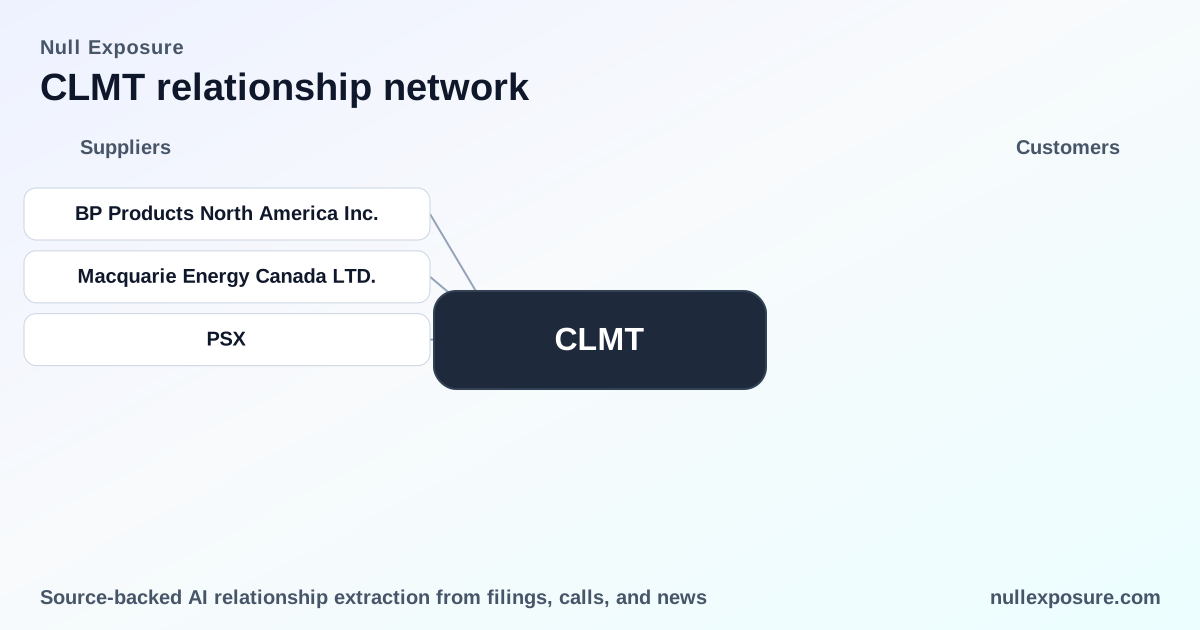
Calumet Specialty Products Partners (CLMT): supplier relationships that drive the refinery economics
Calumet Specialty Products Partners refines and converts crude and renewable feedstocks into specialty hydrocarbon and fuel products, monetizing through product sales across industrial and retail channels and margin capture in refining and specialty streams. The company’s commercial performance is tightly coupled to feedstock procurement: a small set of supply partners provides the bulk of crude oil inputs that underpin production at key facilities. For investors and counterparties, the supply map is the operating map.
Discover more supplier intelligence at https://nullexposure.com/.
A compact supplier base with outsized influence
Calumet’s publicly disclosed supplier roster is highly concentrated: the company reported that three counterparties supplied approximately 83.6% of its crude oil in 2024, a structural fact that shapes procurement risk, pricing exposure and operational continuity. The 2024 Form 10‑K shows a mix of contractual tenors—long‑term contracts, month‑to‑month evergreen arrangements and spot purchases—which produces a hybrid contracting posture that balances secured volumes with market flexibility.
BP Products North America Inc.
BP Products supplied approximately 54.5% of Calumet’s total crude oil supply in 2024, under a combination of term contracts and month‑to‑month evergreen crude supply contracts. This single counterparty concentration positions BP as the dominant feedstock source for the company in FY2024, making BP a primary operational counterpart for Calumet. (Source: Calumet 2024 Form 10‑K)
Macquarie Energy Canada LTD.
Macquarie Energy Canada provided roughly 17.7% of the company’s crude oil supply in 2024 under a crude oil supply agreement, representing the second largest single supplier by volume. This supply tranche contributes materially to Calumet’s feedstock portfolio and reduces the residual sourcing requirement after BP’s share. (Source: Calumet 2024 Form 10‑K)
Phillips 66 (PSX)
Calumet maintains long‑term feedstock supply agreements with Phillips 66, with certain agreements structured to continue on a month‑to‑month basis thereafter; these contracts are specifically key to operations at the Karns City and Dickinson facilities, making Phillips 66 a strategically critical supplier for those refining assets. (Source: Calumet 2024 Form 10‑K)
Contracting posture and company‑level constraints — what the filings reveal
Calumet’s disclosures present a set of company‑level signals relevant to counterparties and investors:
-
Mixed contract tenors: The company explicitly states it uses short‑term and long‑term contracts alongside month‑to‑month evergreen and spot purchases for crude oil. That mix produces operational flexibility but leaves material exposure to spot market volatility when significant volumes are bought on short notice. (Source: Calumet 2024 Form 10‑K)
-
Concentration and materiality: Three counterparties accounted for roughly 83.6% of crude supply in 2024, a concentration that creates single‑counterparty dependency risk even where contractual terms exist. (Source: Calumet 2024 Form 10‑K)
-
Purchase commitments and scale: The company disclosed estimated minimum purchase commitments across crude, other feedstocks and finished product agreements totaling approximately $244.6 million, which signals substantial near‑term procurement obligations. (Source: Calumet 2024 Form 10‑K)
-
Service provider reliance: Calumet leverages leased railcars (about 2,100), trucking and rail logistics and third‑party auditors, positioning logistics and audit service providers as material operational enablers rather than peripheral vendors. (Source: Calumet 2024 Form 10‑K)
-
Government counterparty involvement in related projects: Calumet disclosed that Montana Renewables, LLC (MRL) executed a $1.44 billion loan guarantee agreement with the U.S. Department of Energy, with tranches drawn in 2025, which signals direct federal involvement in financing adjacent renewable fuel capacity. This is a company‑level financing event and a signal about capital structure and strategic investment into renewable feedstocks. (Source: Calumet filings and LGA disclosure, Jan 2025)
-
Capital access framework: The company has an active equity distribution program (an ATM) with BMO Capital Markets, establishing a framework for opportunistic equity issuance that provides liquidity optionality for working capital or capital projects. (Source: Calumet 2024 Form 10‑K, Equity Distribution Agreement)
If you need a deeper vendor risk model built from these supplier relationships, visit https://nullexposure.com/ for tailored exposure analysis.
What these constraints imply for investors and operators
-
Concentration risk is the dominant near‑term operational risk. With BP supplying over half of crude inputs and three counterparties supplying 83.6%, contract renewals or commercial disputes with any major supplier would have immediate operational ramifications. (Source: Calumet 2024 Form 10‑K)
-
Contract structure balances security and price exposure. Long‑term agreements provide base volumes, while month‑to‑month and spot purchasing allows the company to chase margin opportunities; the net effect is higher sensitivity to crude price swings and to counterparty spot availability. (Source: Calumet 2024 Form 10‑K)
-
Criticality is facility‑specific. Phillips 66’s contracts are explicitly tied to Karns City and Dickinson operations, flagging those sites as dependent on continuity of feedstock supply from Phillips 66. (Source: Calumet 2024 Form 10‑K)
-
Logistics and finance are binding constraints. Leased railcars, trucking partners and purchase commitments create operational and cashflow commitments that can constrain flexibility under stressed market conditions. (Source: Calumet 2024 Form 10‑K)
Practical monitoring checklist for counterparties and credit officers
- Track BP’s continuing share of supply and any shifts in the BP‑Calumet commercial relationship or contract tenor; BP is the single largest operational lever on Calumet’s refinery throughput. (Source: Calumet 2024 Form 10‑K)
- Monitor crude procurement cadence and spot purchase frequency to assess margin volatility and liquidity pressure driven by feedstock cost swings. (Source: Calumet 2024 Form 10‑K)
- Observe the Phillips 66 agreements and renewal terms for Karns City and Dickinson to evaluate facility‑level supply continuity risk. (Source: Calumet 2024 Form 10‑K)
- Watch government financing developments connected to the Montana Renewables project for indirect balance‑sheet and strategic implications. (Source: Calumet LGA disclosure, Jan 2025)
Learn how we map supplier concentration into credit and operational scoring at https://nullexposure.com/.
Bottom line
Calumet’s supplier footprint is small but powerful: BP provides more than half of crude inputs, Macquarie supplies a meaningful secondary tranche, and Phillips 66’s contracts are operationally critical at specific facilities. The company’s blended contract structure yields flexibility and exposure simultaneously, while purchase commitments and logistics dependencies create arms‑length friction on the balance sheet. For investors and counterparties, the key questions are contract renewal dynamics with the largest suppliers, the pace of spot purchases, and the durability of logistics and financing arrangements that underwrite throughput. Monitor those items to anticipate margin shifts or operational interruptions.