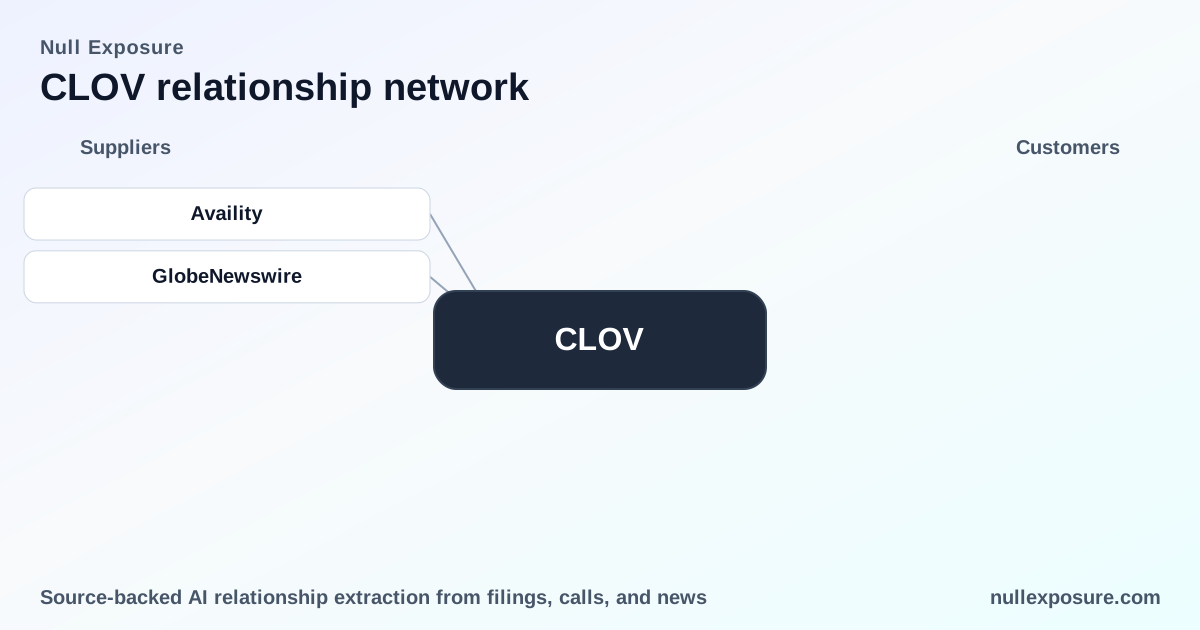
Clover Health (CLOV): the supplier map investors need to price operational risk and upside
Clover Health is a Medicare Advantage-focused physician enablement company that monetizes through premium-based insurance operations, provider partnerships, and a mix of outsourced services and subscription-based technology. The company combines large-scale medical claims flow with targeted vendor relationships—outsourcing core plan operations under master agreements while buying hosted software and administrative services via subscriptions—creating a profile where vendor performance and contract structure are direct drivers of margins and member experience. For a concise supplier risk snapshot and tailored monitoring tools, visit https://nullexposure.com/.
Why suppliers matter to the Clover thesis
Clover’s economics depend on predictable claims handling and efficient provider enablement. Its operating posture shows a deliberate split: critical plan operations are transitioned under framework/master services agreements, while day-to-day IT and administrative functionality is handled through subscription relationships. That mix generates both scalability and vendor concentration risk: when a large partner underpins claims processing or provider connectivity, vendor performance becomes a financial lever on operating margins and regulatory outcomes.
- Contracting posture: Combination of master services/framework agreements for plan operations and subscription contracts for cloud/hosted services.
- Concentration and criticality: Certain hospital system agreements and PBM/service-provider dependencies are treated as material; termination or supplier underperformance is disclosed as potentially material to operations.
- Maturity and spend profile: A handful of suppliers are mid-sized expense items ($1M–$10M annually), one administrative partner (medical records retrieval) is a sub-million-dollar relationship, and core claims represent the dominant spend line in the financials.
If you’re benchmarking supplier exposure across Medicare Advantage operators, see more resources at https://nullexposure.com/.
Relationship-by-relationship: what investors should know
Below are the concrete relationships disclosed or reported in the public record. Each entry is succinct and sourced.
Availity
Clover has entered a multi-phase initiative with Availity to increase provider administrative efficiency and improve patient access and care. This partnership is positioned as a connectivity and provider workflow enhancement that supports Clover’s physician enablement model (news item reported March 9, 2026 via QuiverQuant summarizing the announcement).
Source: QuiverQuant report on a Clover–Availity initiative (published 2026-03-09).
GlobeNewswire press release (company communication)
Clover distributed a press release reiterating growth potential and profitability strategy in connection with 2026 Star Ratings commentary; the public release was circulated via GlobeNewswire and reproduced in news feeds (the distribution was summarized in a GlobeNewswire notice captured in March 2026). The item provides corporate positioning rather than a vendor relationship.
Source: GlobeNewswire press release summary (distributed / captured March 2026).
CarePoint Health (IJKG Opco LLC; Hudson Hospital Opco LLC; Hoboken University Medical Center Opco LLC)
Clover has active contracts with members of the CarePoint Health system for the provision of inpatient and hospital-based outpatient services, making these hospital relationships operationally important for claim adjudication and network adequacy. The company discloses these agreements in its filings as active provider service arrangements.
Source: Company filing describing contracts with IJKG Opco LLC, Hudson Hospital Opco LLC, and Hoboken University Medical Center Opco LLC (CarePoint Health).
UST HealthProof
Clover’s agreement with UST HealthProof is structured as a master services arrangement that transitions certain plan operation functions to the vendor; this is a framework-level outsourcing move that embeds third-party operations into core Medicare Advantage plan administration.
Source: Company filing referencing the master services agreement with UST HealthProof.
Medical Records Exchange, LLC (d/b/a Credo / formerly ChartFast)
Clover uses Medical Records Exchange (Credo) for administrative services related to medical records retrieval through electronic applications and portals; fees recorded were $0.7M in 2024, $0.8M in 2023, and $0.3M in 2022, indicating a steady but modest annual spend band on this specific service.
Source: Company filing disclosing expenses and fees incurred with Medical Records Exchange, LLC for years ended December 31, 2024–2022.
Thyme Care, Inc.
Since July 2021 Clover contracted Thyme Care for oncology care management services; related fees were $4.1M in 2024 and $2.3M in 2023, placing Thyme Care in the mid-size annual spend band and reflecting targeted clinical outsourcing for specialty care management.
Source: Company filing disclosing Thyme Care contract and fees (years ended December 31, 2024 and 2023).
PBM suppliers (unnamed)
Clover’s filings specifically flag pharmacy benefit manager (PBM) suppliers as concentration risks: if a PBM supplier’s ability to perform is impaired or an agreement terminates, Clover could experience disruption that it may not remediate quickly on acceptable terms. The disclosure frames PBM relationships as operationally sensitive even where individual vendor names are not provided.
Source: Company filing language describing PBM supplier risk to operations.
Interpreting the constraints as investor signals
The company’s public disclosures produce several actionable signals for investors:
- Framework/master services for core plan ops: The explicit transition of plan functions to UST HealthProof under a master services arrangement indicates strategic outsourcing of critical operations rather than light transactional purchases. That increases operational leverage to the vendor’s performance and contract terms.
- Subscription-dominant cloud posture: Cloud and hosted software are procured under subscription contracts, signaling predictable recurring costs but also potential vendor lock-in and steady fixed spend that constrains marginal margin improvement.
- Materiality is acknowledged: The filing language that supplier events could have a material adverse effect on the business elevates supplier monitoring to a first-order risk for investors.
- Service-provider relationships are active and spend is concentrated in a few mid-size vendors: CarePoint, Thyme Care, and Credo are called out with line-item expense history—these represent tangible counterparty exposures at the $0.7M–$13M scale annually.
- Claims scale dominates financial risk: The filings report net medical claims as a principal cost item (large numeric disclosure), underlining that vendor arrangements around claims and provider contracting are the primary operational lever.
These are company-level characteristics: they describe how Clover structures and relies on supplier relationships across the business rather than isolated vendor anecdotes.
For a deeper supplier risk scorecard and monitoring feed tailored to Medicare Advantage operators, explore resources at https://nullexposure.com/.
Investment implications and what to watch next
Investors should treat Clover’s supplier map as both a lever and a liability. Vendor performance affects margins, regulatory compliance, and member experience; framework agreements suggest long contract tenors and transition risk; subscriptions create steady fixed costs; mid-sized vendor spend indicates concentration risk without excessive diversification; explicit PBM and hospital-contract disclosures highlight potential single-point failures.
Key monitoring priorities:
- Track renewal dates and termination provisions in master services agreements (UST HealthProof).
- Watch PBM contract disclosures and any operational interruptions reported to regulators.
- Monitor claim trends and provider-network dispute disclosures tied to CarePoint and similar arrangements.
- Observe trends in third-party fees (Credo, Thyme Care) for rising outsourced care-management costs.
Bottom line
Clover’s supplier architecture is intentional: strategic outsourcing of plan operations combined with hosted software and targeted clinical partners yields operational scale but concentrates execution risk. Investors must read filings for contract-level language, spend trajectories, and any operational incident reports—these items will be the earliest indicators that supplier relationships are moving from supportive to material.
For investor-grade supplier intelligence and continuous monitoring of relationships like those outlined here, start with the home page at https://nullexposure.com/.