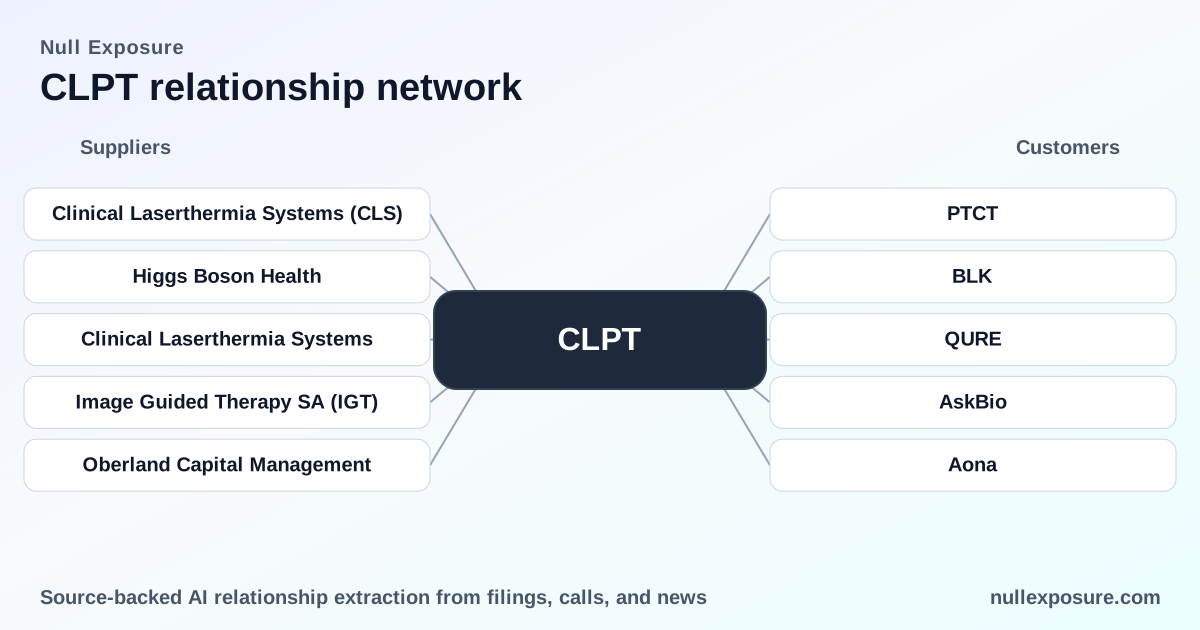
ClearPoint Neuro (CLPT): supplier relationships that shape commercialization and risk
ClearPoint Neuro operates a therapy-enabling navigation and delivery platform for the brain that monetizes through system sales, consumable disposables, licensing and strategic collaborations. The company sells navigation systems and integrated therapy solutions (including Laser Interstitial Thermal Therapy), licenses technology and partners on digital and clinical workflows; its revenue base is concentrated and recurring consumable sales are critical to margin expansion (Revenue TTM: $34.3M, Market Cap: $328.1M, latest reported EBITDA: - $21.96M). For investors and operators, the supplier map defines manufacturing capacity, regulatory integration and go-to-market cadence—areas where single-source exposure and contractual minimums materially influence execution.
Explore more on supplier exposure and remediation strategies at https://nullexposure.com/.
How the supplier mix supports the ClearPoint product stack
ClearPoint’s product strategy bundles navigation hardware, third-party laser technology and adjacent software—creating a stack that relies on a mix of exclusive licensing, third-party manufacturing and strategic digital partnerships. Key takeaways: the company depends on external technology suppliers for core therapy components, holds long-term real estate commitments for manufacturing, and carries purchase minimums that create predictable spend but concentrate sourcing risk.
Clinical Laserthermia Systems (CLS) — optics.org report (relationship entry 1)
ClearPoint holds exclusive global rights to commercialize a laser therapy platform developed by Clinical Laserthermia Systems, enabling ClearPoint to offer MR-guided laser therapy integrated with its navigation offering. According to an optics.org report referencing FY2022 disclosures, that exclusivity is foundational to ClearPoint’s Prism system commercialization pathway. (Source: optics.org, reporting on FY2022.)
Clinical Laserthermia Systems — BioSpace press release (relationship entry 2)
The ClearPoint Prism Neuro Laser Therapy System was developed and is manufactured for ClearPoint by CLS, and the company publicized FDA clearance for the integrated system, confirming CLS’s role in both IP and production for critical therapy components. A BioSpace release covering the clearance highlights the manufacturing and development relationship. (Source: BioSpace press release.)
Image Guided Therapy SA (IGT) — BioSpace press release
ClearPoint’s Prism system integrates a thermal ablation monitoring module called Thermoguide, licensed or sourced from France-based Image Guided Therapy SA (IGT), which supplies critical thermal monitoring software used during MR-guided ablations. BioSpace’s product announcement names IGT’s Thermoguide as the thermal monitoring component of the clinical solution. (Source: BioSpace press release.)
Higgs Boson Health — GlobeNewswire collaboration announcement
ClearPoint entered a collaboration with Higgs Boson Health to bring a patient‑facing digital application (ManageMySurgery) to market, focused on drug delivery to the brain and spine and brain‑computer interface workflows, expanding ClearPoint’s commercial offering into digital patient engagement and perioperative management. The company announced the collaboration in a GlobeNewswire release tied to FY2022 activity. (Source: GlobeNewswire announcement.)
Oberland Capital Management — MassDevice financing report
ClearPoint executed a note financing agreement with Oberland Capital Management for up to $110 million, materially altering its capital structure and providing committed liquidity to support commercialization and supplier payment obligations. MassDevice reported on the financing in connection with FY2025 disclosures. (Source: MassDevice report.)
What the constraints tell operators about contracting posture and concentration
The documented constraints give a clear picture of how ClearPoint structures its supply relationships and where operational leverage concentrates:
- Long-term real estate/production commitments. ClearPoint leases a manufacturing-capable facility that runs through 2033, signaling a long-term capital posture and an expectation of in‑house production scale. This is a company-level indicator of committed manufacturing capacity rather than a short-term sourcing posture.
- Single-source concentration is a critical operational risk. The company explicitly acknowledges reliance on single-source suppliers as a risk to fulfilling demand—this is a critical materiality signal affecting supply continuity and pricing leverage.
- Supplier spend and minimum purchase commitments are non-trivial. ClearPoint reports open purchase orders of roughly $1.2M at year‑end 2024 and a license/collaboration agreement with $4.2M of remaining minimum purchase commitments over five years, placing supplier spend squarely in the $1M–$10M band and creating predictable but concentrated outflows.
- Counterparty mix includes individuals (physicians). The company contracts with physicians for services like training, a relationship class that introduces compliance and reporting constraints distinct from standard vendor contracts.
- Regulatory integration and manufacturer role. ClearPoint and its third-party suppliers are required to comply with FDA Quality Management System Regulation practices; explicitly, CLS is named as the manufacturer of the Prism system, tying regulatory responsibility and product quality directly to that supplier.
- Service provider exposure for IT and security. ClearPoint engages third-party consultants for IT infrastructure and security—an operational dependency that is lower in spend but high in control risk.
These constraints collectively describe a company with committed capital and contractual obligations, concentrated supplier exposure, and regulatory entanglement—factors that change how procurement, contingency planning and supplier governance must be executed.
Read how to transform supplier risk into strategic advantage at https://nullexposure.com/.
Practical implications for investors and operators
- For investors: Watch CLS execution on manufacturing and supply continuity. The commercial value of ClearPoint’s Prism system is directly tied to CLS technology and manufacturing continuity; clearance events increase revenue potential but also concentrate counterparty risk. The Oberland financing materially improves runway, but the company still runs an operating loss and needs growth from system and consumable sales to reach profitability (Operating Margin TTM: -59.5%).
- For operators: Prioritize dual‑sourcing strategies for critical components where possible, codify supplier quality and audit rights in contracts, and enforce minimum performance metrics tied to the $4.2M purchase commitment framework. Physician contracting and IT vendors require separate compliance playbooks.
- For commercial partners: Integration with third‑party software (IGT’s Thermoguide) and digital front-end partners (Higgs Boson Health) expands the value proposition but requires coordinated regulatory and reimbursement planning.
For a deeper supplier exposure baseline and remediation playbook, visit https://nullexposure.com/.
Bottom line
ClearPoint’s supplier network is both an accelerator and a structural risk. Exclusive rights and third‑party manufacturing (notably CLS) enable an integrated therapy stack that can drive higher-margin consumables and system sales, but single-source concentration, long-term lease commitments and contractual minimums increase execution risk and require rigorous supplier governance. Investors should track manufacturing ramp metrics, supply continuity reports, and milestones tied to the Oberland financing; operators should treat supplier audits, quality agreements and dual-sourcing options as immediate priorities.