Cellectar Biosciences (CLRB): Supply partners, constraints, and what investors need to know
Cellectar Biosciences develops targeted radiopharmaceuticals for oncology and monetizes by advancing clinical candidates to commercialization or partnering/licensing opportunities; the company currently operates as a pre-revenue developer and outsources critical production and trial operations. CLRB's pathway to value depends on de-risking isotope supply and scaling manufacturing for its alpha-emitting CLR225 program, while preserving limited cash against ongoing negative operating results. For a quick view of supplier intelligence and how it maps to strategic risk, visit https://nullexposure.com/.
Why supply relationships matter for a pre-revenue biotech
Cellectar is not selling a stable product line today — it sells an R&D-to-commercial promise. That structure makes supplier and service relationships directly material: securing reliable, commercial-scale sources of isotopes and finished drug product is a prerequisite for late-stage trials and eventual launch economics. The company reported zero revenue, negative EBITDA of $22.8 million, and a compact shareholder base (roughly 4.24 million shares outstanding), so preserving continuity of supply and predictable contractual terms is mission-critical.
- Key balance-sheet and market context: Market capitalization ~$13.9M, Revenue TTM = $0, Analyst target price = $33.33. These numbers frame why partnerships are both strategic assets and potential failure points.
What CLRB disclosed about its supplier partners
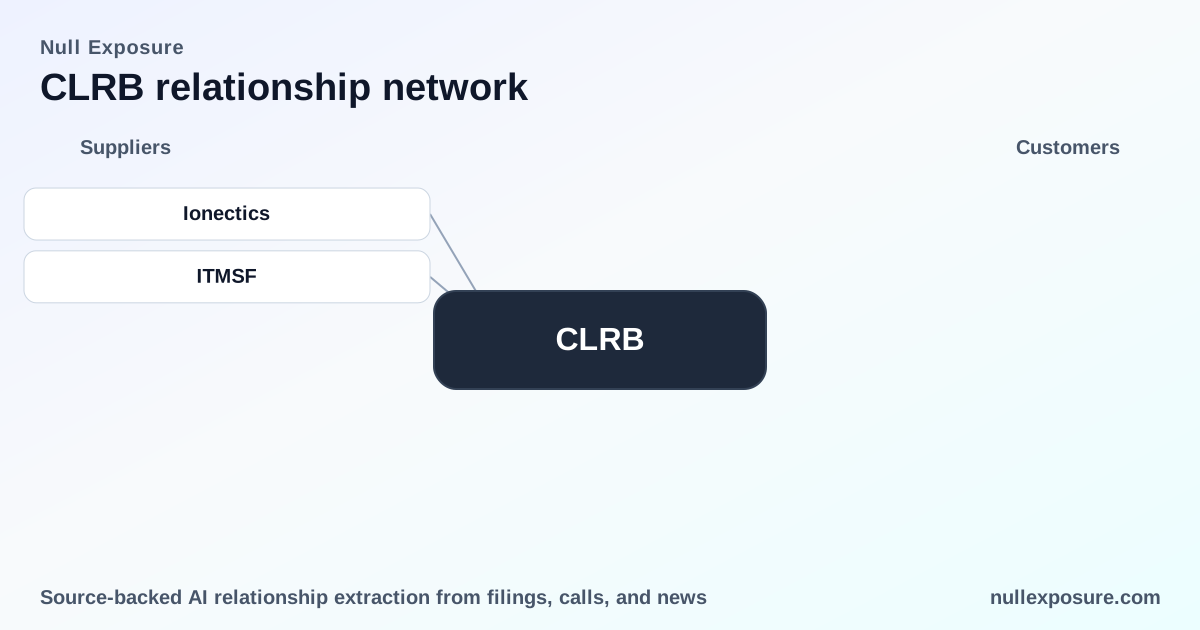
Cellectar explicitly named two partners in its 2025 Q4 earnings call that underpin commercial-scale access for CLR225: ITM Technologies and Ionectics. Both relationships are described as supply partnerships to support access to the key isotopes for the alpha-emitting program.
ITM Technologies — commercial-scale isotope supply
CLRB said it strengthened infrastructure supporting CLR225 through a supply partnership with ITM Technologies (inferred ticker ITMSF) to provide commercial-scale access to 225 (presumably actinium-225) and astatine-211 for future clinical development. The description positions ITM as a strategic supplier for the isotope inputs that enable late-stage trials. (Source: CLRB 2025 Q4 earnings call, discussed in March 2026.)
Ionectics — a parallel supply lane for alpha emitters
CLRB also named Ionectics as a new supply partner, noting the arrangement provides commercial-scale access to 225 and astatine-211 alongside ITM, thereby creating redundancy and throughput capacity for CLR225 clinical development. The company framed the relationship as infrastructure strengthening for the program. (Source: CLRB 2025 Q4 earnings call, discussed in March 2026.)
Company-level constraints that affect supplier strategy
Beyond named partners, SEC filings and company disclosures reveal several company-level signals that shape how suppliers are used and the risks investors should track:
-
Long-term contracting posture: Filings reference a contractual period running March 1, 2023 to April 30, 2029, indicating CLRB undertakes multi-year commitments for key arrangements. This implies stability in occupancy and certain supplier commitments but also creates fixed-cost exposure. (Source: company filing describing an Amended Lease.)
-
Outsourced manufacturing model: CLRB states it sources isotopes and finished product through a decentralized and distributed network of contract manufacturers, and warns that loss of required licenses or permits by third-party collaborators would negatively impact manufacturing and R&D activities. This is a structural operational choice—low capital intensity for in-house production but high dependency on third-party compliance and licensure. (Source: company filings.)
-
Service reliance for clinical operations: The company relies on third-party clinical investigators and contract research organizations to run trials and perform data collection/analysis, which reinforces the criticality of supplier/service partner performance for timelines and regulatory outcomes. (Source: company filings.)
-
Relative spend scale signal: A disclosed aggregate rent obligation in filings (~$893k–$918k over the Amended Lease term after abatements) is categorized in the data as a spend band consistent with $100k–$1M, suggesting CLRB’s named supplier engagements are modest in dollar magnitude relative to larger biotech players, or that many supplier costs are staged across partners rather than concentrated. Treat this as a company-level signal about spend scale rather than proof of any single supplier’s fee schedule. (Source: company filing.)
What this means for investors: risk and upside mapped to supply
Securing commercial-scale isotope supply for CLR225 is a clear positive: redundant suppliers (ITM and Ionectics) materially reduce single-point-of-failure risk for trial dosing and scale-up, and long-term contract posture provides runway visibility. At the same time, the outsourced manufacturing model creates operational concentration risk in the form of third-party licensure and GMP compliance; regulatory or permit interruptions among vendors would directly halt trials.
Financially, CLRB is an asymmetric bet: small market cap and pre-revenue status amplify both upside—and binary downside if trials or supply fail. The presence of specialized suppliers reduces development execution risk but does not substitute for clinical readouts. Investors should treat supply partnerships as necessary but not sufficient conditions for value creation.
If you want a consolidated view of counterparty exposures and supplier commitments, follow the ongoing supplier-tracking coverage at https://nullexposure.com/.
Practical next steps for due diligence
For investors and operators evaluating CLRB supplier relationships, prioritize the following:
- Review the full 2025 Q4 earnings call transcript and any associated supply agreements to confirm scope, exclusivity, and termination triggers for ITM and Ionectics. (Source: CLRB 2025 Q4 earnings call, March 2026.)
- Confirm licensing and GMP status for each named supplier and map contingency plans for isotope availability in case of disruptions; filings explicitly flag third-party license risk. (Source: company filings.)
- Benchmark supplier spend and throughput against expected clinical dosing schedules to validate the inferred spend band and any capital commitments required to scale.
Explore supplier analytics and contract flags at https://nullexposure.com/ to streamline your diligence on CLRB and similar suppliers.
Bottom line: supply secured, but execution still decisive
Cellectar has taken the sensible step of signing supply partnerships with ITM Technologies and Ionectics to secure commercial-scale access to actinium-225 and astatine-211 for CLR225, which meaningfully reduces one major execution risk. Company filings reinforce an outsourced manufacturing model and a long-term contracting posture that trade capital intensity for third-party dependency. Investors should value the supply redundancy but continue to underwrite clinical and regulatory execution risk, since CLRB remains pre-revenue with negative operating results. For focused tracking of supplier links and contractual signals, visit https://nullexposure.com/ and add CLRB to your watchlist.