CleanSpark (CLSK): Supplier Dependencies and What They Mean for Operations and Investors
CleanSpark runs an energy- and software-driven bitcoin-mining business that monetizes through mining revenue and hosting services while scaling capacity via hardware purchases and power contracts. The company purchases specialized ASIC miners and secures large-scale, long-term electricity supply to underpin its data-center campuses; it also historically generated hosting and profit-sharing revenue through co-location arrangements. For investors, the supplier profile is a story of extreme hardware concentration, deliberate power contracting, and evolving service partnerships. For a complete supplier map, visit https://nullexposure.com/.
The headline: concentrated hardware sourcing and intentional power commitments
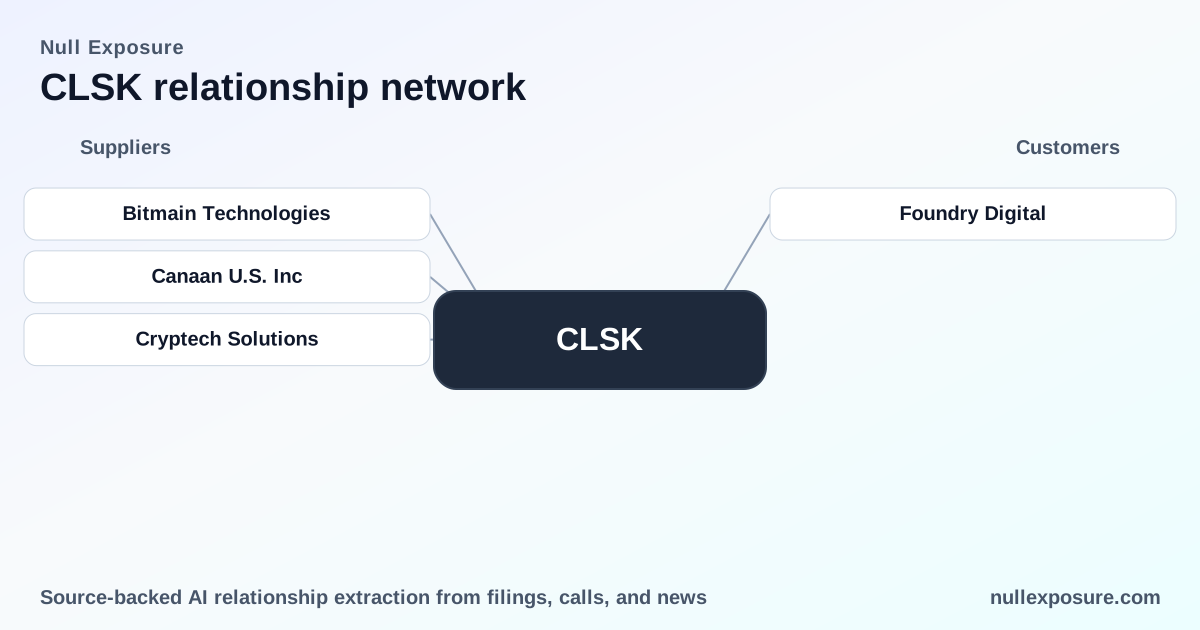
CleanSpark disclosed a very concentrated supplier base for bitcoin miners in its FY2025 Form 10‑K. Bitmain accounted for 96% of miner purchases in FY2025, with Canaan supplying the remainder and Cryptech moving from material supplier in prior years to a non‑material source in 2025. At the same time the company executed long‑term power supply agreements totaling 285 megawatts tied to a new campus acquisition in October 2025, signaling a strategic move to lock in capacity for growth. These two elements—hardware concentration and long‑term power contracting—define the supplier risk and operational posture investors must assess. Learn more at https://nullexposure.com/.
Supplier roll call: who CleanSpark buys from (and what changed)
Below are the suppliers CleanSpark listed in its FY2025 10‑K, with concise takeaways and source notes.
Bitmain Technologies
CleanSpark purchased 96% of its bitcoin miners from Bitmain in FY2025, up from 75% in FY2023 and 100% in FY2024, making Bitmain a dominant and critical hardware supplier for the company. According to CleanSpark’s FY2025 Form 10‑K, Bitmain is the primary manufacturer of the machines purchased during the year. (Source: CleanSpark FY2025 10‑K, fiscal year ended September 30, 2025.)
Canaan U.S. Inc
Canaan supplied 4% of miner purchases in FY2025, having been a non‑material supplier in prior years; this represents a small but notable second source in the current year’s procurement mix. (Source: CleanSpark FY2025 10‑K, fiscal year ended September 30, 2025.)
Cryptech Solutions
Cryptech was not a material supplier in FY2025 or FY2024, but previously supplied 25% of purchases in FY2023, indicating procurement shifts away from that provider over the last two years. (Source: CleanSpark FY2025 10‑K, fiscal year ended September 30, 2025.)
What the constraints tell investors about CleanSpark’s operating model
The company’s disclosures give clear signals about contracting posture, concentration, criticality and maturity of supplier relationships:
-
Contracting posture — long‑term power commitments. CleanSpark executed long‑term power supply agreements tied to an October 27, 2025 property acquisition in Austin County, Texas, totaling 285 megawatts to support a next‑generation data‑center campus. This demonstrates a forward‑looking, capital‑intensive approach to securing electricity supply essential to mining economics. (Company-level signal; source: FY2025 10‑K.)
-
Geographic concentration — North America operations. Leases and operational disclosures point to mining and data‑center locations primarily in Georgia and Tennessee, with new development in Texas, underlining a North American regional footprint for critical assets. (Company-level signal; source: FY2025 10‑K.)
-
Concentration and criticality — Bitmain as a single‑point supplier. Multiple disclosures identify Bitmain as the dominant equipment source—a critical supplier—which creates high procurement concentration risk and operational dependency on one manufacturer’s delivery schedules and product roadmap. (Attribute to Bitmain; source: FY2025 10‑K.)
-
Relationship role and stage — utilities and shifting hosting partnerships. CleanSpark relies on utility providers for power and historically earned hosting and profit‑sharing revenue from co‑location agreements; those co‑location agreements with Coinmint and GRIID were terminated in February 2025 and October 2024 respectively, signaling a change in the company’s hosting business model and partner maturity. (Company-level signal; source: FY2025 10‑K.)
-
Segment focus — hardware‑centric procurement. Management explicitly characterizes machine purchases as hardware sourced from suppliers like Bitmain, indicating the business’s dependence on physical ASIC supply rather than commoditized cloud or software vendors. (Attribute to Bitmain reference; source: FY2025 10‑K.)
For a visual breakdown of these supplier signals, visit https://nullexposure.com/.
Investment implications: risk, optionality, and levers management uses
The supplier footprint drives three practical implications for investors and operators:
-
Operational control through power contracts is a net positive. The 285 MW of long‑term power agreements represent an explicit attempt to control the largest variable cost in bitcoin mining—electricity—and supports capacity expansion with predictable input availability. That contracting posture de‑risks growth execution versus merchant power exposure.
-
Hardware concentration is a strategic vulnerability. Relying on Bitmain for the vast majority of miners creates supply‑chain and negotiating risk: production bottlenecks, firmware issues, geopolitical trade actions, or pricing shifts at a single vendor will have outsized effects on CleanSpark’s deployment timeline and cost structure. This is the single largest supplier risk vector for the company.
-
Revenue model evolution reduces some counterparty exposure but introduces transition risk. Terminated co‑location agreements with Coinmint and GRIID reduce legacy hosting revenue streams and push CleanSpark toward a vertically integrated operational model; this improves margin capture potential but concentrates execution risk on CleanSpark’s own facility operations and grid relationships.
Key operational levers investors should monitor: miner delivery schedules and inventories, realized electricity cost per MWh under the new contracts, and any public comments on diversification of mining suppliers.
Practical risk checklist for due diligence
- Confirm delivery cadence and warranties for Bitmain equipment and any multi‑vendor procurement strategies.
- Model electricity costs under the 285 MW commitments versus spot market exposures.
- Monitor any further changes to hosting partnerships or new colocation contracts that would affect revenue mix.
Bottom line and action items
CleanSpark’s supplier profile is marked by high concentration on Bitmain for hardware and deliberate long‑term power contracting to secure capacity—a combination that amplifies both operational leverage and single‑vendor risk. Investors should weigh the upside from controlled power inputs against the downside of hardware dependency when building scenarios for cash flow and deployment timelines.
For a full supplier profile and downloadable references, review the CleanSpark supplier page at https://nullexposure.com/. If you want a tailored supplier risk brief for a portfolio position, start at https://nullexposure.com/ and build from the company-level signals highlighted above.