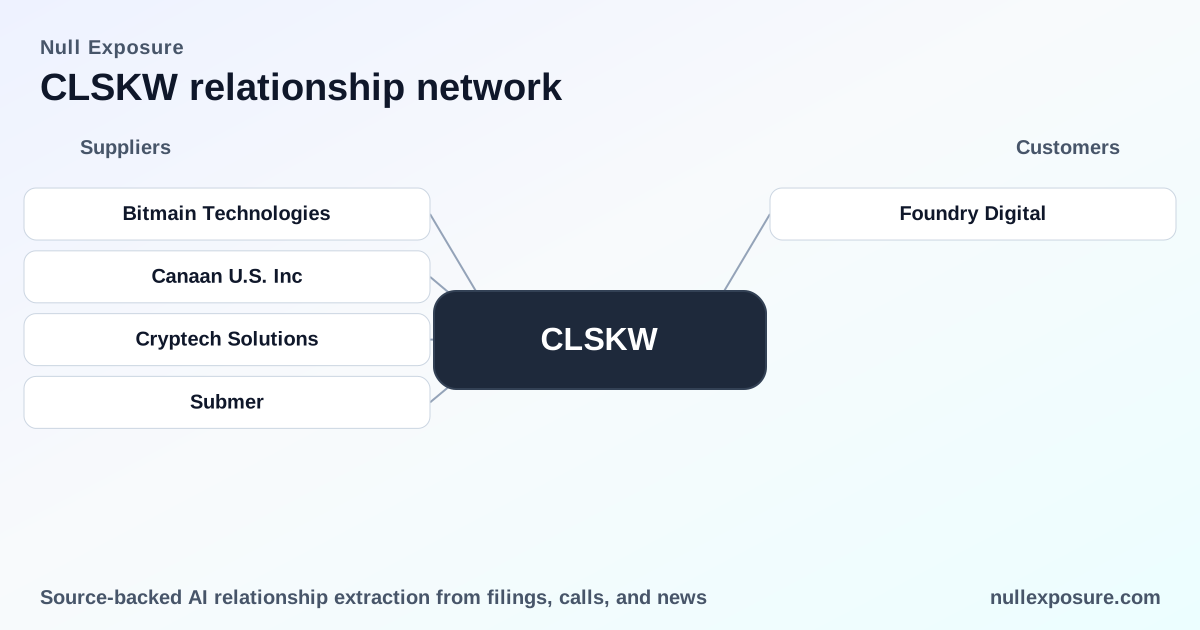
CleanSpark (CLSKW) supplier posture: concentration, critical inputs, and where value — and risk — flows
CleanSpark operates large-scale bitcoin mining operations across the Americas and monetizes primarily through the production and sale of bitcoin generated by its fleets of mining machines and by developing energy-anchored data-center capacity that can be repurposed for high-density workloads. The company's supplier relationships are central to that model: machine supply drives production capacity, power contracts enable scale, and emerging partnerships enable conversion of mining sites into higher‑value colocation. For an investor or operator evaluating counterparty risk and operational leverage, the supplier map is concentrated and operationally critical. Learn more about related supplier intelligence at https://nullexposure.com/.
How CleanSpark runs the business and why suppliers matter
CleanSpark’s economics are straightforward: bitcoin mined on owned or hosted equipment converts electricity and capital investment into crypto revenue. That conversion is only as fast and cheap as the company’s ability to acquire high-efficiency miners, finance capital needs, and secure long-term power. The 2025 Form 10‑K documents three structural characteristics that define the supplier posture:
- High supplier concentration for miners. CleanSpark reports purchases heavily skewed to a single manufacturer, creating a single‑point dependency for machine deliveries.
- Capital and liquidity frameworks in place. The company uses master loan facilities and short-term revolvers to fund equipment and working capital, which shapes procurement timing and counterparty exposure.
- North American operations with long-term power commitments. Recent land and power agreements support a large, centralized build-out strategy that ties supplier performance directly to revenue generation.
These attributes combine into a procurement profile that is capital‑intensive, geographically focused (North America), and dependent on a small set of critical suppliers and financiers. For more supplier-level insight and monitoring tools, see https://nullexposure.com/.
Supplier relationships and commercial context
Bitmain Technologies — the dominant equipment supplier
Bitmain accounted for 96% of miner purchases by purchase amount in FY2025, making it the company's principal source of mining hardware. CleanSpark’s 2025 Form 10‑K explicitly identifies Bitmain as the manufacturer of most machines purchased during the year, and the filing frames this supplier relationship as critical to the mining business given the scale and preferential pricing referenced in the report. (Source: CleanSpark 2025 Form 10‑K, FY2025)
Canaan U.S. Inc — small, secondary equipment source
Canaan is listed as a supplier responsible for 4% of miner purchases in the same disclosure, positioning it as a secondary, low‑share supplier in FY2025. The 10‑K attributes a modest portion of procurement to Canaan, indicating limited exposure but available alternative sourcing. (Source: CleanSpark 2025 Form 10‑K, FY2025)
Cryptech Solutions — minor historical vendor presence
Cryptech Solutions appears in the supplier list with 0% in the latest purchase column but 25% in an earlier period, signaling it was a more meaningful source historically but not a primary vendor in FY2025. The 10‑K captures Cryptech’s presence across periods, which speaks to shifting vendor mixes over time. (Source: CleanSpark 2025 Form 10‑K, FY2025)
Submer — strategic partner for immersion‑cooled colocation
A recent market article highlights a partnership between CleanSpark and Submer to deploy modular immersion‑cooled data centers, enabling rapid conversion of existing mining campuses (for example the 250‑MW Sandersville site) into AI colocation facilities. This relationship is strategic for CleanSpark’s asset‑repurposing thesis and supports higher‑margin uses of power and infrastructure. (Source: TradingView/Zacks coverage, March 2026)
Constraints and what they signal about the operating model
CleanSpark’s filings and disclosures present a mixture of contract types and company‑level constraints that shape supplier risk and negotiating posture:
- Framework financing in place. The company entered a Master Loan Agreement with Coinbase Credit providing a line of credit (up to $300 million under later amendments) in which the lender can provide digital assets or cash. This is a framework facility that supports flexible liquidity for equipment purchases and working capital. (Source: CleanSpark 2025 Form 10‑K, Master Loan Agreement disclosure)
- Long‑term power commitments. CleanSpark acquired property in Austin County, Texas and executed long‑term power supply agreements totaling 285 megawatts to underpin a next‑generation data‑center campus, illustrating the company’s reliance on long‑dated energy contracts to secure economics. (Source: CleanSpark 2025 Form 10‑K)
- Short‑term revolver for working capital. A September 2025 Master Loan with Two Prime Lending Limited provides a revolving line of credit with borrowings tied to one‑month Term SOFR plus spread, maturing in 2026 — a short‑term facility to bridge near‑term liquidity. (Source: CleanSpark 2025 Form 10‑K)
- Large capital spend concentration. Cash flow statements show payments on miners and mining equipment of $418,212 (in thousands) for the year ended September 30, 2025, confirming the company’s placement in a $100m+ capital spend band and making supplier terms and delivery timing material to near‑term production. (Source: CleanSpark 2025 Form 10‑K)
Two constraints explicitly name counterparties: the Bitmain manufacturing role and the Coinbase Credit financing facility are both referenced directly in filing excerpts, allowing clear linkage to those counterparties in the company’s procurement and capital stack.
Investment implications and operational risk
CleanSpark’s supplier profile creates concentrated operational leverage: revenue is sensitive to miner delivery schedules, miner quality, and power availability. Investors should weigh:
- The concentration risk from Bitmain supplying the vast majority of miners in FY2025 — a supplier disruption or shift in pricing dynamics would have an outsized effect on capacity growth and margins.
- The importance of financing frameworks (Coinbase Credit, Two Prime) to fund ongoing equipment purchases — changes to these facilities could alter procurement cadence and working capital.
- The strategic optionality provided by partnerships like Submer, which support asset repurposing into AI colocation and reduce single‑market dependency on bitcoin alone.
Key operational risks and levers:
- Supplier concentration and delivery lead times;
- Power contract duration and pricing;
- Financing availability and covenant terms.
Final read: what operators and investors should do next
For investors evaluating CLSKW exposure, the supplier reality is simple and stark: CleanSpark is capital‑intensive and supplier‑concentrated, with critical dependencies that drive both growth and risk. Operators should model scenarios where miner supply or financing tightens and stress power availability under different demand mixes.
For ongoing supplier intelligence, monitoring, and risk quantification, visit https://nullexposure.com/ to access deeper counterparty profiles and alerts.
If you want an investor‑grade dossier on CleanSpark’s counterparty exposures or a tailored supplier risk brief, start at https://nullexposure.com/ and request the CleanSpark supplier package.