Catalyst Bancorp (CLST): Funding, vendor posture, and the role of the Federal Home Loan Bank
Catalyst Bancorp operates as the holding company for St. Landry Homestead Federal Savings Bank and monetizes through traditional regional-bank activities: accepting retail and commercial deposits, originating loans, and investing in securities while supplementing deposit funding with wholesale borrowings. Net interest income driven by loan growth and the management of interest expense on deposits and borrowings is the economic engine, and third-party services—core processing, cybersecurity, and audit—are recurring operational cost centers that shape supplier relationships and vendor risk.
If you are evaluating supplier exposure or partnership opportunities with Catalyst, start with the bank’s balance between deposit funding and FHLB/other borrowings; that mix determines how critical wholesale funding partners are to ongoing loan origination. For a quick view of the supplier landscape and relationship signals, see NullExposure’s platform: https://nullexposure.com/.
How Catalyst funds lending and where suppliers plug in
Catalyst runs a classic small regional bank funding model: deposits first, supplemented by advances and short-term borrowings. The company discloses a material use of Federal Home Loan Bank (FHLB) advances to support loans and securities investments, and it reports changes in short-term FHLB borrowing as a direct driver of interest expense variability. On the cost side, the bank executed a core processing upgrade in 2024 with roughly half-a-million dollars of conversion and associated expenses, which highlights a mid-sized, recurring spend profile for critical services rather than purely one-off projects.
- Contracting posture and maturity: Catalyst shows a mix of long-term and short-term borrowings with a published maturity schedule for outstanding borrowings, indicating predictable debt amortization and planning for vendor contract horizons.
- Spend concentration: Several line items point to concentrated, but not outsized, spend—core conversion in the $500k range and FHLB advances disclosed in the tens of thousands figure—so vendors supplying core and cybersecurity services will be strategically important but not single-source dominant.
- Operational criticality: Core processing, cybersecurity and audit services are treated as essential—Catalyst explicitly engages third parties to design and test these systems—so supplier performance is directly tied to regulatory compliance and day-to-day operations.
If you want the full supplier map and risk signals, run a live supplier scan at https://nullexposure.com/.
What the public record shows about Catalyst’s relationships
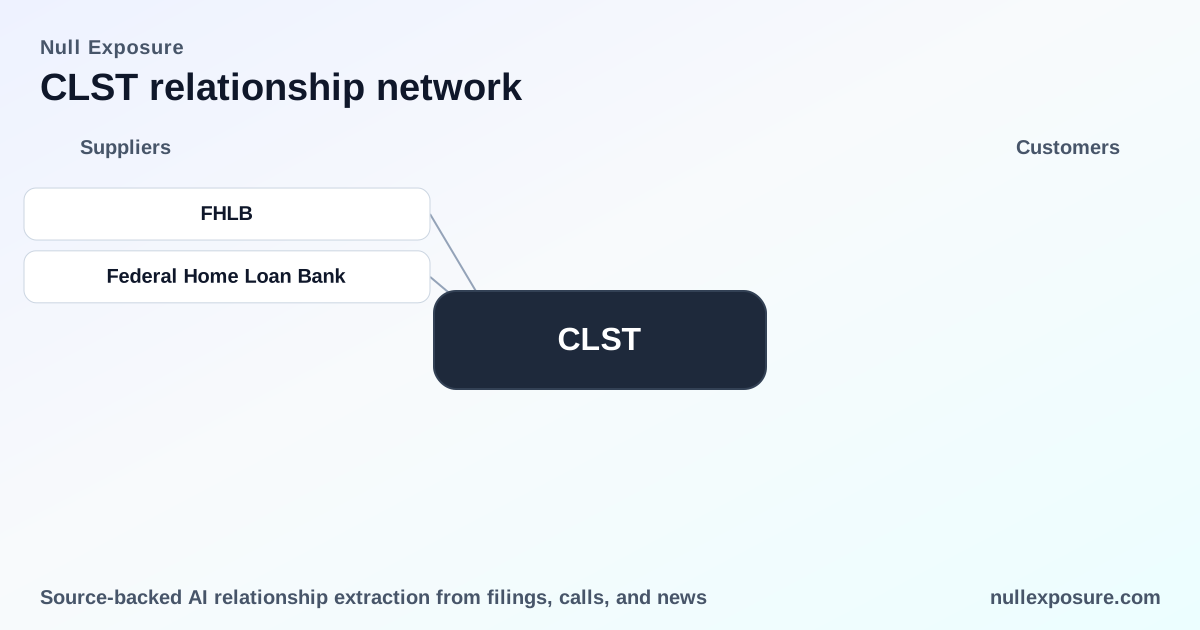
Federal Home Loan Bank / FHLB — funding counterparty (news: PR Newswire)
Catalyst reported that an increase in the volume of short-term FHLB advances during the fourth quarter of 2025 raised interest expense on borrowings, offsetting a decline in deposit interest costs and pulling on margins. According to the company’s fourth-quarter 2025 release published on PR Newswire (March 9, 2026), this change in short-term FHLB utilization was a primary driver of borrowing cost dynamics in that quarter.
Federal Home Loan Bank — strategic borrowing source (sec filing summary: TradingView)
TradingView’s coverage of Catalyst’s SEC 10-Q for FY2025 highlights the bank’s explicit operational strategy: attract deposits and supplement them with borrowings from the Federal Home Loan Bank and other sources to fund loan originations and securities investments. That regulatory filing-level language frames the FHLB as a standing and structural counterparty in Catalyst’s funding plan (TradingView summary of company 10-Q, FY2025).
Both entries in the public results point to the same counterparty role: the FHLB is a recurring, strategic funding provider whose use materially influences interest expense and liquidity behavior.
Constraints and company-level signals that matter to suppliers and investors
The company-level constraint evidence provides practical signals for supplier negotiations and investor diligence:
- Long-term borrowings exist and are scheduled: Catalyst published a maturity schedule for borrowings outstanding as of Dec 31, 2024 (amounts maturing in 2025, 2027, 2028), which signals planned repayment and rollover risk over a multiyear horizon rather than purely ad hoc short-term financing.
- Spend bands indicate mixed magnitude: The bank reported roughly $531,000 of data conversion and upgrade costs in 2024 (company-level), consistent with a $100k–$1m spend band for certain IT initiatives, while total FHLB advances disclosed (an entry showing $45,719) place wholesale funding in a $10m–$100m scale bracket for liquidity sources. Total borrowings of $9.6 million at year-end 2024 show intermediate-scale reliance on borrowings.
- Service-provider posture is active and ongoing: Catalyst explicitly engages third parties to audit processes, review network security, and test infrastructure—this is an operationally active vendor program with recurring contractual relationships in cybersecurity, audit, and core processing.
- Concentration and criticality: The combination of a material core conversion and ongoing cybersecurity/vendor testing means suppliers in those categories are operationally critical; failures or delivery slippage have direct bank continuity and compliance consequences.
These constraints together describe a bank with predictable debt maturities, a blended funding model that leans on FHLB advances, and a vendor ecosystem oriented around essential services with mid-range project spend.
Take a closer look at supplier risk and contract timing on NullExposure: https://nullexposure.com/.
What this means for investors and supplier operators
- For investors: monitor the mix of deposit versus FHLB borrowings and the maturity ladder. Changes in short-term FHLB usage have immediate margin impacts, as 4Q2025 demonstrated. Watch quarterly disclosures for swings in advance volumes and total borrowings that will compress or expand net interest margins.
- For suppliers and operators: position offerings around core processing and cybersecurity—these are prioritized by the bank and represent the clearest runway for recurring revenue and influence on bank operations. Price and contract terms should reflect the bank’s mid-sized spend profile (projects in the $100k–$1m range and service lines with multi-year commitments).
- For risk managers: prioritize SLAs and disaster-recovery commitments; the bank’s active use of third parties for security and testing makes vendor resiliency and auditability a procurement focal point.
To map vendor relevance against the bank’s funding and maturity profile, request a bespoke relationship report at https://nullexposure.com/—we can tailor contract timing and exposure analysis to your diligence needs.
Catalyst Bancorp’s supplier landscape is straightforward: FHLB is a structurally important funding partner whose use changes margin dynamics, and a small set of core and security vendors are operationally critical. Investors should watch borrowings and advances; suppliers should prioritize enterprise-grade performance and clear disaster recovery guarantees.