Clarivate (CLVT) — Supplier map and operational constraints investors must price
Clarivate operates a tightly integrated information and analytics business that packages citation indexes, content collections and discovery tools into subscription products for universities, corporations, law firms and governments. The company monetizes through recurring subscription licenses and content access fees, while augmenting margins with higher-value analytics and workflow products such as Clarivate Nexus. For investors evaluating supplier risk, the critical question is whether Clarivate’s content ecosystem—built on third‑party collections and indexes it does not fully control—creates leverage or vulnerability in renewal cycles and product differentiation. For a focused supplier view, see the detailed relationship notes below and visit https://nullexposure.com/ for further supplier intelligence.
How Clarivate turns content partnerships into revenue
Clarivate’s revenue model is subscription-first: libraries and corporate R&D organizations pay recurring fees for access to search, discovery and analytics layers underpinned by indexed content. Strategic products like Clarivate Nexus combine proprietary citation indices (Web of Science) with externally sourced collections such as Primo, Summon Central and ProQuest content to create a sticky, higher‑margin offering. This bundling strategy increases customer switching costs because buyers pay not just for raw content but for integrated discovery, analytics and provenance features that support research workflows.
- Contracting posture: Clarivate negotiates multi-year enterprise licenses with institutional customers, embedding renewal cadence and service-level expectations into long-term agreements.
- Concentration and criticality: Content partnerships are high-impact: access to unique or essential third‑party collections directly affects product completeness and competitive differentiation. Content suppliers therefore functionally influence Clarivate’s product scope.
- Maturity: The company operates mature information assets with steady renewal revenue but faces pressure from academic budget cycles and slower revenue growth as indicated by modest YoY quarterly revenue decline in recent reporting.
- For more supplier risk signals and relationship maps, consult https://nullexposure.com/.
What the ProQuest relationship is, in plain English
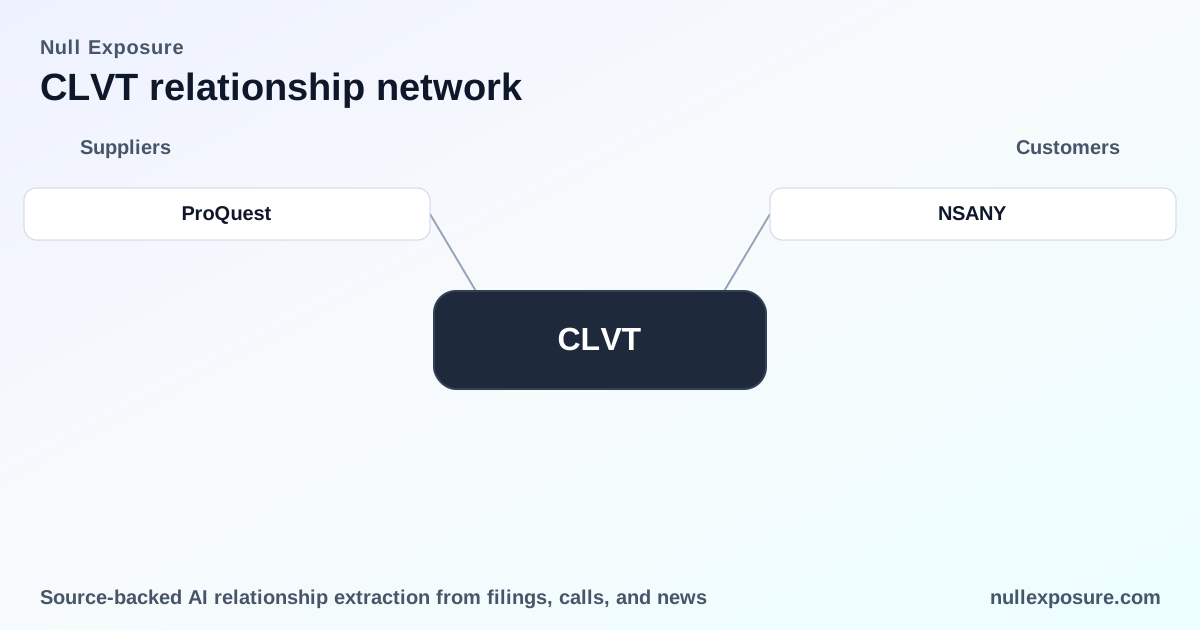
Clarivate’s Nexus product is explicitly built on a mix of internal indices and external content collections, with ProQuest listed among the content suppliers providing collections used to power discovery and search. A March 9, 2026 news item noted that Nexus “is powered by industry‑leading indexes and content collections, including … ProQuest collections.” This ties ProQuest directly into the delivery of Nexus’s content breadth and user experience (StockTitan news feed, March 9, 2026).
Why that matters for investors
ProQuest is a recognizable and widely used academic content provider; its inclusion in Nexus adds breadth to Clarivate’s discovery coverage and helps sustain institutional value propositions. However, reliance on third‑party collections also means Clarivate's product parity and go‑to‑market claims depend on maintaining those supplier relationships and negotiated access rights.
Relationship list (complete)
- ProQuest — Clarivate sources ProQuest collections to power its Nexus discovery fabric; this connection is publicly referenced in reporting about Nexus’s content mix (StockTitan news feed, March 9, 2026).
Company-level constraint signals and implications
Clarivate’s own risk disclosures identify dependence on third parties for data, information and services as a material operational factor. The company states it is dependent on third parties, including public sources, for data, information, and other services, and relationships with such third parties may change and could adversely affect operations. This language—drawn from Clarivate’s public filings—translates into several investor‑relevant signals:
- Supplier reliance is explicit and recognized at the board/reporting level. That elevates counterparty negotiations and contract durability to core operational risk.
- Negotiation leverage can shift. If third‑party suppliers aggregate, consolidate, or change licensing models, Clarivate could face cost pressure or scope reductions that are difficult to pass on to institutional customers.
- Concentration risk is non-trivial. The product value (discovery accuracy, breadth) is partially dependent on external collections that Clarivate does not wholly own or control.
- Operational maturity lowers but does not eliminate risk. Clarivate’s long-term customer contracts and integration capabilities reduce churn risk, but supplier contract terms remain a strategic lever.
These constraints are company-level signals drawn from filings and should be factored into any supplier risk premium or valuation adjustment for CLVT.
Practical risk‑adjustment checklist for analysts
When modeling Clarivate’s exposure to supplier dynamics, score the following items into your sensitivity cases:
- Renewal cadence and pass‑through pricing ability for content cost increases.
- Contract length and exclusivity (if any) with key content suppliers.
- Substitutability of third‑party collections versus Clarivate’s proprietary indices.
- Visibility on supplier negotiations and the potential impact on product roadmaps.
Use these checkpoints to stress-test EBITDA and ARR scenarios given the company’s recurring revenue mix and the filing‑reported dependency on third‑party content.
What to watch next and recommended actions
- Monitor public statements or filings for explicit supplier contract renewals or re‑pricing events. Clarivate discloses supplier dependence in filings; any amendment language regarding content sourcing should be treated as a leading indicator of margin pressure.
- Track product announcements where Clarivate highlights new content sources or expanded proprietary coverage; these signal reduced supplier reliance and potential margin upside.
- For more granular supplier profiles and relationship timelines, visit https://nullexposure.com/ to supplement financial analysis with operational intelligence.
Investors should treat Clarivate’s supplier relationships as an integral part of its moat and a potential vector for volatility. ProQuest’s inclusion in Nexus enhances product quality but underscores the company’s exposure to third‑party content dynamics. For deeper supplier mapping and ongoing monitoring tools, go to https://nullexposure.com/.
Concluding note: quantify supplier risk within your scenario framework rather than treating it as a qualitative footnote—Clarivate’s product economics and competitive positioning are materially influenced by the third‑party collections that feed its discovery and analytics layers. For ongoing supplier monitoring and to integrate these signals into investment models, visit https://nullexposure.com/.