Clorox (CLX) — supplier relationships that move margins and operations
Thesis: The Clorox Company operates as a global manufacturer and marketer of branded consumer and professional cleaning and wellness products, monetizing through product sales, scale-driven procurement economics, and a steady dividend profile; its margin profile and operational continuity are driven as much by supplier contracting and raw-material sourcing as by brand strength. For investors evaluating supplier risk and operational execution, the recent ERP modernization and the GOJO transaction are material strategic inflection points that change how Clorox controls costs, service levels, and integration of acquired supply chains. For a curated view of supplier exposure and operating signals, visit https://nullexposure.com/.
Why supplier architecture matters to Clorox’s P&L and operations
Clorox is a manufacturing-first business: its profitability depends on continuous access to chemicals, resins, non-woven fabrics and packaging. Supply continuity, contract structure and geographic sourcing are first-order drivers of gross margin and working capital. The company uses forward-purchase and framework contracts to stabilize input pricing and availability, and sources from both U.S. and international vendors, including some single-source suppliers. Interruptions to those flows will directly influence production volumes and revenue recognition.
- Contracting posture: Clorox leverages framework and forward-purchase agreements to reduce commodity volatility and secure capacity, a posture that supports predictable gross margins and inventory planning.
- Geographic sourcing and concentration: The supplier base is global; reliance on single-source providers for certain inputs increases operational leverage to supplier performance.
- Criticality and materiality: Raw-material supply interruptions are explicitly material to operations and can constrain revenue and margins.
- Supplier maturity: Relationships span basic commodity suppliers to specialized manufacturers for non-woven fabrics and chemical derivatives, creating a mix of transactional and strategic supplier engagements.
These company-level signals explain why both systems modernization and M&A-driven supplier integration are strategic priorities for Clorox’s management.
Vendor relationships that matter right now
The following relationships come from recent reporting and reflect material, observable supplier or partner interactions.
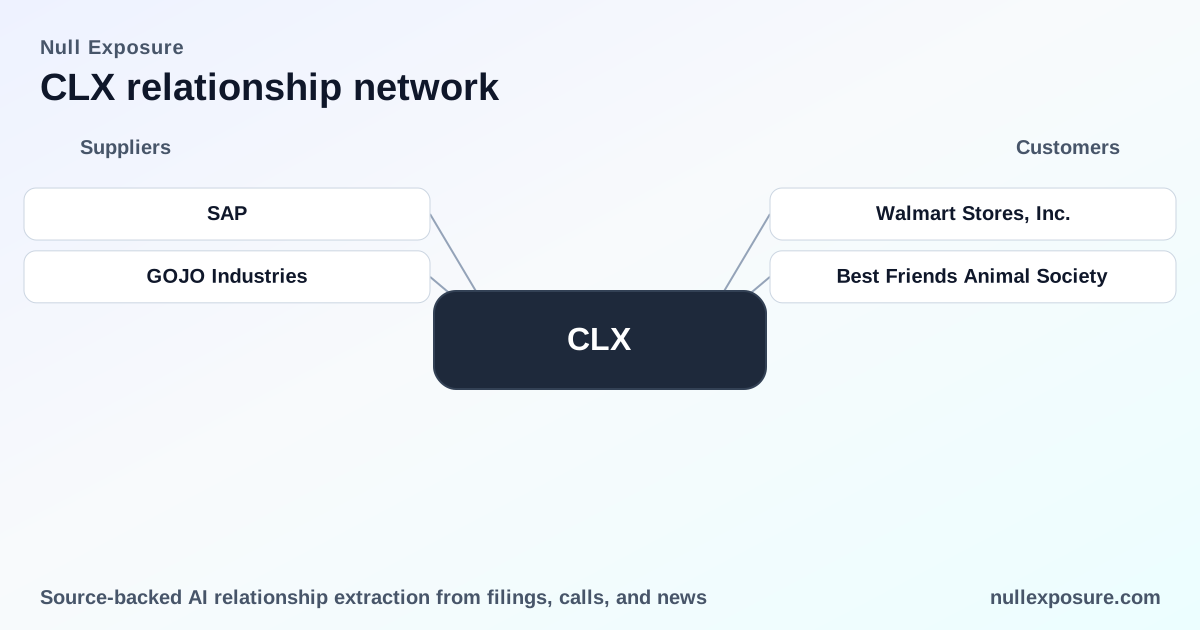
SAP — Clorox completed a multi-year ERP upgrade to SAP S/4HANA as a multi-hundred-million-dollar program; the initiative cost roughly $580 million and concluded in February 2026 as part of a five-year modernization to replace legacy systems and create a unified “digital backbone.” According to an ITBrew feature from February 2026, the upgrade spanned five years and was intended to modernize the company’s core transactional systems. A 247WallSt piece in February 2026 reported that the SAP implementation caused disruption during rollout, underlining execution risk tied to large-scale IT transformations. (ITBrew, Feb 2026; 247WallSt, Feb 2026)
GOJO Industries — Clorox agreed to acquire GOJO Industries, the maker of Purell hand sanitizer, expanding the company’s presence in health & hygiene and adding manufacturing and distribution capabilities in high-growth hygiene categories. SimplyWallSt reported the acquisition in early 2026 as a strategic build-out of Clorox’s wellness portfolio and a move to internalize a key hygiene brand’s supply chain. (SimplyWallSt, FY2026)
How the SAP program and GOJO deal change the supplier map
The SAP S/4HANA implementation is a strategic enabler of supplier integration, forecasting and procurement discipline: centralizing transactional data reduces PO fragmentation, shortens procurement cycles and improves visibility into supplier performance and inventory turns. The $580 million investment accelerates the company’s ability to enforce framework contracts and optimize forward purchases, but the reported rollout disruption is an execution risk that translated into short-term operational friction and pressure on near-term revenue cadence.
The GOJO transaction changes the supplier footprint by bringing a major hygiene brand and its manufacturing capabilities under Clorox control. That shift converts a third-party supply relationship into an internal manufacturing asset, reducing outsourced supplier dependence for Purell products and creating opportunities for margin capture, scale synergies and tightened distribution control. Integration execution will determine how quickly those benefits flow to EBITDA.
For detailed supplier performance tracking and exposure analytics, see https://nullexposure.com/ — the platform consolidates vendor signals and operational constraints for investor due diligence.
What these relationships tell investors about operating constraints
Treat supplier constraints as strategic levers, not just line-item risks:
- Contract framework orientation supports margin stability but requires disciplined execution in procurement and inventory management to realize savings.
- Global sourcing increases resilience and complexity; dual sourcing for critical inputs reduces single-point failures but increases contracting overhead.
- Materiality of inputs is high: interruptions translate directly into lost sales and elevated costs. The company explicitly recognizes supply interruption as a material risk.
- Manufacturing relationships are central to product continuity: raw materials like resin and non-wovens are not commoditized in practice because production processes and supplier capacity limit substitution speed.
These are company-level signals that shape the probability distribution of future cash flows and should be integrated into any valuation or operational risk model.
Investment implications and a short checklist for diligencing CLX supplier exposure
- Catalyst: Integration of GOJO and supply-chain benefits from SAP should improve gross margin through verticalization and better procurement analytics over the medium term.
- Risk: Short-term execution risk from ERP rollout is real and was reported to have caused operational disruption during FY2026; monitor rollback indicators and supply-chain KPIs.
- Balance-sheet and cash flow: A $580 million investment in ERP is large but positions the company to extract procurement and working-capital benefits; quantify payback in your model.
- Monitoring items: frequency of supplier shortages, days of inventory, vendor concentration for resin/non-wovens, and progress updates on GOJO integration.
Bold takeaway: ERP modernization plus strategic acquisition creates a near-term execution window and a multi-year upside to margins if procurement discipline and integration execution are successful.
For ongoing monitoring and access to signal-driven exposure reports, visit https://nullexposure.com/ — the site centralizes supplier and constraint intelligence for investors.
Final view and next steps
Clorox is transitioning from legacy operational systems and a partially outsourced supply model to a more integrated, data-enabled manufacturer with expanded owned hygiene capacity. The combination of a completed SAP rollout and the GOJO acquisition reconfigures supplier risk into execution risk, with compelling upside to margins if integration is clean. Investors should weigh near-term operational noise against multi-year improvements in procurement efficiency and margin capture.
To review supplier-level signals and constraints that affect CLX valuation and operational risk, explore our coverage at https://nullexposure.com/.