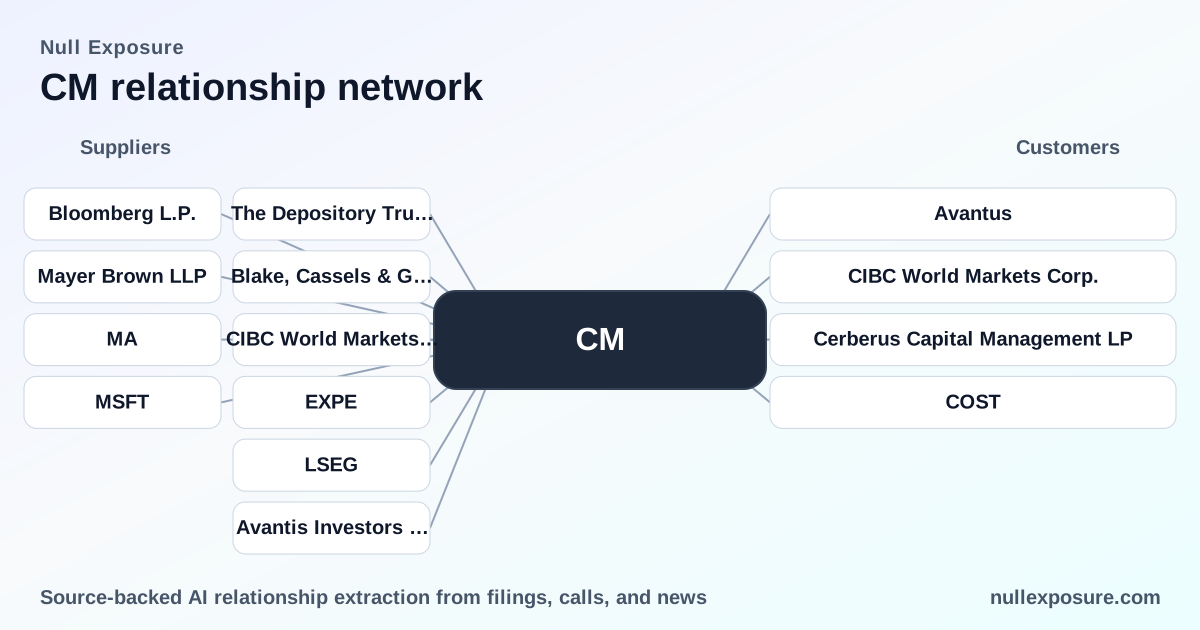
CM supplier relationships: what investors should know
Canadian Imperial Bank of Commerce (CM) runs a diversified banking and capital-markets franchise that monetizes through customer deposits, lending spreads, card and transaction fees, and capital-markets issuance and distribution. For investors evaluating counterparty and operational risk, the supplier map for CM in FY2026 highlights a conventional mix of settlement infrastructure, legal and tax advisers, underwriters/distribution arms, market-data vendors and strategic retail partnerships that together support funding, compliance and product distribution. For a fast vendor-risk readout and supplier scoring, visit https://nullexposure.com/.
What the supplier signals tell you about CM's operating model
CM's supplier relationships reflect a banking operating model built on standardized market plumbing and established professional services. Settlement and clearing are handled through global market utilities, underwriting and distribution are executed by the bank's own capital-markets arm and external placement agents, and legal/tax opinions are obtained from recognized international law firms. No supplier-level contractual constraints were provided in the feed, which is itself a company-level signal: the data contains no explicit restrictions or bespoke vendor covenants to flag.
That pattern implies the following operating characteristics at the company level:
- Contracting posture: standardized, low-customization — CM uses market utilities and widely used law firms, which reduces bespoke vendor lock-in.
- Concentration: moderate — reliance on a handful of market infrastructure providers (e.g., DTC, Bloomberg) creates focal points of systemic dependency, but those providers are highly redundant across the industry.
- Criticality: high for a few nodes — settlement/clearing and primary legal opinions are mission-critical for funding and regulatory compliance.
- Maturity: high — relationships are with established firms and public-market infrastructure, indicating mature contractual and operational practices.
The supplier list — what each relationship means for investors
The Depository Trust Company (DTC)
CIBC will deliver notes in book‑entry form through the facilities of The Depository Trust Company on multiple issuance dates in March 2026, confirming DTC handles settlement for CM’s debt placements. According to prospectus supplements filed in March 2026 (StockTitan), DTC is the settlement vehicle for these note issues.
Source: StockTitan prospectus supplements (March 2026).
Blake, Cassels & Graydon LLP
Blake, Cassels & Graydon serves as Canadian tax counsel and provided a formal opinion summarizing principal Canadian federal income tax considerations for purchasers of the notes, a standard feature of cross‑border debt documentation. The firm’s opinion is recorded in CM’s pricing supplements in March 2026 (StockTitan).
Source: StockTitan pricing supplements (March 2026).
CIBC World Markets Corp.
CIBC World Markets Corp., acting as agent for the bank, receives placement commissions on the notes — the filings enumerate commission rates ranging from 1.0% to 3.0% per $1,000 principal depending on the specific tranche and supplement. Prospectus language in March 2026 cites the underwriting/agent role and commission schedule (StockTitan).
Source: StockTitan prospectus supplements (March 2026).
Bloomberg L.P.
CM obtained closing price levels from Bloomberg L.P. without independent verification for the pricing supplements, indicating Bloomberg is the market‑data source used in valuation and pricing mechanics for the debt issues. This is documented in the March 2026 filings (StockTitan).
Source: StockTitan prospectus supplements (March 2026).
Mayer Brown LLP
Mayer Brown provided a U.S. federal income tax opinion that the notes should be treated as debt instruments for U.S. tax purposes, a conclusion used to advise U.S. investors on tax treatment in the March 2026 documentation (StockTitan).
Source: StockTitan prospectus supplements (March 2026).
Expedia Group / Expedia
CIBC expanded its "CIBC by Expedia" online travel booking platform to additional CIBC credit cards, broadening client access to Expedia’s global travel network and associated rewards, a strategic partnership that drives card engagement and non‑interest revenue. SimplyWall.St reported this expansion in FY2026.
Source: SimplyWall.St company updates (FY2026).
London Stock Exchange (LSEG)
CM announced admission of transferable securities to trading on the London Stock Exchange’s main market on 27 February 2026, indicating active use of international equity/debt venues for liquidity and distribution. This market-admission event was reported via Reuters/TradingView in early 2026.
Source: Reuters via TradingView (Feb 27, 2026).
Avantis Investors by American Century Investments
CIBC Asset Management launched Canadian and U.S. ETFs in partnership with Avantis Investors by American Century Investments, reflecting product-distribution collaboration to scale the asset‑management business. SimplyWall.St noted the ETF launch activity in February 2026.
Source: SimplyWall.St corporate release (Feb 20, 2026).
Mastercard
CIBC launched the "CIBC Adapta Mastercard" in FY2026, a co‑brand card product that broadens payment‑network partnerships and card revenue opportunities. SimplyWall.St captured the product launch date (May 2, FY2026).
Source: SimplyWall.St corporate update (May 2, 2026).
GitHub (GitHub Copilot)
CIBC rolled out a custom-built AI platform and adopted GitHub Copilot as part of its technology tooling and developer productivity stack, signaling investment in developer enablement and AI‑assisted workflows. SimplyWall.St recorded the rollout in August FY2026.
Source: SimplyWall.St technology update (Aug 15, 2026).
Mid‑analysis: concentration, operational risk and vendor replaceability
The supplier roster shows a clear split between critical market utilities (DTC, Bloomberg), legal/tax advisers (Blake Cassels, Mayer Brown) and commercial partners (Expedia, Mastercard, Avantis). This structure underpins a predictable funding and distribution model: global settlement enables cross‑border note placements, market data anchors pricing, law-firm opinions support cross‑jurisdictional investor acceptance, and card/retail partnerships drive customer revenue.
- Key operational risk: DTC represents the single largest operational dependency for the bank’s securities settlement; while industry redundancy exists, any DTC disruption would materially affect note settlement timelines.
- Commercial upside: Partnerships with Expedia and Mastercard are revenue-accretive and customer‑facing, improving card spend and fee income.
For a deeper vendor-risk scorecard and a prioritized due-diligence checklist, go to https://nullexposure.com/ — the supplier view is essential for pricing bank risk premiums.
Regulatory and legal profiles investors should track
Legal opinions from Blake, Cassels & Graydon and Mayer Brown reflect standard practice for cross-border issuance and investor tax treatment; they reduce legal execution risk for CM's note programs. Bloomberg’s role in pricing inputs is customary but elevates dependence on third‑party market data for valuation controls. Underwriting commissions disclosed in the prospectuses reveal the bank’s internal distribution economics and cost of issuance.
Investor takeaways and recommended next steps
- Settlement and pricing infrastructure are standard and high‑quality — DTC and Bloomberg are core dependencies; monitor operational resilience and contingency plans for clearing and market‑data outages.
- Legal and tax opinions are in place and mature, reducing cross‑border execution risk, but track any jurisdictional changes to tax treatment that could affect investor appetite.
- Strategic retail partnerships (Expedia, Mastercard) materially support retail revenue and card activation, representing a durable growth lever outside capital‑markets activity.
For asset managers and credit analysts building scenario models, focus on settlement concentration and distribution economics (underwriting commissions) as levers that affect funding cost and execution. If you want a supplier-focused risk score and a one‑page vendor heat map for CM, visit https://nullexposure.com/ for immediate access.
Bold, actionable observation: CM's supplier set is conventional for a large Canadian bank — infrastructure is concentrated but industry‑standard, legal/tax coverages are robust, and commercial partnerships strengthen retail revenue. For a vendor-level breakdown tailored to your investment horizon, start a supplier review at https://nullexposure.com/.