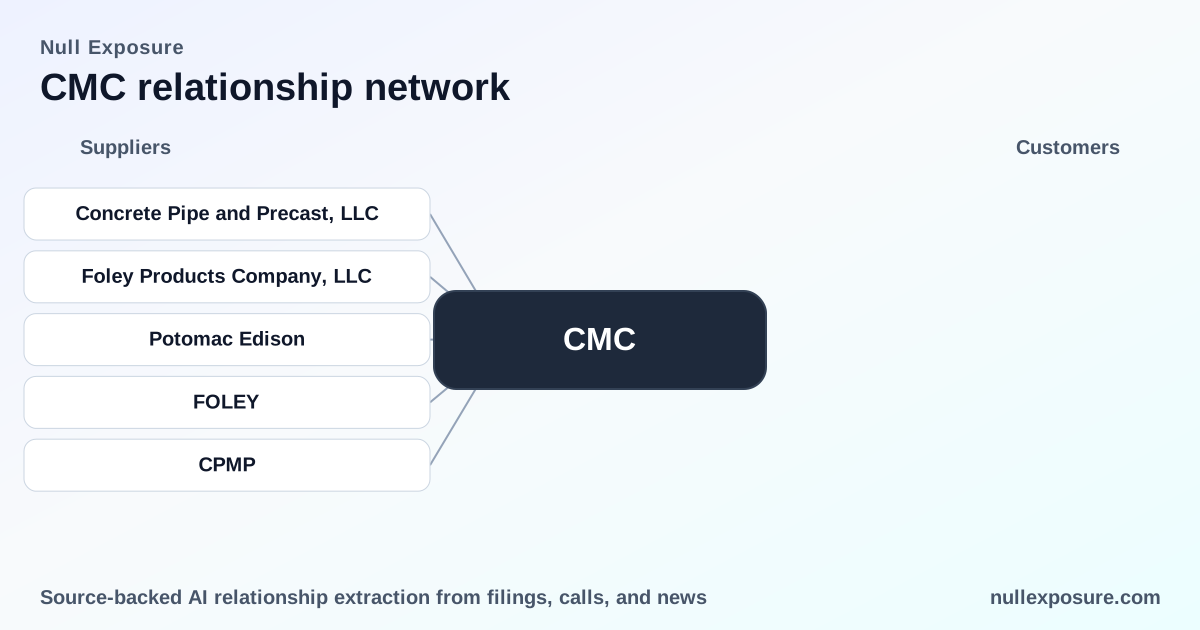
Commercial Metals Company (CMC): Supplier relationships, recent deals, and what investors should price in
Thesis: Commercial Metals Company operates as an integrated metals and construction materials platform that monetizes through downstream manufacturing, strategic M&A, and control of inputs and local distribution; recent activity shows a deliberate push into precast concrete assets and infrastructure connectivity that strengthens project-level control and regional market reach, while long‑term purchase commitments and domestic sourcing shape its contracting posture and supplier risk profile. Learn more about how these supplier moves affect operating leverage and counterparty exposure at https://nullexposure.com/.
Why the recent activity matters to investors
CMC is executing a two‑track approach: acquire regionally dominant precast suppliers to capture construction value chains, and lock in supply and utility access to support plant and site operations. The combination increases revenue capture on infrastructure projects and reduces transaction risk on large civil contracts. Given CMC’s disclosed multi‑year “take‑or‑pay” arrangements for key commodities and a sourcing posture weighted toward domestic suppliers, these acquisitions and infrastructure ties both de‑risk and concentrate operational exposure into U.S. regional markets.
Visit https://nullexposure.com/ for a concise dashboard of supplier-linked events and primary documents.
The relationships — what each one means in plain English
Concrete Pipe and Precast, LLC (reported in FY2025 10‑K)
CMC disclosed it “entered into an Equity Purchase Agreement to acquire Concrete Pipe and Precast, LLC (CP&P), a portfolio company of Eagle Corporation, and a leading supplier of precast concrete solutions to the U.S. Mid‑Atlantic and South Atlantic markets.” This is a clear regional expansion play to secure precast supply and local market share. Source: CMC FY2025 10‑K filing.
Foley Products Company, LLC (reported in FY2025 10‑K)
The company stated it “entered into a Securities Purchase Agreement (the ‘Foley Purchase Agreement’) to acquire Foley Products Company, LLC, a leading provider of precast concrete products and reinforced concrete pipe to southeastern and western U.S.” This transaction expands CMC’s footprint into southeastern and western regional construction supply chains. Source: CMC FY2025 10‑K filing.
Potomac Edison (reported in December 2025 news)
A Panhandle News report covering transmission-line work notes an extension of 138 kV service to the Cannon Hill Switching Station, which in turn will provide service to the CMC Substation. That local utility tie‑in signals capital investment in site power reliability and capacity, an operational dependency that affects completion cadence for energy‑intensive operations. Source: Panhandle News, December 18, 2025.
Foley Products Company (mentioned on FY2025 Q4 earnings call)
On the Q4 2025 earnings call CMC management reiterated excitement about the agreement to acquire Foley Products Company, underscoring its strategic priority and near‑term integration expectations. The direct callout from management makes Foley a visible integration priority for 2026 execution. Source: CMC FY2025 Q4 earnings call.
CPMP (mentioned on FY2025 Q4 earnings call)
Management referenced “the addition of Foley in combination with our recently announced acquisition of CPMP,” identifying CPMP as a contemporaneous acquisition target accompanying Foley. This confirms a cluster of targeted precast consolidations rather than isolated deals. Source: CMC FY2025 Q4 earnings call.
What the constraints tell investors about CMC’s operating model
CMC’s disclosed constraints yield company‑level signals about contracting posture and risk:
- Long‑term contract posture: CMC references “take or pay” multi‑year commitments with minimum annual purchase requirements for commodities such as electrodes and natural gas. This indicates predictable input volumes and fixed‑cost exposure, improving demand visibility for suppliers while embedding minimum purchase obligations for CMC. That structure supports supply stability but increases fixed‑commitment risk if volumes decline.
- Buyer and domestic sourcing posture: Management explicitly states it sources “primarily from domestic suppliers,” signaling reduced exposure to international tariff shock but potential concentration risk within U.S. supplier markets.
Together these constraints imply an operating model with mature supplier relationships, multi‑year purchase contracts, and significant buyer leverage, balanced against the concentration risk that comes from domestically focused sourcing.
How these relationships change the risk/reward profile
- Upside: Acquiring CP&P, Foley, and CPMP creates vertical optionality — CMC can capture more margin in construction projects and cross‑sell across steel and precast product lines. Energy tie‑ins like the Potomac Edison project increase reliability for production ramps and large project deliveries.
- Downside: Integration risk and regional concentration grow with clustered acquisitions; long‑term “take‑or‑pay” commitments raise operating leverage and the potential for stranded purchase obligations in demand downturns. The domestic supplier posture reduces tariff exposure but concentrates supplier counterparty risk inside U.S. markets.
Practical investor implications and near‑term catalysts
- Watch integration milestones and quarter‑by‑quarter contribution from newly acquired precast assets; management’s execution cadence on Foley and CPMP will determine when synergies flow to the P&L.
- Monitor utility project timelines tied to the CMC Substation (Potomac Edison) because delays or cost overruns in site power upgrades can shift plant start dates and cash flow timing.
- Track commodity purchase commitments relative to demand forecasts; multi‑year minimums will affect free cash flow variability if construction activity slows.
If you want an organized view of supplier events and primary filings as these integrations progress, review the consolidated supplier tracker at https://nullexposure.com/.
Bottom line and recommended next steps
CMC is converting supplier relationships into a regional, vertically integrated construction materials platform while simultaneously locking in input availability through long‑term contracts and local infrastructure investments. The strategic coherency is clear: regional precast acquisitions plus secured utility access raise revenue capture and execution control, but they also increase concentration and fixed‑commitment exposure.
Action items for investors and operators:
- Prioritize monitoring of integration KPIs for Foley and CPMP on each quarterly call.
- Assess balance‑sheet flexibility against the company’s multi‑year purchase commitments.
- Evaluate regional demand trends in the Mid‑Atlantic, Southeast, and West to gauge revenue absorption for the new precast assets.
For tracking updates, primary documents, and a supplier‑centric view of CMC’s M&A and operational ties, visit https://nullexposure.com/.