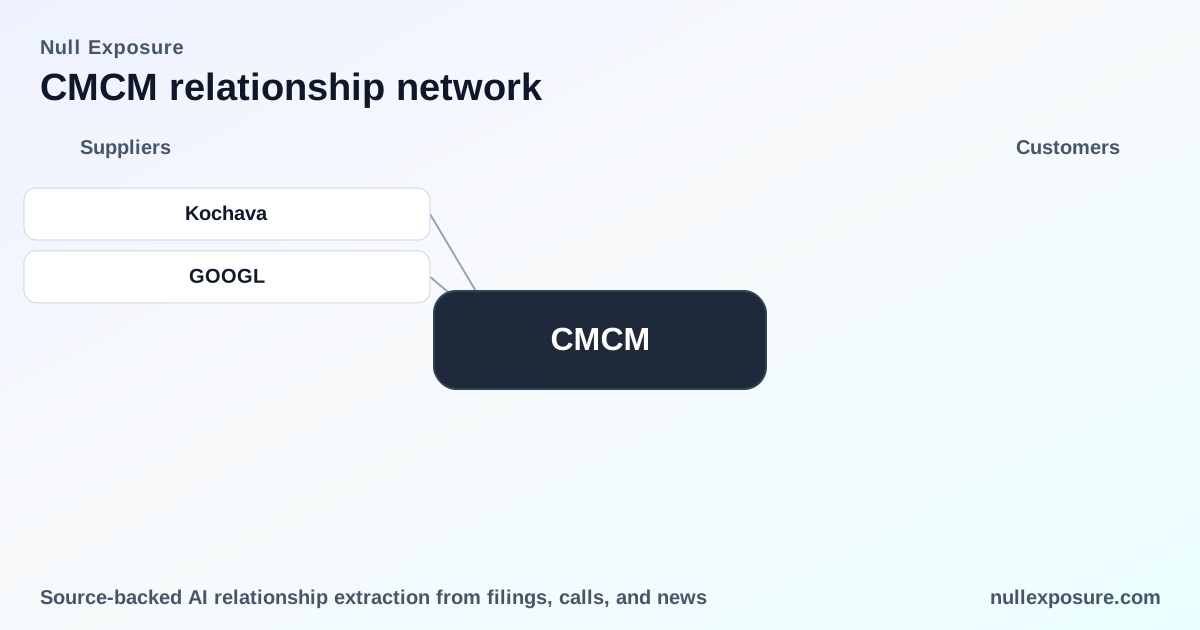
CMCM supplier relationships: what investors need to know
Cheetah Mobile (CMCM) operates consumer-facing mobile products and device integrations and monetizes primarily through platform partnerships and advertising-linked technology integrations. Its commercial model depends on third‑party platform access and marketing/measurement vendors to deliver reach and attribution so that ad inventory and AI-enabled features convert into revenue. For investors, the supplier footprint is therefore a leading indicator of distribution, measurement integrity, and platform dependency. For a practical supplier risk map and supplier monitoring, visit https://nullexposure.com/.
Quick read for busy investors
Cheetah’s supplier references in public records cluster into two themes: measurement/ad-tech relationships tied to attribution integrity, and strategic platform integrations that extend product capabilities and marketing reach. The historical Kochava link raises questions about past ad measurement exposures; the Google integrations are concrete product-level partnerships that increase visibility and product stickiness. These supplier relationships are not peripheral — they are embedded in how CMCM converts attention into revenue.
The complete supplier list from public mentions
Below I cover every supplier relationship surfaced in the compiled results and provide a plain-English summary and source for each entry.
Kochava — historical ad‑measurement customer relationship (FY2018)
Cheetah Mobile and its Kika property were customers of Kochava at the time researchers uncovered click‑injection and click‑flooding ad‑fraud activity affecting attribution data in FY2018, linking CMCM products to the environment where those measurement problems occurred. Source: BuzzFeed News coverage of the fraud findings (link: https://www.buzzfeednews.com/article/craigsilverman/android-apps-cheetah-mobile-kika-kochava-ad-fraud).
Google — integration with Gemini 2.5 Flash (Q3 2025, earnings summary)
Cheetah executives reported an integration with Google’s Gemini 2.5 Flash in Q3 2025, indicating a direct technical and marketing connection that positions CMCM products to leverage Google’s model capabilities. Source: earnings-call summary reported on Futunn for Q3 2025 (link: https://news.futunn.com/en/post/65469425/earnings-call-summary-cheetah-mobile-cmcmus-q3-2025-earnings-conference).
Google — product feature promoted by Google Cloud at AI Asia Conference (Q3 2025, transcript)
The company’s voice‑enabled “wheel robot” was described on an earnings call as integrating with Google’s Gemini 2.5 Flash and was recently showcased by Google Cloud at its AI Asia Conference, reflecting a co-marketing or platform showcase that amplifies CMCM product visibility. Source: earnings-call transcript posted on InsiderMonkey (link: https://www.insidermonkey.com/blog/cheetah-mobile-inc-nysecmcm-q3-2025-earnings-call-transcript-1652001/).
What the relationship map implies about CMCM’s operating model
The supplier pattern surfaces clear characteristics of CMCM’s business model and contracting posture.
- Contracting posture — collaborative and platform‑facing. Integrations with Google’s Gemini indicate CMCM negotiates product-level access to high-value platform capabilities rather than simple reseller or ad-broker relationships. Those integrations look strategic and productized: they increase end-user utility and marketing leverage.
- Concentration and criticality — platform dependency is material. Google’s role as a technology and visibility partner is a critical lever for product differentiation and distribution; loss or degradation of that integration would be consequential to product positioning and growth channels.
- Measurement and trust constraints — exposure to ad‑measurement ecosystems. The Kochava mention ties CMCM historically to third‑party measurement infrastructure that was implicated in attribution fraud episodes. Measurement vendors are not mere vendors here; they are core to revenue realization through advertising.
- Maturity of supplier relationships — mixed vintage and continuity. The Kochava relationship dates back to FY2018 and reflects legacy ad-tech ties; the Google interactions are recent and indicate an evolution toward cloud/AI platform partnerships that strengthen product capabilities and market credibility.
There are no formal constraint excerpts provided in the source set to reallocate to specific suppliers; the absence of listed constraints is itself a company‑level signal that public records in this pull do not surface explicit contractual covenants, exclusivity clauses, or supply-side performance guarantees.
For a systematic supplier monitoring program and deeper diligence on CMCM’s platform contracts, see https://nullexposure.com/.
Investor implications — risk and opportunity framed
- Opportunity: The Google integrations are a clear growth enabler. Product-level integrations with major platform AI offerings will increase user engagement and provide marketing lift when promoted by Google Cloud, converting into better monetization prospects for new product lines such as the voice‑enabled wheel robot.
- Risk: Historical ties to measurement vendors implicated in ad‑fraud ecosystems create reputational and revenue integrity risk. Even if issues date to FY2018, unresolved attribution or audit gaps could complicate advertiser confidence and CPM pricing.
- Operational risk: Heavy reliance on a small set of platform partners increases single‑point exposure for distribution and feature parity. Investors should watch contractual terms, dependency clauses, and the company’s ability to port integrations across competing cloud/AI vendors.
- Governance and remediation: Past measurement exposures imply the need for stronger vendor oversight, independent audits, and clearer attribution controls. Investors should prioritize disclosure around remediation steps taken after FY2018 and seek evidence of continuous monitoring with current measurement partners.
If you are mapping counterparty risk into valuation scenarios or underwriting supplier continuity, Null Exposure’s supplier intelligence pack provides a straightforward operational overlay — explore it at https://nullexposure.com/.
Practical next steps for investors and operators
- Request the company’s current vendor list and ask specifically about measurement vendors and the contractual terms governing attribution and audit rights.
- Validate the Google integrations: request product demos or proof points showing how Gemini 2.5 Flash materially changes user engagement or monetization KPIs.
- Insist on remediation documentation tied to the FY2018 measurement exposure: third‑party audits, independent attestation, and changes to ad‑tech supply chains.
Bottom line
CMCM’s supplier footprint matters: legacy ad‑measurement ties introduce revenue integrity risk while recent Google integrations represent a meaningful strategic upgrade in product capability and distribution. Investors should weigh the upside from platform co‑marketing and AI integrations against the downside of measurement and concentration risk, and demand transparent, contemporaneous evidence of vendor governance. For further supplier signal enrichment and ongoing monitoring, visit https://nullexposure.com/.