Columbus McKinnon (CMCO): supplier relationships and what they mean for investors
Columbus McKinnon designs, manufactures and sells intelligent motion and lifting solutions to industrial customers worldwide and monetizes through product sales, aftermarket service and targeted acquisitions that expand addressable markets and technology scope. The company runs a centralized purchasing model for key raw materials and components while funding strategic growth through deal activity—most recently completing the Kito Crosby acquisition—supported by external financial and legal advisors. For a concise vendor-risk view and M&A counterparty detail, see https://nullexposure.com/.
The business model in two sentences for investors
Columbus McKinnon generates roughly $1.00 billion in trailing revenue with gross profit of $344.5 million and an operating margin around 8.6%, selling hardware and support services that require a steady supply of steel, motors and electro‑mechanical components. Profitability and growth are influenced by commodity and supplier concentration, the company’s ability to negotiate company‑wide contracts, and periodic inorganic expansion financed and advised externally.
Why supplier relationships matter here
CMCO’s operations are materially dependent on a limited set of strategic suppliers for core inputs: steel in various forms, electric motors, bearings, gear reducers, enclosures, wire harnesses and other electromechanical parts. The company disclosed that principal raw material and component purchases aggregated to approximately $375 million in fiscal 2025, representing a substantial portion of cost of goods sold. That scale creates both bargaining leverage when centralized purchasing works and clear operational exposure if a major supplier or commodity price swings.
Key operating characteristics for investors:
- Contracting posture: Purchasing is negotiated on a company‑wide basis through a global purchasing group, indicating standardized terms and supplier rationalization rather than ad‑hoc local buying.
- Concentration: Large aggregate spend (>$100M band) on materials concentrates execution risk with a limited supplier base.
- Criticality: Inputs are mission‑critical to manufacturing; substitutes (for example different steel grades or specific motors) carry lead times and qualification cost.
- Maturity: The purchasing model is centralized and mature operationally—evidence points to strategic supplier relationships rather than spot buying—implying predictable but potentially sticky supplier terms.
If you want a quick operational risk snapshot that ties procurement to corporate strategy, visit https://nullexposure.com/ for related supplier intelligence.
M&A counterparties and legal advisors tied to the Kito Crosby deal
PR Newswire’s March 9, 2026 release on the completion of the Kito Crosby acquisition lists the financial and legal counterparties involved. Each relationship below is presented in plain language with the source.
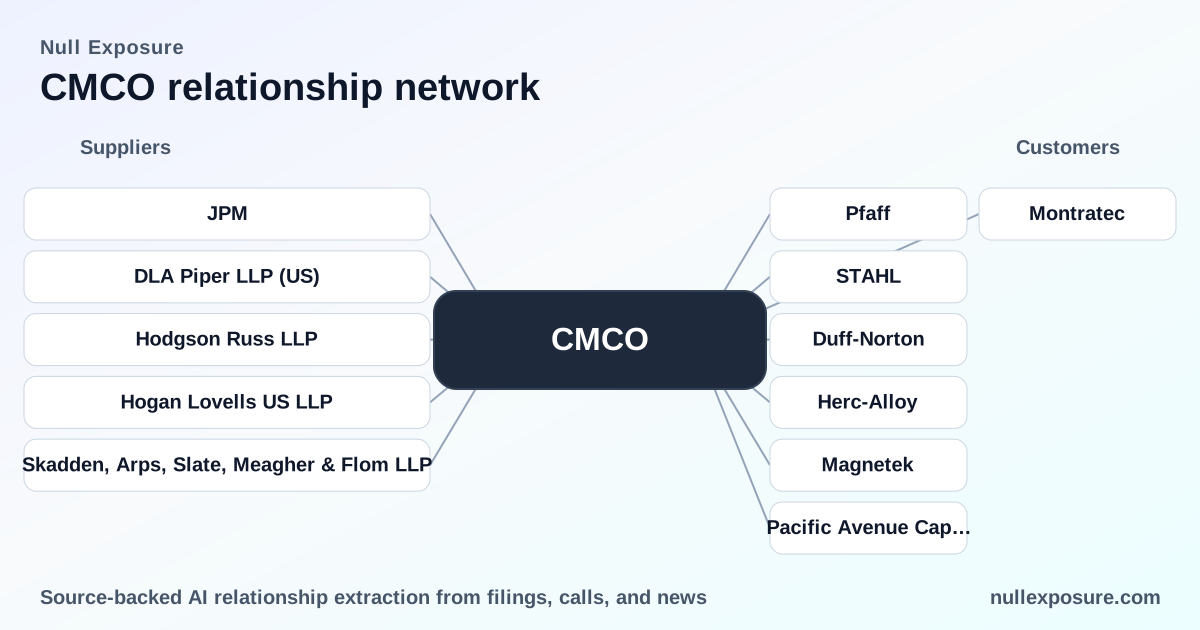
JPM
JPM acted as one of the named counterparties associated with Columbus McKinnon’s transaction advisory activities in FY2026; PR Newswire notes J.P. Morgan Securities LLC as the financial advisor on the Kito Crosby acquisition (PR Newswire, March 9, 2026). https://www.prnewswire.com/news-releases/columbus-mckinnon-completes-acquisition-of-kito-crosby-302678766.html
J.P. Morgan Securities LLC
J.P. Morgan Securities LLC served as Columbus McKinnon’s financial advisor on the Kito Crosby deal, providing transaction execution and financing advisory services credited in the company press release announcing deal completion (PR Newswire, March 9, 2026). https://www.prnewswire.com/news-releases/columbus-mckinnon-completes-acquisition-of-kito-crosby-302678766.html
DLA Piper LLP (US)
DLA Piper LLP (US) was retained as a legal advisor to Columbus McKinnon in connection with the transaction, indicating use of large, international counsel for cross‑border or complex deal work (PR Newswire, March 9, 2026). https://www.prnewswire.com/news-releases/columbus-mckinnon-completes-acquisition-of-kito-crosby-302678766.html
Hodgson Russ LLP
Hodgson Russ LLP acted as legal counsel to Columbus McKinnon for the acquisition, suggesting local or regional counsel engagement alongside global firms in FY2026 M&A activity (PR Newswire, March 9, 2026). https://www.prnewswire.com/news-releases/columbus-mckinnon-completes-acquisition-of-kito-crosby-302678766.html
Hogan Lovells US LLP
Hogan Lovells US LLP provided legal advisory services on the transaction for Columbus McKinnon, reflecting the company’s use of top‑tier US law firms for deal documentation and regulatory matters (PR Newswire, March 9, 2026). https://www.prnewswire.com/news-releases/columbus-mckinnon-completes-acquisition-of-kito-crosby-302678766.html
Skadden, Arps, Slate, Meagher & Flom LLP
Skadden, Arps, Slate, Meagher & Flom LLP also served as legal advisor to Columbus McKinnon on the Kito Crosby acquisition, reinforcing the pattern of engaging multiple prominent law firms for complex transactions (PR Newswire, March 9, 2026). https://www.prnewswire.com/news-releases/columbus-mckinnon-completes-acquisition-of-kito-crosby-302678766.html
What these relationships imply for supplier risk and capital allocation
The listed relationships are transactional advisory and legal counterparties tied to an acquisition, not production suppliers, but they reveal how Columbus McKinnon sources external expertise for inorganic growth. Investor implications:
- Capital deployment: Use of a prominent financial advisor indicates a disciplined approach to deal execution and likely access to sophisticated financing structures; financial cost and integration execution will be key near‑term value drivers.
- Governance and complexity: Multiple top-tier law firms on a single deal imply either jurisdictional complexity or a preference for segmented legal work—both raise transaction costs but lower legal execution risk.
- Supplier risk remains industrial: Strategic buying and $375M of material spend confirm that operational margin sensitivity is dominated by commodity and supplier execution, not advisory spend.
Investment takeaways — concise and actionable
- Revenue scale and margins: CMCO produces around $1.0B revenue with modest net margins; margin expansion depends on procurement effectiveness and successful integration of acquisitions.
- Concentrated input exposure: $375M of principal purchases in fiscal 2025 signals meaningful supplier concentration—procurement strategy is a central lever for margin resilience.
- M&A‑enabled growth: Recent use of high‑caliber financial and legal advisors for the Kito Crosby deal indicates management is actively pursuing inorganic growth to supplement organic demand.
- Valuation context: The company shows a high trailing P/E but a lower forward P/E in public data, and analysts assign an average target price near $26.50, so execution on cost and integration will determine whether multiple expansion is sustainable.
For investors focused on supply‑chain exposure and deal execution, the combination of centralized procurement, large material spend, and an active M&A program are the primary signals to monitor. For a targeted vendor-risk profile or counterparty mapping, visit https://nullexposure.com/ to see how these pieces fit into broader supplier intelligence.
Conclusion: Columbus McKinnon runs a centralized, high‑spend procurement model that is critical to manufacturing margins while leaning on external financial and legal advisors to execute acquisitions that expand market reach; investors should weigh supplier concentration risk against the upside from successful deal integration and procurement optimization.