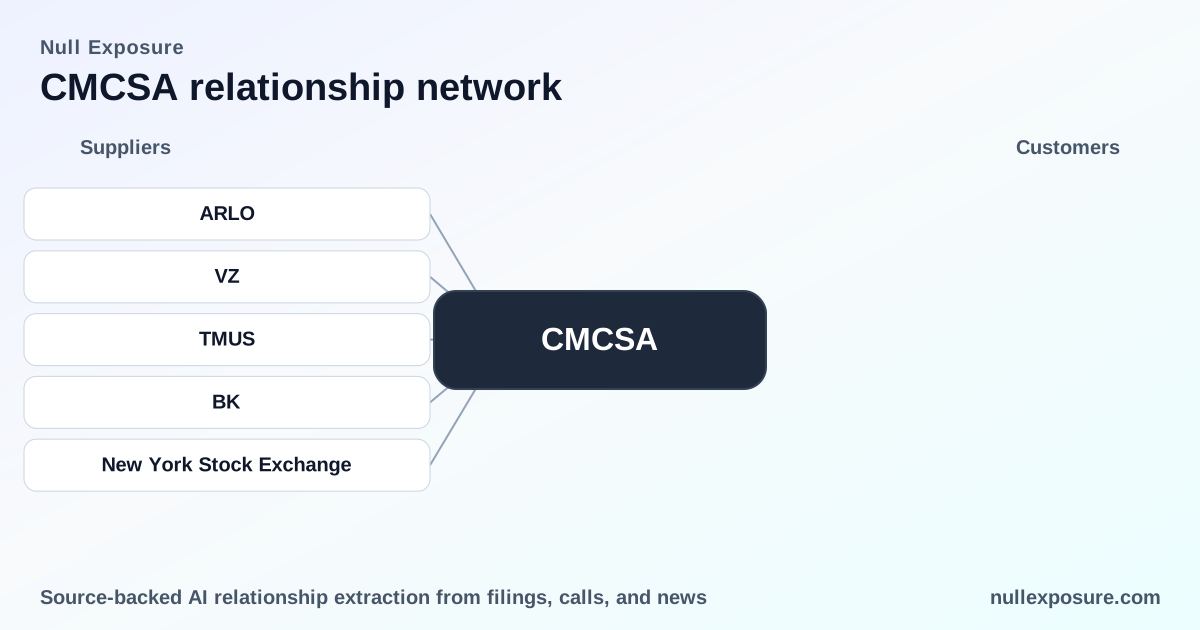
Comcast (CMCSA) supplier map: what investors need to know
Comcast monetizes by bundling broadband, pay-TV, wireless and advertising with content production and distribution through NBCUniversal; its core revenue streams are broadband subscriptions, video distribution fees, advertising sales and ancillary services such as Xfinity home offerings and mobile MVNO services. Comcast’s supplier posture is a mix of long-term, high-dollar content and equipment commitments plus strategic network and platform relationships that extend its consumer reach without proportionally increasing capital intensity.
For an expanded supplier intelligence view, visit https://nullexposure.com/.
Why supplier relationships matter for Comcast’s margins and risk profile
Comcast operates at scale and extracts margin through vertical integration of distribution and media, but that position depends on a handful of expensive, long-dated supplier commitments. Programming rights and licensed content represent the company’s largest and most critical operating expense, while hardware and network access vendors are material to service delivery and customer experience. These supplier dynamics drive both operating leverage and concentrated counterparty risk.
Company-level operating constraints that shape supplier risk
The public record conveys several clear operating-model signals about Comcast’s supplier posture:
- Long-term, fixed-price content commitments are embedded in the cost structure. Comcast discloses significant fixed-price purchase obligations for licensed content, which impose predictable but substantial cash outflows over multiple years.
- Programming is critical to the value proposition. Comcast identifies programming expenses as its most significant operating expense, underscoring that content access is a mission-critical supplier relationship rather than a marginal input.
- Material vendor concentration for customer premise equipment and network gear exists. Comcast purchases substantial volumes of gateways, set-top boxes and network equipment from a limited set of suppliers, creating operational dependence and negotiation leverage in both directions.
- Large spend and balance-sheet commitments are the norm. Public filings show operating lease expenses in the billions and programming/production obligations measured in tens of billions, signaling supplier spend well above $100m bands and multi-year liquidity planning.
- Comcast leverages third-party networks for specific services. The company relies on external wireless and broadband network partners for parts of its offering, indicating a hybrid delivery model that trades capital expenditure for access agreements.
These constraints are company-level characteristics, not relationship-level attributions unless specifically noted in filings.
Catalog of disclosed supplier relationships (concise summaries)
Arlo Technologies (ARLO)
Comcast has partnered with Arlo to provide connected home security solutions to millions of Xfinity Internet households, integrating Arlo’s smart-home devices into Comcast’s distribution footprint and subscription channels. This relationship is publicly discussed in Arlo’s Q4/FY2025 commentary and contemporary news coverage (InsiderMonkey and TradingView coverage dated March 2026).
Verizon (VZ)
Comcast modernized its MVNO partnership with Verizon to support continued profitable growth for Comcast, Charter and Verizon, preserving a capital-efficient path to mobile services while leveraging Verizon’s network for retail and business customers. This was described during Comcast’s 2025 Q4 earnings remarks (Comcast 2025 Q4 earnings call, March 7, 2026).
T‑Mobile (TMUS)
Comcast added T‑Mobile as a network partner for business customers, expanding its multi-network MVNO posture and enabling a convergence proposition that relies on third-party radio access rather than incremental mobile tower investment. Management detailed this network expansion on the company’s 2025 Q4 earnings call (March 7, 2026).
The Bank of New York Mellon (BK)
Comcast notified The Bank of New York Mellon, acting as trustee, of plans to redeem approximately $2.1 billion of 2026 Notes and about $650 million of 2027 Notes, a capital markets action disclosed in SEC filings summarized on March 2026 reporting outlets. This trustee interaction is a standard capital-servicing relationship in the context of debt redemptions (SEC Form filings summarized March 2026).
New York Stock Exchange
Comcast’s Form 8‑K filings list the 2.0% Exchangeable Subordinated Debentures due 2029 (trading symbol CCZ) as listed on the New York Stock Exchange, reflecting an issuer-listing relationship that carries listing compliance and disclosure obligations. The listing venue and instrument details were disclosed in Form 8‑K summaries published in March 2026.
(Each relationship summary references contemporaneous company filings and market reporting from March 2026 as noted above.)
For more supplier relationship intelligence and deeper supplier maps, see https://nullexposure.com/.
What these relationships signal for investors and operators
- Cash-flow and liability rhythm: Long-term content deals and large programming obligations create a predictable but front-loaded cost base; investors must model multi-year contractual cash outflows rather than assuming only variable content spend. The disclosed redemptions of debt notes emphasize active liability management.
- Operational concentration risk: Heavy reliance on a limited set of CPE and network partners makes Comcast vulnerable to supplier disruption or price shifts, but also gives Comcast negotiating clout given its scale.
- Capital-efficiency via network partnerships: The MVNO arrangements with Verizon and T‑Mobile demonstrate a deliberate strategy to deliver mobile services without replicating radio access networks, preserving free cash flow and reducing capex volatility.
- Product-extension opportunities: The Arlo partnership shows Comcast is monetizing Xfinity’s installed base through device and subscription add-ons, which lifts average revenue per user without major customer-acquisition spend.
- Maturity and scale: Contractual obligations and lease expenses reported in the billions indicate mature, enterprise-level supplier relationships that require sophisticated procurement, treasury, and contingency planning.
How to act on these supplier signals
- For investors: incorporate multi-year programming and lease obligations into free cash flow and leverage scenarios; stress-test EBITDA under higher content costs and supplier disruptions. Track MVNO revenue mix and device-add revenue to gauge convergence benefits.
- For operators and procurement teams: prioritize redundancy in CPE supply chains, codify contingency plans with network partners, and convert one-off device partnerships into recurring service bundles where possible.
For a vendor-level scorecard and to map supplier criticality across Comcast’s footprint, explore https://nullexposure.com/ for interactive supplier reports.
Final takeaways
- Comcast’s core risks are contractual and operational, not purely market share. Long-term content commitments and concentrated equipment spend drive both margin stability and counterparty exposure.
- Network partnerships trade capital intensity for operational flexibility, which preserves cash flow but requires robust supplier governance.
- Partnerships like Arlo extend monetization options and reduce churn risk by deepening product engagement within the Xfinity base.
To review Comcast’s supplier relationships in actionable format and download supplier-level evidence, visit https://nullexposure.com/.