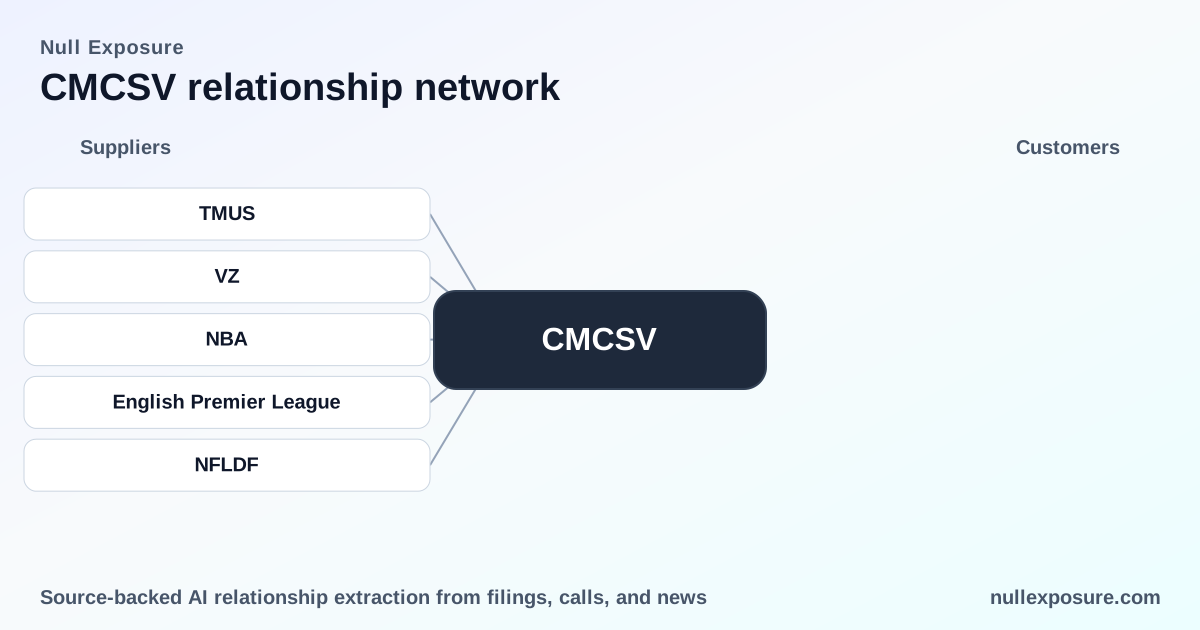
Comcast’s supplier map: wireless partners and content rights that drive convergence value
Comcast monetizes a two-sided media and connectivity franchise: it sells broadband and pay-TV bundles to consumers while capturing advertising and subscription dollars from content and distribution. The company leverages network partnerships for mobile service resale and pays for high-value sports and entertainment rights to keep churn low and ARPU high. Revenue comes from converging connectivity with exclusive content and capital-efficient wireless partnerships rather than owning the full mobile network stack.
If you evaluate supplier risk for CMCSV, start with how those relationships affect customer retention, margin leverage, and capital intensity. For a concise supplier-risk workflow and ongoing monitoring, see https://nullexposure.com/ for how institutional investors track these inputs.
What the supplier map looks like in practice
Comcast’s recent disclosures and press coverage show two distinct supplier sets that matter for investors: mobile network partners that supply the wireless product and content rights holders that feed Peacock, NBC, and broadcast channels. These relationships are complementary: mobile partnerships reduce capital expenditure while sports and premium content sustain customer engagement and willingness to pay.
- Mobile partnerships are contractual and commercial — structured to be capital-efficient via MVNO and partner MVNE agreements.
- Content rights involve long-duration, high-dollar contracts that are operationally critical for video subscribers and advertising revenue.
For an institutional-grade supplier analysis and alerts on new disclosures, visit https://nullexposure.com/.
Recent supplier relationships (what to know, one at a time)
T-Mobile — network partner for business customers
Comcast confirmed in its 2025 Q4 earnings call that T‑Mobile will be added as a network partner for business customers, reinforcing a capital-efficient mobile platform that supports a growing convergence proposition for business subscribers. This was disclosed in the 2025Q4 earnings commentary released in March 2026. (Source: Comcast 2025 Q4 earnings call, 2026-03.)
Verizon — modernized MVNO partnership for retail growth
Management announced in the same 2025 Q4 earnings call that Comcast has modernized its MVNO partnership with Verizon, positioning wireless to support profitable growth for Comcast, Charter, and Verizon. This is a contractual posture intended to sustain retail wireless scale without duplicative network capex. (Source: Comcast 2025 Q4 earnings call, 2026-03.)
Verizon — evidence in subscriber additions and product delivery
News coverage documents the commercial outcome: Comcast added 307,000 mobile subscribers in FY2025—service routed through the Verizon deal—for a total of 7.8 million mobile subscribers, demonstrating the partnership’s contribution to customer growth. This subscriber figure underlines the scale impact of the Verizon arrangement on Comcast’s connectivity business. (Source: BroadbandBreakfast report on FY2025 mobile additions, reporting cited March 2026.)
NBA — long-term, high-dollar content rights
CNBC reported on October 31, 2024 that Comcast signed an 11‑year, $2.45 billion per year deal with the NBA to air games on broadcast networks and Peacock beginning in the 2025–26 season. This contract is a material, multi-year content commitment designed to protect live-sports viewership and subscription economics. (Source: CNBC, Oct 31, 2024.)
English Premier League — high-value sports inventory for NBCUniversal
CNBC coverage highlights that NBCUniversal has invested heavily in rights for the English Premier League among other properties, indicating continued strategic priority on premium sports to defend linear and streaming viewership. These rights are structurally important for ad monetization and subscriber retention. (Source: CNBC, Oct 31, 2024.)
NFL — cornerstone live sports investment
CNBC also notes NBCUniversal’s multibillion-dollar spending on NFL broadcast rights such as “Sunday Night Football,” reinforcing Comcast’s orientation toward exclusive, appointment-viewing content as a retention anchor and advertising platform. (Source: CNBC, Oct 31, 2024.)
What these supplier links imply for Comcast’s operating model
Comcast runs a mixed outsourcing posture: network access is outsourced (MVNO/MVNE) while content is vertically locked via exclusive rights. That implies different risk profiles:
- Contracting posture: mobile partners are commercial suppliers with renewal and pricing risk; content rights are long-term, high-commitment contracts with renewal and escalation exposure.
- Concentration: wireless supplier concentration is limited by multi-partner strategy (Verizon + T‑Mobile); content concentration is higher where single-rights holders (e.g., NBA) carry outsized value to Peacock and NBC.
- Criticality: content rights are highly critical to retention and advertising; mobile partner arrangements are critical to product delivery but less capital-intensive.
- Maturity: mobile partnership model is mature and scalable; content rights spending reflects strategic, long-duration bets that are harder to alter without revenue consequences.
No supplier-specific compliance or constraint excerpts were captured in the vendor feed, which is itself a signal: the public record supplied here shows contractual relationships and headline commitments but not explicit listed constraints or flagged material supplier covenants.
Risk and opportunity for investors
- Risk — content cost inflation and renewal timing. Long-term sports rights, exemplified by the NBA and NFL commitments, are large fixed commitments that compress marginal returns if subscriber growth lags.
- Risk — dependency on third-party network economics. The MVNO model lowers capex but transfers margin and pricing risk to commercial agreements with Verizon and T‑Mobile.
- Opportunity — capital efficiency and scale benefits. Modernized MVNO agreements and the addition of T‑Mobile for business customers allow Comcast to scale wireless revenue without proportional capital investment, preserving cash flow for content and platform investment.
- Opportunity — differentiated bundle economics. Exclusive sports rights and a large mobile footprint create cross-sell opportunities that drive ARPU and reduce churn.
For a rigorous supplier risk scorecard and to track changes that affect valuation, visit https://nullexposure.com/.
Bottom line and actions for portfolio managers
Comcast’s supplier fabric combines outsourced network delivery with high-commitment content ownership. That hybrid structure reduces capital intensity but concentrates commercial risk in contract renewals and rights inflation — a clear trade-off investors should price into forecasts for margin stability and free cash flow. Monitor renewal timelines for major content contracts and any public renegotiation of MVNO economics; both will materially affect valuation multiples.
To get ongoing alerts on disclosures and to integrate supplier exposure into investment models, go to https://nullexposure.com/.
Overall, Comcast’s strategy is deliberate: preserve capital efficiency on the connectivity side, pay up for differentiation in content. Investors should price both the upside of cross-sell and the downside of escalating rights costs into their CMCSV thesis.