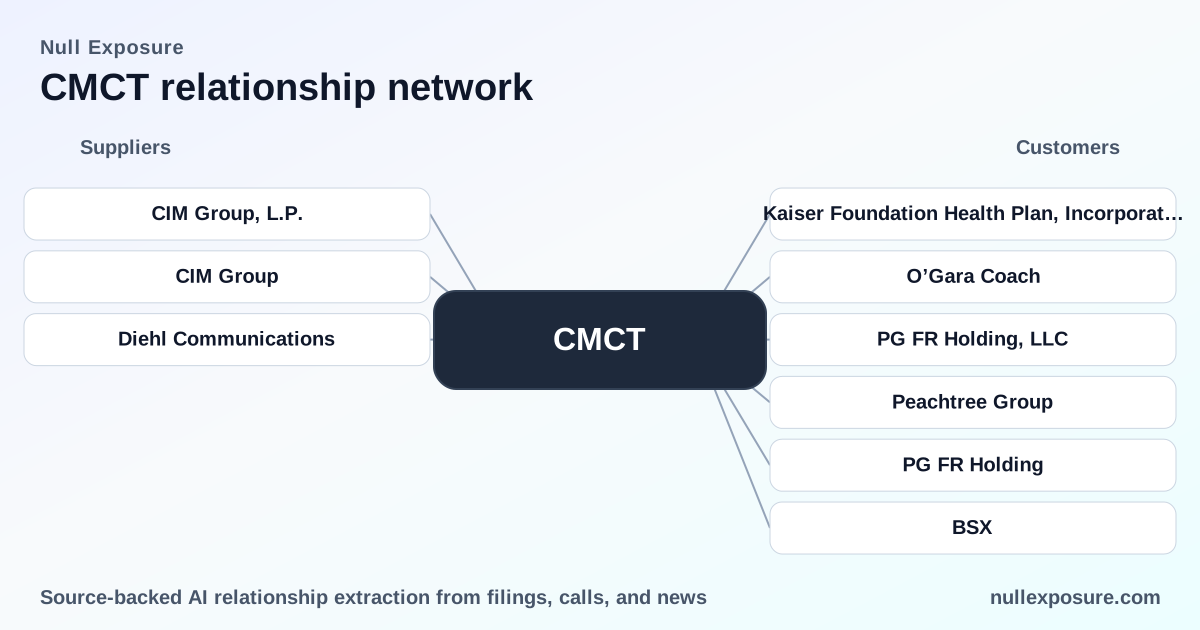
Creative Media & Community Trust (CMCT): the supplier map investors need
Creative Media & Community Trust (CMCT) is a small-cap REIT that acquires and operates Class A and creative office assets and outsources core operating functions to affiliates of CIM Group; the company monetizes through rental income, fee-based services passed to CIM affiliates, and capital events (asset sales and financings). CIM-related management and property services are the operational backbone, while third‑party communications support is limited and tactical. For investors, the primary question is not whether CMCT can lease space, but whether its affiliated supplier structure creates durable operating leverage or concentrated counterparty risk.
Learn more at https://nullexposure.com/.
How CMCT’s operating model actually works in practice
CMCT is not a vertically-integrated operator in its own right — it is an externally managed REIT that channels much of its day-to-day operations through CIM Group affiliates. The firm relies on master services, staffing and investment-management agreements that give CIM affiliates responsibility for acquisition, development, leasing, property management, IT and other administrative tasks. Those arrangements convert operating scale at CIM into recurring fees and expense reimbursements booked on CMCT’s P&L.
- Contracting posture: CMCT uses framework agreements (master services and investment-management agreements) that create long-dated, repeatable service flows rather than one-off engagements, which increases operational embedment with a single manager.
- Concentration and criticality: A small set of CIM affiliates provide mission-critical services — property management, leasing, financing support and IT — making the relationship highly concentrated and operationally critical.
- Maturity and terms: The company’s public filings and press releases reference longstanding dealer‑manager arrangements, staffing agreements, and refinancings that indicate mature, institutionalized counterparty ties rather than nascent vendor relationships.
- Spend profile: Public disclosures show related-party transactions across multiple spend bands — items in the $100k–$1m range and several in the $1m–$10m range, with related-party balances in the $10m–$100m band — which implies meaningful recurring charge flows but not single-vendor mega‑spend.
These attributes create both operational efficiency and governance exposure: the same structure that provides turnkey execution also concentrates performance risk and fee leakage to an affiliate network.
Supplier relationships on record (complete list)
Below I cover every relationship named in the collected results. Each entry is a compact, plain-English summary with a source citation.
CIM Group, L.P.
CMCT is operated by affiliates of CIM Group, L.P., which provide in‑house acquisition, credit analysis, development, finance, leasing and onsite property management capabilities that run the REIT’s day‑to‑day operations. According to StockTitan’s press releases and CMCT investor notices, CIM affiliates are the administrator and manager under master services and investment-management agreements (first seen March 2026). (Source: StockTitan / press releases, March 2026.)
CIM Group
CIM Group is the parent and external manager cited across multiple news reports: CMCT acquired properties from CIM Group in a $282 million transaction in Oakland, and company leadership (Shaul Kuba) is identified as a CIM co‑founder who also serves as CMCT’s CIO, underlining operational and ownership linkages between the REIT and CIM. (Source: The Real Deal / San Francisco Business Times, May 2023; Los Angeles Business Journal, FY2023 & FY2025 profiles.)
Diehl Communications
Diehl Communications is listed as CMCT’s media relations contact for corporate press and shareholder communications, indicating a standard external PR engagement rather than substantive operational dependency. (Source: StockTitan press release and Markets FinancialContent press notices, December 2025.)
What the supplier footprint means for investors
The supplier map produces clear, investable implications.
- Operational leverage with affinity: CIM affiliates deliver core operating services, which produces operating leverage when property performance is good and accelerates execution on acquisitions and developments. The firm’s monetization is therefore amplified by a manager with in‑house capabilities.
- Concentrated counterparty risk: Because management, leasing, property management and IT are run through CIM affiliates, any operational failure, strategic divergence, or governance dispute at CIM would directly affect CMCT’s cash flow and valuation. This is not a diversified vendor model.
- Fee and related‑party economics: Public disclosures show recurring reimbursements, property management fees, asset management fees and other related-party charges across multiple material bands; these are recurring P&L items that reduce net distributable cashflow and deserve close scrutiny in valuation models.
- Governance and alignment: Long‑running master services and dealer‑manager arrangements create predictability but also raise the bar for active governance — investors should evaluate board oversight, fee disclosure, and conflict-mitigation mechanisms in filings.
Midstream action: if you’re mapping counterparty risk across REIT suppliers, centralize related-party fee lines and contract term expirations to model downside scenarios — more on supplier analytics at https://nullexposure.com/.
Practical checklist for relationship monitoring
Investors and operators evaluating CMCT should prioritize the following:
- Confirm the scope and expiry dates of master services and staffing agreements with CIM affiliates and review renewal fee mechanics.
- Reconcile related‑party reimbursements and management fees against third‑party market rates for comparable services.
- Track concentrated vendor dependencies (IT, leasing, onsite management) and contingency plans for transition or replacement.
- Monitor related-party receivable/payable balances and any changes after financing events or asset sales.
Final takeaways and next steps
- CIM is central to CMCT’s operating model: that is both a strength (scale and capability) and a concentration risk (single-manager dependency).
- Related‑party economics are material: recurring fees and reimbursements appear across multiple spend bands and will influence distributable cashflow.
- Governance is the lever: the quality of board oversight and the transparency of management agreements determine whether the CIM relationship is an asset or a structural liability.
For a deeper supplier-risk assessment or to benchmark CMCT against other externally managed REITs, start with our practical resources at https://nullexposure.com/. If you want a tailored supplier-risk scorecard for CMCT, visit https://nullexposure.com/ to request a focused analysis.