Costamare Bulkers (CMDB): Supplier relationships that reshape fleet economics
Costamare Bulkers Holdings Limited owns and operates dry bulk vessels and monetizes through charter revenues, selective asset acquisitions and sales, and the operation of an integrated dry-bulk platform. The company’s near-term revenue profile is driven by vessel utilization and charter rates, while strategic deals for fuel supply and fleet additions are explicitly intended to reduce operating cost volatility and increase scale. Investors should view recent counterparty arrangements as operational levers that change fuel cost exposure, fleet composition and the company’s degree of vertical integration.
For more supplier-risk intelligence and counterparty mapping, visit https://nullexposure.com/.
How CMDB makes money, and why these relationships matter
Costamare Bulkers generates cash from time and voyage charters on its owned vessels; revenue is sensitive to freight markets and asset utilization. Financials show $597.2M in trailing revenue with negative net margin (TTM profit margin -6.25% and diluted EPS -2.28), indicating the business remains cyclical and margin-constrained despite positive gross profit. High insider ownership (about 65% insiders) creates a concentrated governance posture and operational continuity, while institutional ownership is limited (~20%), which influences strategic decision-making and capital deployment.
Contracting posture is transactional for chartering but strategic where counterparty commitments reduce input cost volatility—bunkering agreements or long-term charters can materially alter cash flow stability. Fleet acquisitions and platform purchases shift the company from an asset-owning operator toward an integrated operator with greater control over crewing and commercial management. These relationships therefore move CMDB risk from spot market exposure to counterparty and integration risk, which investors must price differently.
Counterparty relationships that change the risk profile
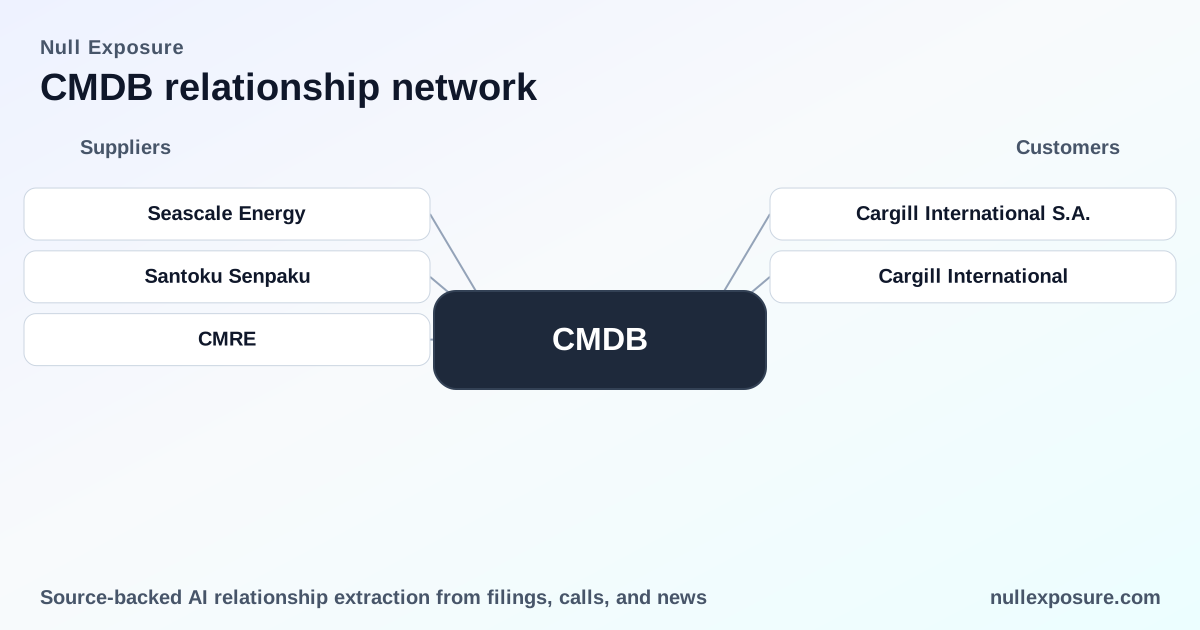
Seascale Energy — bunkering agreement with a Cargill/Hafnia JV
Costamare Bulkers entered a bunkering services agreement with Seascale Energy, a joint venture between Cargill and Hafnia, covering its owned and operating fleet; the deal is framed as part of a broader strategic cooperation that includes sustainability initiatives. According to multiple press reports in March 2026, the agreement centralizes fuel procurement for CMDB’s fleet and attaches sustainability objectives to bunkering sourcing (ShippingTelegraph and gCaptain, March 2026). Key takeaway: the contract reduces fuel procurement volatility and links CMDB to large commodity counterparties, shifting risk to supplier execution and contract terms.
Source: ShippingTelegraph and gCaptain coverage (March 2026) reporting the Seascale Energy bunkering agreement.
Santoku Senpaku — one-off capesize vessel acquisition
Costamare Bulkers purchased a 176,000 dwt capesize bulk carrier formerly named Imperator Australis from Japanese operator Santoku Senpaku, representing a targeted fleet-upgrade and scale move following the company’s spin-off. Splash247 reported the vessel addition in March 2026, which expands CMDB’s capesize capacity and exposes the company to the larger-ship charter market. Key takeaway: fleet expansion through third-party purchases accelerates revenue capacity but raises near-term capital intensity and market exposure to capesize TC rates.
Source: Splash247 report on the Imperator Australis acquisition (March 2026).
Costamare (related entity) — acquisition of Costamare Bulkers Inc. operating platform
On May 6, 2025, CMDB completed the acquisition of Costamare Bulkers Inc. (“CBI”), a dry-bulk operating platform, from Costamare and a minority shareholder; the results of CBI were consolidated from that date forward. This transaction formally integrates an operating platform into CMDB’s structure, creating internal commercial and technical management capabilities rather than outsourcing them. StockTitan’s company reporting in 2026 captured the disclosure of this platform acquisition. Key takeaway: owning the operating platform increases operational control and potential margins long term, but it concentrates execution risk and requires successful integration.
Source: StockTitan report summarizing CMDB’s disclosure about acquiring CBI (reported 2026, reflecting May 6, 2025 transaction date).
Constraints and what the absence of reported constraints signals
There are no explicit constraints listed in the supplied supplier-relationship feed. As a company-level signal, absence of documented contractual constraints in this public feed implies limited public visibility into long-term supplier covenants, minimum off-take commitments, or restrictive covenants tied to fleet financing. Investors should treat this absence as an information gap, not a regulatory or operational guarantee: contractual terms live in private agreements and financing documents that are not captured here.
Operationally, use the visible signals—high insider ownership, recent platform acquisition, fleet purchases and a structured bunkering agreement—to infer CMDB’s contracting posture: selective long-term supplier commitments for inputs, opportunistic asset purchases, and tighter internalization of operating functions.
Strategic implications for investors and operators
- Cost stability. The bunkering agreement with Seascale Energy reduces fuel price execution uncertainty and links CMDB to large commodity players, improving predictability of voyage economics.
- Scale and market exposure. Capesize acquisition increases exposure to volatile but high-reward capesize charter markets; investors must balance incremental earnings potential against fleet financing cost.
- Integration risk. Owning the operating platform enhances margin capture but requires management bandwidth and capex discipline; poor integration would erase projected efficiency gains.
- Governance concentration. Insiders control roughly 65% of equity, which streamlines decision-making but concentrates control and could limit minority investor protections.
For a deeper read on supplier concentration and counterparty credit, consult our resource center at https://nullexposure.com/.
How to use these relationship signals in valuation and diligence
Treat the Seascale Energy contract as a partial hedge on fuel costs—model a lower volatility scenario for voyage costs over the contract term. Model acquisition synergies from CBI conservatively: assume integration costs and a delayed margin uplift. For the capesize addition, stress-test earnings to a scenario where capesize time charter rates fall 25–40% to assess balance-sheet resilience given cyclicality.
Bottom line for capital allocators
Costamare Bulkers is actively reshaping its operating footprint: fuel procurement is being centralized through a JV with major commodity firms, fleet scale is increasing via targeted purchases, and an operating platform has been internalized. These moves shift risk from pure spot-market exposure to counterparty execution and integration risk—both manageable if management executes and financing remains disciplined. Given the company’s negative EPS and slim operating margins, the next 12–24 months of charter markets and integration outcomes will determine whether these relationship-driven levers generate durable value.
For tailored counterparty exposure analysis and tracking of supplier-linked revenue effects, visit https://nullexposure.com/ for our full suite of supplier intelligence and portfolio tools.
Disclaimer: This commentary synthesizes public reporting and company disclosures for investor research purposes and does not constitute investment advice.