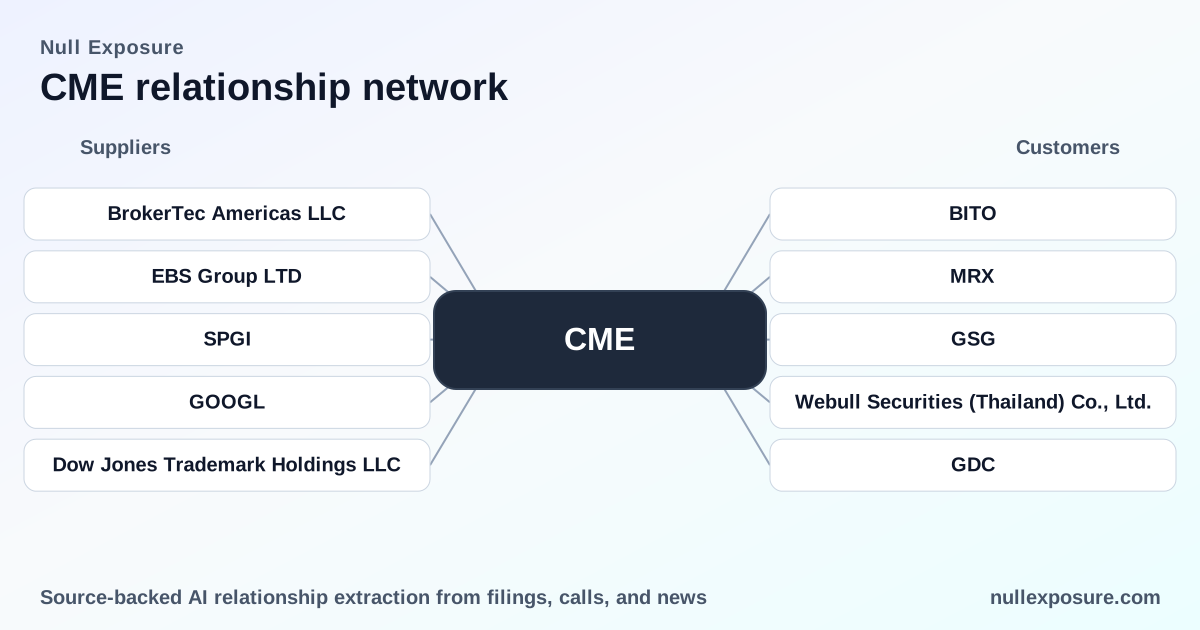
CME Group Inc.: supplier map and operational implications for investors
Thesis: CME Group operates as the global hub for derivatives trading — monetizing exchange fees, clearing and settlement services, market data licensing, and intellectual-property licensing for benchmark indices and trademarks. Its supplier relationships are a mix of market infrastructure partners, index and trademark licensors, and cloud/technology providers that enable trading, market data, and post-trade services; these relationships influence recurring revenue durability, cost structure, and operational resilience.
For deeper supplier intelligence and comparative supplier scoring, visit https://nullexposure.com/ for our full framework and proprietary signals.
How CME’s commercial model depends on third parties
CME's revenue model is concentrated on transaction-driven fees (futures/options execution and clearing) and high-margin licensing for market data and index/trademark usage. Third-party suppliers lift three functional layers of this business: execution and liquidity platforms (BrokerTec, EBS), benchmark/index licensors (S&P Dow Jones Indices; Standard & Poor's; Dow Jones Trademark Holdings), and large-scale cloud infrastructure (Google Cloud) that supports scaling, distribution, and product innovation. The combination produces high revenue leverage to volumes with a relatively predictable licensing income stream, but creates operational dependencies where cloud and market-data arrangements are critical to uptime, latency and product distribution.
Supplier roster — concise, sourced summaries
Below are every supplier relationship captured in the available coverage, each with a one- to two-sentence plain-English summary and its source.
BrokerTec Americas LLC
BrokerTec is referenced as the venue CME uses for fixed-income trading, reflecting CME’s integration of fixed-income liquidity into its market architecture and product offering. According to a StockTitan news piece summarizing CME activity (March 9, 2026), BrokerTec provides the fixed-income trading channel used alongside CME’s other platforms.
EBS Group LTD
EBS is identified as the foreign-exchange trading platform that CME leverages, adding FX liquidity and product breadth to CME’s derivatives ecosystem. The same StockTitan report (March 9, 2026) notes CME’s FX trading occurs via the EBS platform.
S&P Dow Jones Indices LLC
S&P Dow Jones Indices is called out as the owner of the S&P 500 Index product that CME references and uses in licensing and product construction. The StockTitan coverage (March 9, 2026) explicitly names S&P Dow Jones Indices as the index provider of the S&P 500 product.
Google Cloud
Google Cloud is cited as a strategic partner in CME’s initiatives to increase trading volumes, diversify revenue and enhance customer efficiencies through cloud-enabled services, indicating cloud infrastructure underpins a portion of CME’s technology stack. TradingView’s summary of CME’s SEC 10‑K and strategic initiatives (March 9, 2026) lists Google Cloud as a named partner for these efforts.
Dow Jones Trademark Holdings LLC
Dow Jones Trademark Holdings LLC is referenced for trademark licensing (Dow Jones, DJIA and related marks) that CME licenses to support index products and benchmarks used on its platform. StockTitan’s reporting (March 9, 2026) notes these trademarks are licensed for use by Chicago Mercantile Exchange Inc.
Standard & Poor's Financial Services LLC
Standard & Poor’s Financial Services LLC is listed as the owner of S&P trademarks (e.g., S&P®, S&P 500®) that are licensed by CME for product and benchmark distribution. The StockTitan item (March 9, 2026) references these S&P trademark licenses.
How these relationships shape CME’s operating model and risk profile
-
Contracting posture — strategic and licensing-heavy. CME’s supplier engagements are structured as strategic partnerships and intellectual-property licenses rather than short-term commoditized purchases. Index and trademark relationships are licensing agreements that provide durable rights to distribute benchmark products, while cloud providers are strategic platform partners that support differentiated product deployment.
-
Supplier concentration — diversified across functional tiers. Publicly referenced suppliers span execution platforms (BrokerTec, EBS), index licensors (S&P DJI, Dow Jones Trademark, S&P FS), and cloud infrastructure (Google Cloud), which indicates functional diversification across categories rather than single-vendor concentration for all mission-critical services.
-
Criticality — high for cloud and market-data/licensing. Cloud infrastructure and index/trademark licenses are material to revenue continuity: cloud affects distribution, latency and product rollouts; index/trademark licenses underpin product monetization and brand association. Execution venues are operationally significant for liquidity and product breadth.
-
Maturity — enterprise-grade relationships consistent with a large exchange. These partners and the nature of the agreements are consistent with a mature operating model focused on reliability, low-latency performance and contractual license stability. CME’s public positioning and counterpart roster reflect enterprise-level contracting and governance.
No supplier-specific contractual constraints are recorded in the examined sources; at the company level this is a signal of limited public constraint disclosures in the cited materials rather than evidence of operational weakness.
Key takeaway: CME’s suppliers are not random vendors; they represent structural components of the exchange stack — licensing and cloud arrangements are strategic and revenue-critical, while execution platforms expand product capability and liquidity.
For investor-ready supplier profiles and risk scoring, see our analysis hub at https://nullexposure.com/.
What investors should watch next
- License renewals and fee terms: Renewal cadence and fee escalation for S&P/Dow Jones licenses will directly affect licensing income and margin sustainability. Public filings and trademark notices are the primary channels to monitor.
- Cloud contracting and service-level commitments: Any changes in CME’s cloud arrangements with Google Cloud (region footprint, SLAs, pricing) will influence operating cost trajectory and product rollout speed.
- Execution platform integration and volumes: BrokerTec and EBS usage trends point to fixed-income and FX product health; volume shifts across those platforms will flow through to transaction and clearing revenues.
Bottom line and action items
CME’s supplier relationships, as publicly referenced, confirm a strategic, diversified and enterprise-grade supplier posture that supports its high-margin exchange model while concentrating risk in cloud and licensing commitments. Investors should prioritize monitoring licensing renewals, cloud service disclosures, and execution-venue volumes in quarterly filings and operational updates.
Explore our supplier-risk playbooks and comparative scoring at https://nullexposure.com/ — our tools translate these relationships into investment signals and operational risk scores.
If you want a tailored supplier-risk brief for CME or a comparative report versus peers, request one through https://nullexposure.com/ and we will deliver a focused analyst memo.