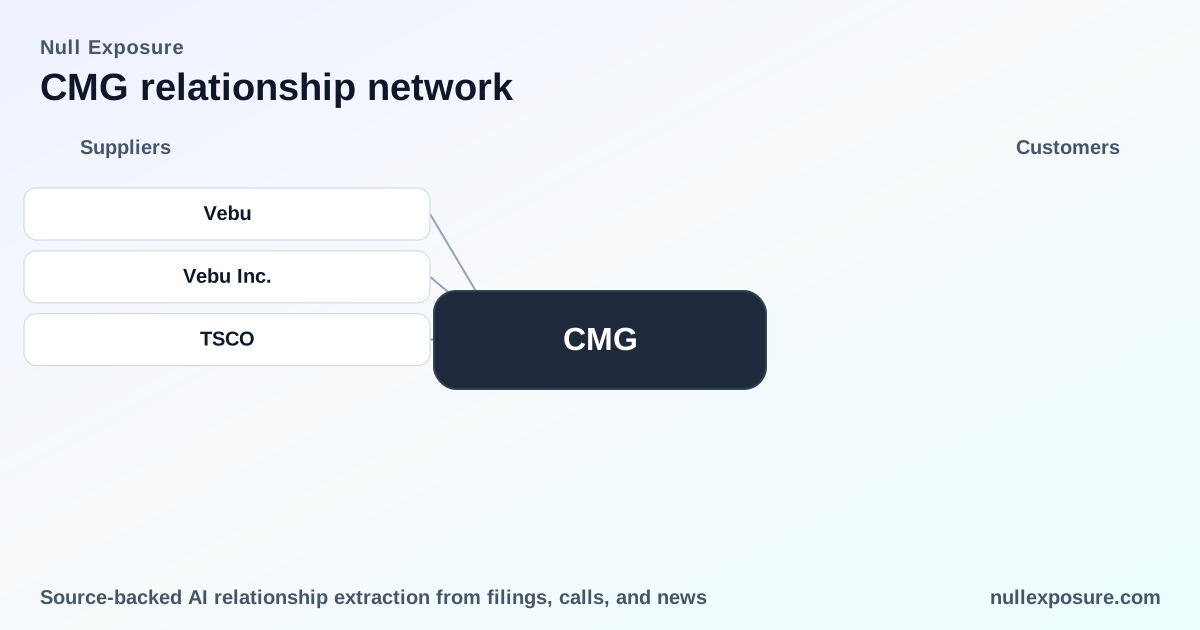
Chipotle (CMG) — Supplier Relationships That Shape Margins and Strategic Optionality
Chipotle monetizes by operating a fast-casual restaurant chain that sells made-to-order tacos and burritos across North America and Europe; revenue is generated directly through restaurant sales and supported by a tightly managed supply chain and selective strategic investments. Supplier relationships are therefore a direct lever on cost, quality, and innovation — both through regular commodity purchases and through equity stakes that embed suppliers into Chipotle’s operating model. For a concise map of supplier interdependencies and governance signals, visit https://nullexposure.com/.
Why suppliers matter to a restaurant operator with strategic investments
Chipotle’s model combines high-frequency retail revenue with selective upstream investments. The 2025 filing shows two distinct supplier modalities in the public record: traditional product suppliers that supply ingredients for restaurants, and a smaller set of strategic technology suppliers in which Chipotle holds equity. These modalities have different implications:
- Procurement and distribution are materially operational. The company uses multiple independently owned regional distribution centers that procure from suppliers selected for quality and price, creating a semi-decentralized distribution posture that supports scale while imposing coordination needs across regions (company-level signal from 10‑K).
- Selective equity stakes align incentives. Chipotle holds preferred shares in at least one supplier (Vebu) and accounts for that investment as a non-marketable equity investment included in long-term investments, indicating a governance influence beyond a typical buyer-supplier contract (documented in the 2025 10‑K).
- Delivery and last-mile are outsourced. Delivery services are fulfilled by third‑party service providers, embedding dependency on external logistics partners for consumer fulfillment (company-level signal).
These characteristics produce a contracting posture that is buyer-oriented but strategically engaged: Chipotle exerts governance influence where the supplier delivers strategic value, while maintaining a distributed supplier network for core inputs.
Supplier-by-supplier: what the 2025 10‑K discloses
Below are the named supplier relationships disclosed in the FY2025 filing, with concise summaries and source notes.
-
Vebu / Vebu Inc. Chipotle is an investor in Vebu Inc., holding preferred shares accounted for as a non‑marketable equity investment included in long‑term investments; purchases from Vebu were listed as $5,561 in 2025, $957 in 2024, and $991 in 2023. According to Chipotle’s 2025 Form 10‑K, Vebu is treated as a related party because Chipotle is a significant customer and maintains board representation. (Source: Chipotle 2025 Form 10‑K, “long‑term investments” and purchases disclosure.)
-
Tractor (inferred symbol: TSCO) Tractor is a material product supplier for Chipotle’s restaurants: purchases from Tractor were $51,953 in 2025, $49,323 in 2024, and $43,555 in 2023, and Chipotle reports it is a significant customer with board representation and accounts for its investment under the equity method. (Source: Chipotle 2025 Form 10‑K, purchases and related-party investment disclosure; symbol inference TSCO.)
What these relationships signal about concentration, criticality, and maturity
Use the following company-level and relationship-level signals to interpret risk and opportunity:
- Concentration and scale: Tractor’s purchase totals are an order of magnitude larger than Vebu’s purchase totals in absolute terms as disclosed, which signals greater procurement concentration around Tractor for core food product supply. This concentration increases operational dependence on Tractor for ingredient flows.
- Strategic criticality vs. supplier maturity: Tractor functions as a mature, high-volume product supplier and also as a strategic partner in which Chipotle exercises governance influence; that combination elevates Tractor’s criticality to operations. Vebu is a strategic technology supplier/investee: the investment and board representation indicate strategic optionality around restaurant automation rather than pure commodity supply.
- Contracting posture and governance: Where Chipotle holds equity and board seats (explicit for both Tractor and Vebu), it transitions from a typical buyer to an investor-partner with formal influence — a structural signal that Chipotle uses governance to secure supply and co-develop capabilities.
- Distribution and service-provider structure (company-level): The 10‑K describes Chipotle’s reliance on multiple independently owned regional distribution centers and third‑party delivery providers. These are company-level features of the operating model that diversify execution risk but also require tight standards and monitoring to protect brand and margins.
Risk and opportunity implications for investors and operators
- Cost and margin sensitivity: Large, recurring purchases from suppliers like Tractor mean procurement disruptions or price inflation at that supplier have direct margin consequences; monitoring volumes and contract terms with Tractor is therefore essential. (Purchases reported in FY2023–FY2025 in the 10‑K.)
- Governance as a risk mitigant and a concentration amplifier: Equity stakes and board seats reduce some counterparty risk by aligning incentives, but they also concentrate Chipotle’s exposure to the supplier’s operating performance and business risk — investors should treat these as strategic concentrations rather than passive procurement relationships.
- Technology upside through Vebu: The equity relationship with Vebu positions Chipotle to capture productivity and labor-cost improvements from restaurant automation; rising purchases from Vebu (noted in 2025) suggest early-stage commercial adoption tied to the investment. (Source: Vebu disclosure in 2025 Form 10‑K.)
- Operational complexity from distribution and delivery: A decentralized distribution network and outsourced delivery model reduce capital intensity but increase the importance of supplier selection and quality oversight — a steady-state operational cost that underpins the brand’s Food with Integrity standards (company-level signals in the 10‑K).
For deeper mapping of these supplier links and governance footprints, explore the supplier intelligence hub at https://nullexposure.com/.
What to watch next (practical indicators)
Investors and operators should monitor the following, drawing directly from the filings and their implications:
- Quarterly procurement trends and any deviations in purchases from Tractor and Vebu versus historical patterns.
- Any changes in the accounting treatment or disclosure language around the equity stakes (e.g., movement from equity-method accounting to consolidation or disposal signals).
- Contract renewals, board‑representation changes, or announcements from Tractor and Vebu that affect supply continuity or strategic roadmaps.
- Indicators of distribution network stress or shifts in third‑party delivery partnerships that could affect unit economics.
Conclusion: supplier relationships as a lever on strategic execution
Chipotle’s 2025 disclosures show a dual approach: scale-dependent procurement from large distributors like Tractor, and targeted, equity-backed partnerships such as Vebu to secure technology advantages. Both modalities are structural to the company’s operating model: procurement concentration drives margin sensitivity, while selective investments create differentiated operating optionality. For ongoing tracking of these supplier linkages and governance signals, see https://nullexposure.com/ — the supplier map is a practical starting point for due diligence and portfolio monitoring.