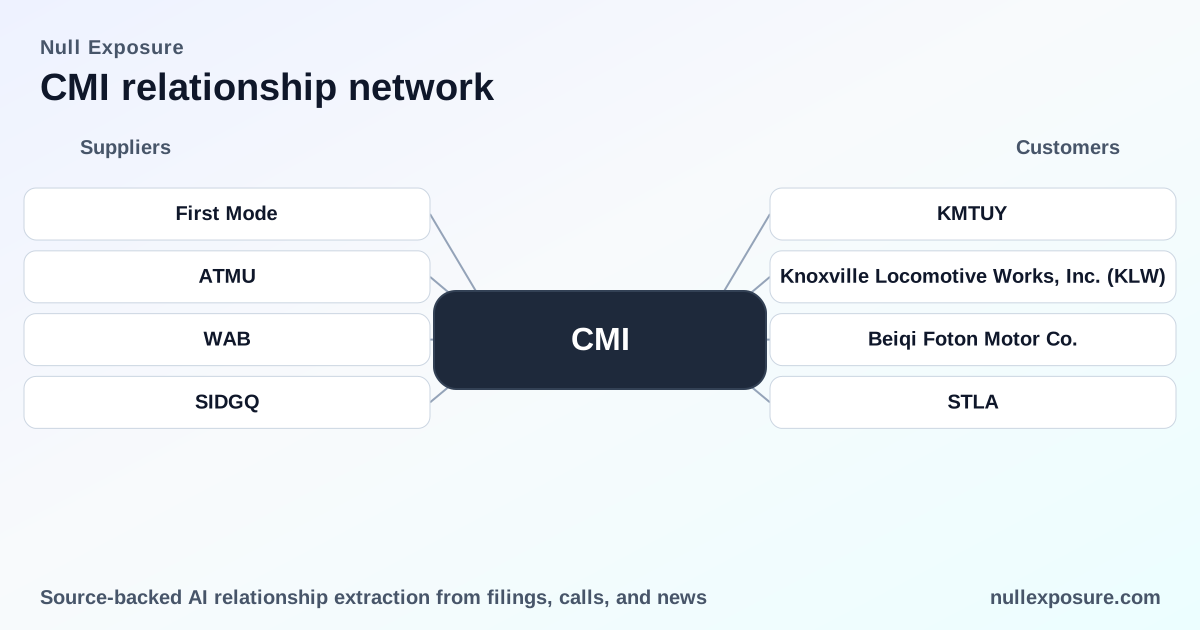
Cummins (CMI) supplier relationships: strategic partners, bottlenecks, and what investors should price in
Cummins operates and monetizes through the design, manufacture and global distribution of diesel and alternative-power engines, filtration and power generation systems, and a broad aftermarket services business that captures recurring revenue from parts and maintenance. With a market capitalization near $75.3 billion and TTM revenue of $33.67 billion, Cummins converts platform-level engineering and component integration into durable margins and aftermarket cash flows. Investors should evaluate supplier relationships as a direct line into Cummins’ product reliability, retrofit strategy and exposure to structural trends such as electrification and longer-life powertrains. For a structured view of supplier risk and partner value, visit https://nullexposure.com/.
What the supplier posture tells investors about Cummins’ operating model
Cummins manages critical inputs through long-term supply agreements that explicitly seek to secure capacity, delivery, quality and predictable cost profiles over extended periods. That contracting posture is a company-level signal: Cummins treats suppliers as strategic assets, locking in continuity where component criticality and manufacturing cadence require stability. The practical implications:
- Contracting posture — long-term: This reduces near-term procurement volatility and supports high-capacity manufacturing plans, but increases the importance of counterparty health and contract renegotiation terms.
- Concentration and criticality: When single suppliers provide differentiated components (alternators, filtration modules, hybrid retrofit systems), a supplier disruption has outsized operational impact and directly affects first-fit and aftermarket revenue.
- Maturity of relationships: The use of long-term agreements indicates established supplier networks and predictable integration, which benefits margins and service reliability across the installed base.
These characteristics drive both resilience and concentrated supplier risk: investors should price the benefit of secured supply against the risk of supplier-specific shocks and long-tail exposure to technological shifts such as electrification or extended component life.
The supplier map investors need to read today
First Mode — retrofit capability and inorganic extension of Cummins’ product set
Cummins acquired assets of First Mode, a leader in retrofit hybrid solutions for mining and rail operations, signaling an acceleration of Cummins’ retrofit and electrified powertrain capabilities. According to the 2025 Q4 earnings call, Cummins completed this asset acquisition to bolster hybrid retrofit offerings and accelerate fielded electrification solutions. Source: Cummins 2025 Q4 earnings call (reported 2026-03-07).
Atmus Filtration Technologies — aftermarket dependence and crowding risk
Analysts flagged Atmus’ heavy dependence on Cummins in FY2026, noting that longer-life engines or migration to electrified systems could reduce replacement demand and pressure Atmus’ valuation. A Simply Wall St piece in FY2026 highlighted Atmus’ exposure to Cummins as a material commercial dependency that investors are monitoring. Source: SimplyWallSt coverage (FY2026).
Wabtec — collaborative development on hybrid drive systems
Wabtec is cited in coverage as a drive system supplier participating in a Cummins–Komatsu initiative to develop hybrid powertrains for heavy mining equipment, indicating strategic component partnerships for electrified heavy equipment. A StockTitan news report in FY2026 described Wabtec’s role in joint hybrid powertrain development with Cummins and Komatsu. Source: StockTitan news (FY2026).
Stamford — alternator integration for genset packages
Cummins’ B4.5 genset package with a Stamford alternator is being positioned as a preferred choice for certain commercial genset markets, showing Cummins’ reliance on specialist alternator suppliers to complete its packaged power products. MarineLink covered this product positioning in FY2026, reinforcing Stamford’s place in Cummins’ genset supply chain. Source: MarineLink (FY2026).
How these relationships translate into financial and operational risk
These supplier relationships demonstrate three converging investment themes:
- Strategic vertical integration and selective M&A: The First Mode asset acquisition is direct evidence that Cummins will use M&A to internalize capabilities critical to electrified and hybrid offerings. That reduces dependency on third-party retrofit suppliers and accelerates product-market fit for retrofit solutions.
- Aftermarket concentration risk: Dependence from suppliers such as Atmus on Cummins as a primary customer is a two-way street — Cummins captures aftermarket economics from its installed base, while suppliers exposed to Cummins create single-counterparty concentration risk that can propagate through the supply network if demand profiles change.
- Component criticality for packaged products: Partnerships with Wabtec (drive systems) and Stamford (alternators) highlight that Cummins’ packaged product reliability rests on a small set of specialized suppliers; supply continuity and contract terms for these parts are direct drivers of product availability and aftermarket service revenue.
Investors should weigh the margin upside from securing supply and integrating retrofit capability against the operational risk of supplier failure and the structural displacement of replacement demand caused by electrification or longer-lasting components.
Visit https://nullexposure.com/ for deeper supplier-level exposure analysis that quantifies concentration and counterparty risk.
Practical investor checklist — signals to watch next
- Contract renewals and length: Monitor disclosures of supplier contract expirations and any move from fixed-price to index-linked components.
- Retrofit and hybrid deployment metrics: Track field conversions and revenue contribution from retrofit products (First Mode integration).
- First-fit demand vs. aftermarket volumes: Watch trends in replacement part volumes and unit lifetimes, which directly affect suppliers like Atmus.
- Supplier health and diversification: Evaluate counterparty financial health and whether Cummins substitutes vendor relationships (e.g., bringing capabilities in-house).
- Regulatory and segment shifts: Heavy mining, rail, and genset markets have different electrification timelines; understand which segments drive Cummins’ supplier choices.
These items are the high-value signals that translate supplier news into earnings risk or upside.
Bottom line and recommended investor actions
Cummins runs a strategically contracted supplier network anchored by long-term agreements that secure capacity and quality, while selectively internalizing capabilities where strategic necessity demands it. The First Mode acquisition and partnerships with Wabtec and Stamford reinforce a product strategy focused on packaged power and retrofit electrification, while supplier concentration — exemplified by Atmus’ dependence on Cummins — creates asymmetric risks that require monitoring.
For investors assessing valuation and operational risk, prioritize disclosures around contract terms, retrofit adoption rates, and aftermarket replacement trends. For a concise, actionable supplier-risk briefing and ongoing monitoring, go to https://nullexposure.com/. If you want a bespoke supplier risk scorecard for Cummins and its ecosystem, the homepage provides the next steps to commission deeper analysis: https://nullexposure.com/.