Cimpress (CMPR) supplier snapshot: audit continuity, centralized procurement and concentrated spend
Cimpress operates a mass‑customization platform that monetizes by taking customer orders for personalized print and merchandise, routing production across company-owned facilities and a broad network of third‑party fulfillers, and capturing margin through scale, cross‑sell and centralized procurement. The company drives revenue from direct and marketplace sales and controls costs by negotiating Cimpress‑wide purchasing frameworks and extending payment terms to manage working capital.
Discover more supplier intelligence at https://nullexposure.com/
The operating posture you need to price in
Cimpress runs a centralized procurement model that negotiates enterprise‑level contracts for major inputs — capital equipment, shipping and raw materials — and then layers a global fulfillment network on top. The company discloses it negotiates Cimpress‑wide contracts and manages framework agreements for large categories, which signals a contracting posture built for scale: centralized sourcing with standardized terms, but operational decentralization through many external fulfillers.
That structure produces several investable characteristics:
- Concentration of spend in a few critical categories. Cimpress reports $260.3 million of purchase commitments for third‑party cloud services and $78.9 million for third‑party fulfillment and digital services, with additional material software and equipment commitments. These figures make cloud and fulfillment vendors high‑impact counterparties for operations and cost control.
- Mixed spend maturity and bands. Commitments range from very large (> $100M) down to sub‑$100k items; this indicates the procurement program runs both long‑term strategic frameworks and many low‑value transactions, increasing operational complexity.
- Active supplier finance and payment management. Cimpress runs a voluntary supply‑chain finance program to extend liquidity to suppliers and has disclosed outstanding obligations with its supply‑chain finance provider of $64,854 and $62,848 as of June 30, 2025 and 2024 respectively, which affects accounts payable composition and short‑term leverage.
- High reliance on external fulfillers. The business explicitly depends on hundreds of third‑party fulfillers for a portion of production, making network availability and vendor performance directly material to revenue delivery.
Collectively, these factors create a procurement profile where centralized contract leverage is balanced by execution risk at the fulfillment edges, and where vendor concentration in cloud and fulfillment services represents the clearest operational and counterparty risk to monitor.
What governance and audit continuity tell investors
Cimpress’ governance choices around its statutory auditor are a signal of established financial controls and continuity. The reappointment of a global Big Four auditor and the board’s control over auditor remuneration are consistent with a mature audit posture that supports reliable financial reporting and capital‑markets engagement.
Documented supplier relationships in the record
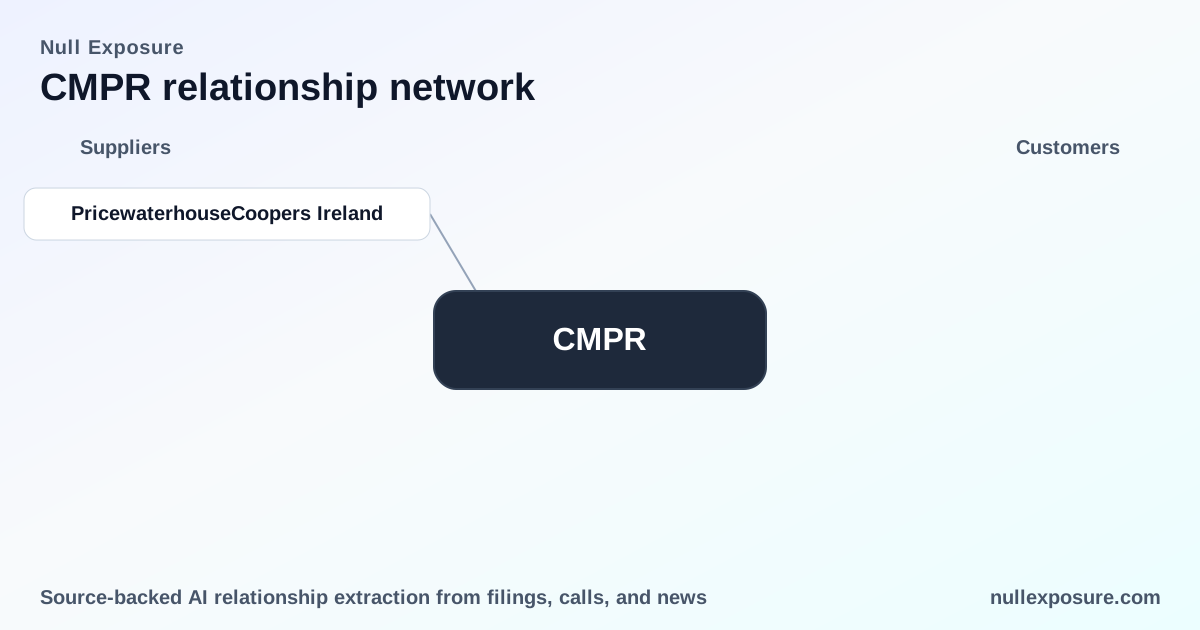
- PricewaterhouseCoopers Ireland — FY2025: Cimpress shareholders approved governance and capital measures and reappointed PricewaterhouseCoopers Ireland as statutory auditor through the 2026 AGM, with auditor remuneration to be set by the board or the audit committee, reinforcing continuity in audit oversight. This was disclosed in a company press release covered by The Globe and Mail in March 2026.
- PricewaterhouseCoopers Ireland — FY2026: Cimpress’ DEF 14A filing describes director reappointments, advisory votes on executive compensation, renewal of share issuance authorities under Irish law, and the appointment and remuneration of its statutory auditor, PricewaterhouseCoopers Ireland, demonstrating the auditor relationship is an explicit agenda item in annual governance filings. This appears in the DEF 14A summary as recorded on StockTitan (SEC filing content).
How the procurement constraints shape risk and upside
The company‑level constraints drawn from Cimpress disclosures describe a supplier ecosystem that is structured and high‑volume:
- Contracting: The procurement team negotiates Cimpress‑wide frameworks for large categories, which delivers bargaining power and lower unit costs but also creates single‑contract dependency risks if a major supplier underperforms.
- Relationship role and stage: External vendors act primarily as service providers and are active partners in day‑to‑day production, from cloud hosting to physical fulfillment, implying operational integration rather than arms‑length spot purchasing.
- Spend profile: The mix of >$100M cloud commitments, $10–100M fulfillment/digital commitments, and multiple lower bands for software, professional fees and equipment shows both scale and fragmentation — a classic setup where headline cost savings depend on a few large contracts while execution risk lives in many small relationships.
These constraints should be read as company‑level signals about procurement sophistication and operational exposure rather than attributes tied to any single vendor unless explicitly noted in a filing.
Discover supplier risk mapping and governance indicators at https://nullexposure.com/
Key takeaways for investors and operators
- Audit continuity with PwC Ireland is a governance positive: a material confirmation of steady financial oversight across AGMs and proxy cycles.
- Cloud and fulfillment vendors are concentration points: monitor contract renewals and service levels for the cloud providers and the largest fulfillment partners; outages or pricing shocks here would disproportionately affect margins.
- Centralized frameworks reduce unit cost but increase single‑point negotiation risk: a large framework gives price leverage but also concentrates counterparty exposure.
- Supply‑chain finance changes cash flow profiles: the voluntary program supports supplier liquidity but shifts cash‑flow timing and short‑term liabilities onto the balance sheet.
- Operational execution is distributed: reliance on hundreds of external fulfillers means operational KPIs (on‑time delivery, quality, capacity) are as important as headline procurement savings.
Final view and action steps
Cimpress’ supplier architecture is clearly engineered for scale — centralized contracting and substantial cloud/fulfillment commitments provide margin leverage, while the extensive third‑party fulfiller base introduces operational and counterparty risk. For investors, the priorities are monitoring major vendor contract renewals and the operational health of the fulfillment network; for operators, focus on SLAs, contingency capacity and the terms of supply‑chain finance.
For deeper supplier intelligence and governance signals, visit https://nullexposure.com/ — our research focuses on supplier relationships that move markets and balance sheets.
If you want a targeted briefing on procurement concentration or audit and governance risks for portfolio diligence, return to our homepage at https://nullexposure.com/ and request a supplier‑level report.