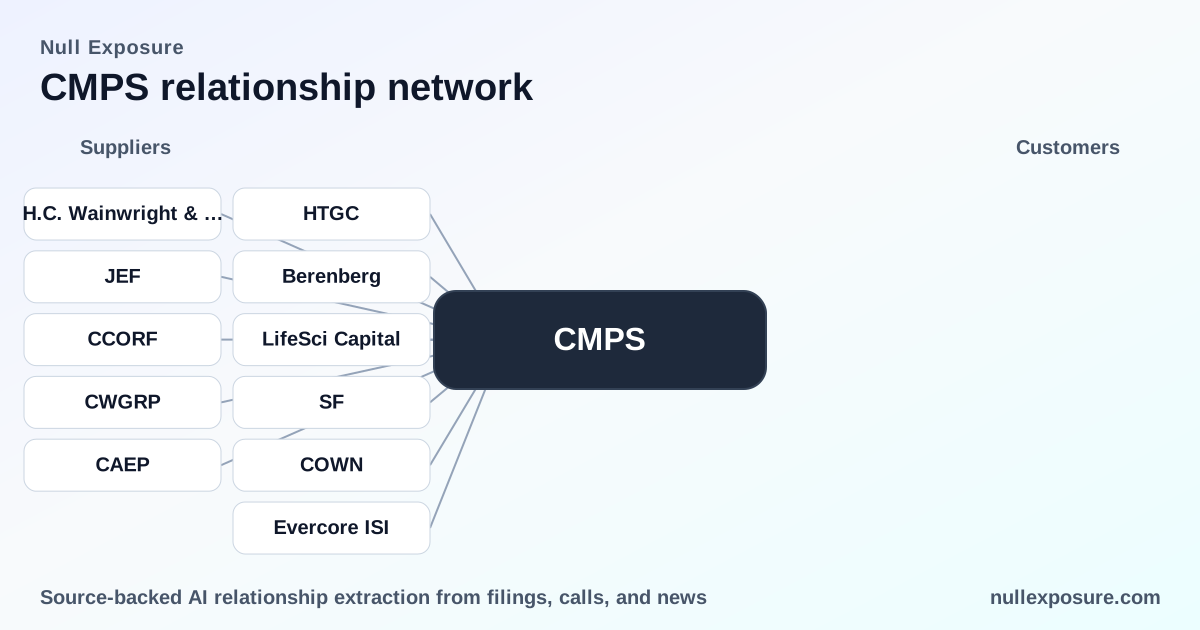
Compass Pathways (CMPS): Supplier map and what the capital markets need to know
Compass Pathways develops and commercializes mental health treatments built around its COMP360 psilocybin formulation; the company currently funds operations through a mix of milestone-driven debt and capital markets activity while relying on third-party manufacturers, clinical CROs and investment banks to execute trials and financing. Revenue remains zero and the company’s capital structure and supplier network are the primary drivers of near-term valuation. For a concise view of supplier and financing counterparties, visit https://nullexposure.com/.
The investing thesis up front
Compass operates as a clinically focused developer rather than a vertically integrated manufacturer: it licenses intellectual property, outsources manufacturing and distribution to contract organizations, and monetizes only when clinical progress converts into regulatory approvals and commercial sales. With a market capitalization around $716 million, negative operating income and zero reported revenue, the company’s value is a function of trial outcomes and the stability of its external manufacturing and financing relationships.
How the supplier footprint shapes risk and runway
Compass’s supplier posture is distinctive and consequential for investors. The company signals long-term contracting patterns (leases and multi-year loans), reliance on licensed IP, and an operational model built around CDMOs/CMOs located in the UK/EMEA. That structure carries clear implications:
- Concentration and criticality: Manufacturing and supply are identified as critical relationships; a disruptive event at a CMO could halt development or commercialization and materially affect financial stability.
- Capital dependence: Compass actively uses milestone-based debt and equity underwritings to extend runway rather than internal cash generation; lender covenants and offering syndicates therefore matter as much as trial readouts.
- Maturity and continuity: Most supplier relationships are active and multi-year, indicating predictability in operations but creating longer tails of exposure if a counterparty fails.
These are company-level signals drawn from contractual excerpts and corporate filings; they are not assigned to an individual supplier unless the source explicitly names that counterparty.
If you want a compact supplier intelligence product built for investors, see https://nullexposure.com/.
Counterparty list — concise takeaways for each relationship
Hercules Capital (HTGC)
Compass amended its term loan with Hercules to expand the facility up to $150 million, with an immediate $50 million draw and milestone‑based tranches; roughly $31.1 million of that draw repaid existing indebtedness. Sources: TradingView reporting the loan amendment and The Globe and Mail press coverage (FY2026).
Berenberg
Berenberg is named among joint book‑running managers for a proposed equity offering tied to Compass’s capital raise plans. Source: market coverage on the offering syndicate reported by Psychedelic Alpha (FY2026).
LifeSci Capital
LifeSci Capital is acting as Compass’s financial advisor in connection with the proposed $150 million public offering, providing advisory services rather than underwriting. Source: BioSpace press release announcing the offering (FY2026).
Stifel (SF)
Stifel is listed as a joint book‑runner on Compass’s proposed equity offering, participating in the syndicate that will place shares into the market. Source: BioSpace press release (FY2026).
TD Cowen (COWN)
TD Cowen is named as a joint book‑runner on the proposed offering; the firm’s role increases distribution capacity for the raise. Source: BioSpace press release (FY2026).
Evercore ISI
Evercore ISI is included among joint book‑running managers for the offering, adding senior advisory and placement resources. Source: Psychedelic Alpha summary of the syndicate (FY2026).
H.C. Wainwright & Co.
H.C. Wainwright is identified as a lead manager and co‑manager in different notices, indicating a prominent placement role in the equity transaction. Source: Psychedelic Alpha and BioSpace reporting on the offering (FY2026).
Jefferies (JEF)
Jefferies appears as a joint book‑runner for the proposed public offering, part of the institutional syndicate handling distribution. Source: BioSpace press release (FY2026).
Canaccord Genuity (CCORF)
Canaccord Genuity is cited as the lead manager for the offering in certain announcements, suggesting a central role in pricing and marketing the deal. Source: Psychedelic Alpha coverage of the offering (FY2026).
Cowen (CWGRP)
Cowen is listed among joint book‑running managers alongside Evercore and Berenberg, sharing underwriting responsibility for the transaction. Source: Psychedelic Alpha reporting (FY2026).
Cantor (CAEP)
Cantor is included in the joint book‑runner group for the proposed offering, contributing distribution and syndicate capacity. Source: BioSpace press release (FY2026).
Hercules Capital, Inc. (duplicate listing)
Additional press noted that as of the facility amendment, $50 million had been drawn and the expanded facility contains five milestone‑based tranches; this confirms both the structure and the immediate cash infusion. Source: InvestingNews and The Globe and Mail (FY2026).
What this pattern means for investors: runway, dilution and operational exposure
- Runway extension via structured debt: The Hercules amendment provides near-term liquidity through tranches tied to milestones; this reduces immediate financing pressure but transfers execution risk to meeting those milestones.
- Equity dilution on the table: A proposed $150 million public offering with a broad syndicate of book‑runners and managers signals parallel reliance on equity markets to fund operations, creating dilution risk for existing holders.
- Manufacturing is the operational chokepoint: The company’s disclosures identify CMOs as critical and material counterparties; regulatory non‑compliance or supply disruption at a CMO would have outsized operational and financial consequences.
- Long‑term contracting posture: Leases and loan maturities are multi‑year, which provides stability but also locks the company into fixed commitments that amplify downside if trials falter.
For a tailored view of how these counterparties affect NAV and dilution scenarios, start here: https://nullexposure.com/.
Practical next steps for portfolio managers and operators
- Monitor Hercules tranche triggers and covenant language in real time; lender behavior determines whether the $150 million facility actually unfolds as planned.
- Track book‑runner and lead manager pricing signals during the offering roadshow: syndicate composition and allocation patterns reveal investor appetite and expected dilution.
- Verify CMO regulatory status and redundancy plans: manufacturing risk is binary and value-determining—confirm secondary suppliers and buffer inventories.
If you need a supplier‑first perspective that combines financing and operational risk, visit https://nullexposure.com/ for more.