Compass Therapeutics (CMPX): the supplier map that underwrites clinical progress
Compass Therapeutics operates as a clinical-stage oncology antibody developer that monetizes progress through equity financings, underwritten public offerings, and eventual partnering or licensing of successful assets; the company is pre-revenue and funds R&D through capital markets activity and strategic transactions rather than product sales. Compass outsources core execution—drug substance and drug product manufacturing, GLP/cGCP studies, and trial operations—to third-party CDMOs and CROs, and routinely leans on investment banks for capital raises and market coverage. For investors and procurement operators, the commercial reality is clear: Compass is capital-market–driven and heavily dependent on external service providers for execution. Learn more at https://nullexposure.com/.
How Compass structures its supplier relationships in practice
Compass’s operating model follows the archetype of small-cap biotech: lean internal R&D and externalized manufacturing and trial operations. The company has non-cancelable short-term manufacturing commitments with CDMOs for clinical materials, and it relies on a range of service providers—CROs, clinical sites, laboratories and information‑security auditors—to run studies and manage operational risk. This posture produces four practical characteristics for suppliers and partners:
- Contracting posture: short-term, execution-focused. Manufacturing commitments are transactional and tied to clinical milestones rather than long-run supply agreements.
- Concentration and criticality: high. Loss or failure of third‑party manufacturers would have a material adverse effect on development timelines and program viability.
- Maturity: typical for clinical-stage biotech. Relationships are established to support near-term trials rather than integrated, long-term commercial supply.
- Geography: global trial footprint potential. Compass states intention to conduct clinical work in overseas jurisdictions, creating cross-border regulatory and logistics requirements.
Those signals matter for procurement: prioritize redundancy in CDMO capacity, insist on rapid escalation clauses, and verify regulatory compliance evidence early.
The capital markets and underwriting relationships that enable operations
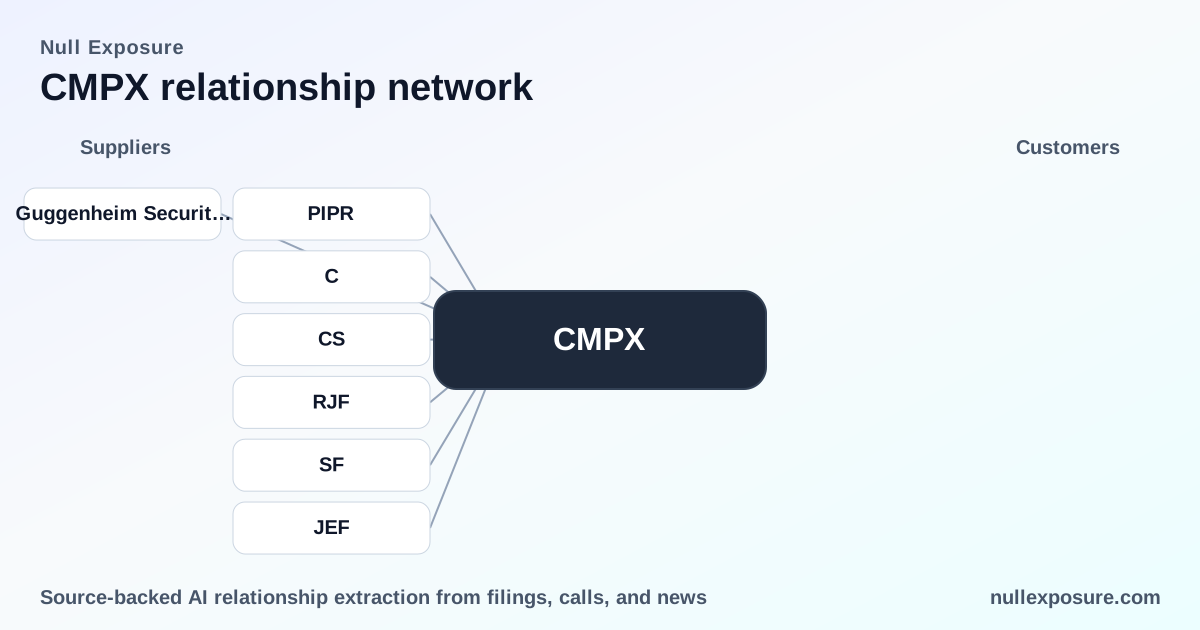
Compass’s supplier ecosystem includes professional services beyond bench work—most notably investment banks that underwrite equity and provide analyst coverage. Underwriting partners and research coverage help unlock the cash that funds CDMO and CRO spend. The relationships visible in the public record are transactional and revolve around offerings and coverage; they directly influence timing and scale of Compass’s ability to pay suppliers.
Detailed relationship summaries (complete inventory)
A GlobeNewswire release dated August 12, 2025 lists Jefferies as a joint active bookrunning manager on a proposed public offering with Compass, indicating Jefferies participated in structuring and running that capital raise. (GlobeNewswire, Aug 12, 2025)
A GlobeNewswire release dated August 12, 2025 identifies Piper Sandler as a joint active bookrunning manager for the same offering, reflecting Piper Sandler’s role in syndicating new equity for Compass. (GlobeNewswire, Aug 12, 2025)
Guggenheim Securities is named in the same August 12, 2025 GlobeNewswire notice as a joint active bookrunning manager, confirming it participated in underwriting Compass’s public offering activity. (GlobeNewswire, Aug 12, 2025)
A MarketBeat instant alert from January 31, 2026 notes that Citigroup acted as one of the underwriters on Compass’s IPO and has been associated with the company’s capital markets activity and analyst commentary. (MarketBeat, Jan 31, 2026)
Credit Suisse is reported in the January 31, 2026 MarketBeat alert as an underwriter on Compass’s IPO, establishing Credit Suisse as a capital markets counterparty to the company. (MarketBeat, Jan 31, 2026)
Stifel is listed in the January 31, 2026 MarketBeat alert among the underwriters for Compass’s IPO, marking Stifel’s participation in initial and follow-on equity placement activity. (MarketBeat, Jan 31, 2026)
A separate MarketBeat note on January 27, 2026 repeats Raymond James’s involvement as a co-manager on the IPO, indicating Raymond James provided distribution support and research coverage around Compass’s public market debut. (MarketBeat, Jan 27, 2026)
The January 27, 2026 MarketBeat alert also restates Citigroup’s underwriting role in the IPO in connection with analyst coverage and the firm’s syndicate responsibilities. (MarketBeat, Jan 27, 2026)
That same Jan 27, 2026 MarketBeat article again documents Credit Suisse’s role as an IPO underwriter for Compass, reinforcing the bank’s role across Compass’s capital-raising events. (MarketBeat, Jan 27, 2026)
The Jan 27, 2026 MarketBeat item reiterates Stifel’s participation as an underwriter and syndicate member on Compass’s IPO, confirming repeated market references to Stifel in the company’s financing history. (MarketBeat, Jan 27, 2026)
A MarketBeat instant alert from January 31, 2026 and related coverage show Raymond James also noted elsewhere as a co-manager and analyst contributor to Compass’s public market narrative, underscoring the firm’s role in investor relations and distribution. (MarketBeat, Jan 31, 2026)
What these relationships imply for investors and sourcing teams
The record is unambiguous: Compass’s ability to fund R&D and meet supplier obligations is directly tied to active relationships with investment banks that underwrite and place equity. Underwriting partners listed above have performed both bookrunning and co-manager functions across offerings and IPO activity, providing distribution capacity and analyst coverage that underpin cash flow expectations. For suppliers, that means counterparty credit risk is correlated with the success and depth of these capital market relationships.
From an operational standpoint, the constraints filed by Compass give clear guidance:
- Short-term contract type: Manufacturing commitments are non-cancelable but finite, indicating CDMO agreements are transactionally structured around clinical-material needs rather than long-term supply. This is a company-level signal about contracting posture.
- Global geography: The company signals potential overseas trials, which increases regulatory and logistic exposure for CRO and manufacturing partners.
- Materiality: Compass explicitly states that loss of third-party manufacturers would be materially adverse, so supplier continuity is a core enterprise risk.
- Service-provider and manufacturer roles: CDMOs and CROs are primary external execution partners; Compass also relies on external security auditors and waste‑disposal vendors as part of its service ecosystem.
These are operational constraints investors should bake into scenario models and that procurement teams must translate into contractual protections and contingency planning. If you manage counterparty exposure, prioritize suppliers with verified capacity and cross-jurisdictional experience.
Learn how to convert supplier intelligence into actionable sourcing decisions at https://nullexposure.com/.
Bottom line and next steps
Compass is a capital-dependent clinical-stage biotech where third-party manufacturers and CROs are mission-critical, and underwriting banks are the financial lifeline that funds that mission. For investors, underwriter relationships and analyst coverage drive financing runway and thus the probability of milestone delivery; for operators and procurement leads, short-term CDMO commitments and global trial plans require operational redundancy and strict compliance oversight.
If you evaluate supplier risk, competitor exposure, or underwriting partnerships for life‑science ventures, start with structured supplier intelligence and financing-readiness assessments. Visit https://nullexposure.com/ for targeted analysis and tools to operationalize these signals.