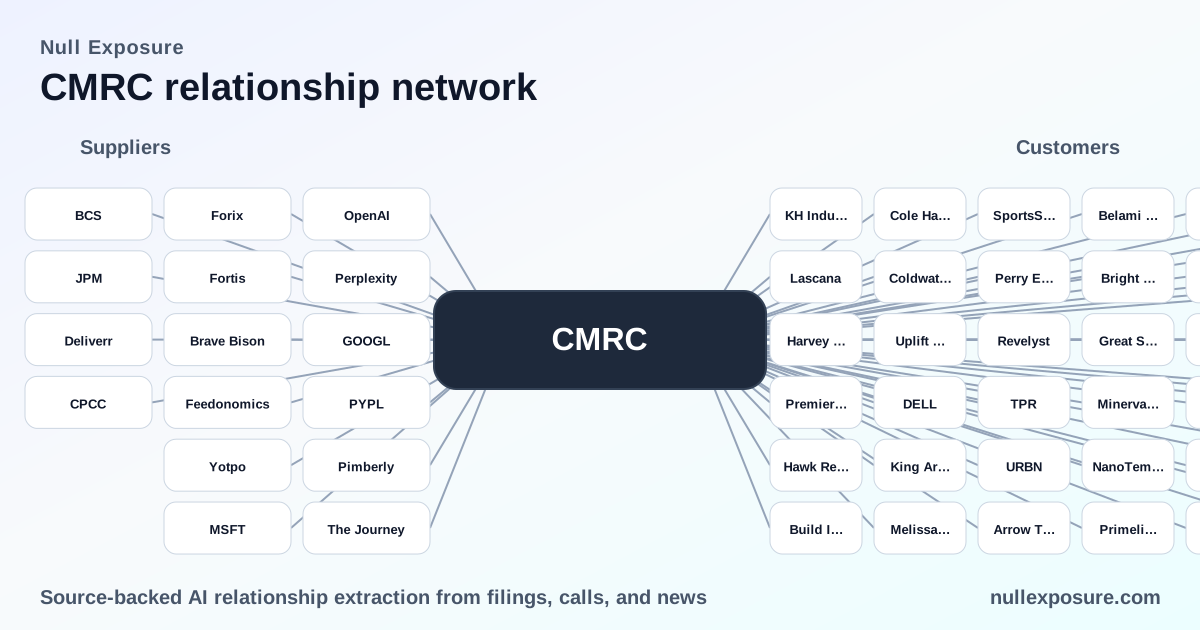
Commerce.com (CMRC) — supplier relationships that shape monetization
Commerce.com operates a SaaS e‑commerce infrastructure that sells platform access, integrations, and value‑added services to merchants and agencies; it monetizes through subscription fees, platform transaction/embedded payments revenue, and upsells for AI and data orchestration features. The company is positioning itself as a unified commerce infrastructure layer that drives higher ARPU through partnerships with cloud, payments, AI and feed‑management vendors. Learn more about supplier risk and opportunity at https://nullexposure.com/.
Why the partner map drives the investment thesis
Commerce.com’s ability to convert platform users into higher‑margin customers depends on integrations and co‑sell relationships with dominant cloud and payments providers. Google Cloud and Feedonomics strengthen product discovery and AI experiences; PayPal, Stripe and Fortis extend payments monetization; and AI relationships (OpenAI, Microsoft, Perplexity) underpin platform differentiation in search and agentic commerce. These relationships are not cosmetic—management cites them on the Q4 2025 earnings call and in press releases as part of a product strategy to improve merchant performance and enable new revenue streams.
If you’re modeling upside from improved monetization or evaluating supplier concentration, see detailed supplier mappings and sourcing notes at https://nullexposure.com/.
What the contracts and hosting posture tell investors
Commerce.com reports non‑cancellable third‑party service commitments that run one to four years, a signal that some supplier relationships are contractual and medium‑duration rather than purely partnership announcements. Separately, management confirms that the majority of platform functions are hosted on Google Cloud Platform in the U.S., positioning Google Cloud as a critical service provider for uptime and operational continuity.
These constraints imply:
- Contracting posture: medium‑term, binding commitments create predictable cost structure but reduce operational flexibility.
- Concentration and criticality: heavy reliance on Google Cloud increases single‑provider operational risk but also creates leverage for product performance.
- Maturity: the presence of signed, non‑cancellable commitments indicates enterprise‑grade vendor relationships rather than experimental integrations.
Midway through your diligence process, review supplier concentration scenarios and outage sensitivity at https://nullexposure.com/.
Vendor relationships that matter — a plain‑English breakdown
Below are every supplier relationship referenced in recent company disclosures and media coverage, with concise summaries and sources.
-
OpenAI — Commerce expanded partnerships to position itself as an AI‑ready infrastructure layer that can surface merchant data to generative models, according to the Q4 2025 earnings call. (Q4 2025 earnings call, March 2026)
-
Perplexity — Commerce delivers pre‑optimized structured product data to Perplexity so LLM‑based search better recognizes merchants’ SKUs and favors the brand, as noted in the company’s FY2025 press release and earnings discussion. (GlobeNewswire July 31, 2025; Q4 2025 earnings call)
-
Microsoft (Copilot) — Management lists Microsoft Copilot among AI partners used to position Commerce for agentic shopping and AI search capabilities. (Q4 2025 earnings call, March 2026)
-
Google / Google Cloud / Google Gemini — Commerce deepened a partnership with Google Cloud to accelerate merchant performance using Google’s next‑generation AI tools and integrates with Google Gemini for AI shopping experiences. (GlobeNewswire July 31, 2025; Q4 2025 earnings call)
-
PayPal — Commerce introduced BigCommerce Payments powered by PayPal and highlights PayPal Fastlane integrations for improved checkout and merchant conversion. (GlobeNewswire July 31, 2025; Q4 2025 earnings call)
-
Stripe — BigCommerce integrated Stripe’s Agentic Commerce Suite to give merchants an easy path to connect product catalogs to multiple AI shopping agents, cited in multiple press reports. (December 18 integration referenced in Yahoo Finance and InsiderMonkey coverage, FY2026 reporting)
-
Feedonomics — Commerce relies on Feedonomics for data enrichment and feed orchestration to streamline product feeds for Google’s AI experiences and improve direct checkout conversion. (InsiderMonkey and TradingView coverage, FY2026)
-
Fortis — Commerce announced a strategic partnership to integrate embedded payments technology for BigCommerce customers, a move framed as a payments monetization step in market commentary. (SimplyWall / market commentary, FY2025–FY2026 reporting)
-
Forix — A Commerce agency partner that collaborated on a merchant storefront launch, including a custom shipping app to improve service and transparency for clients. (GlobeNewswire July 31, 2025)
-
Pimberly — Product Information Management provider Pimberly worked with Commerce and agency partners on the “Branch of the Future” accelerator to digitize building merchants’ operations. (GlobeNewswire July 31, 2025)
-
Brave Bison — Digital agency Brave Bison collaborated with Commerce on the industry accelerator that bundles PIM and consultancy services for merchants. (GlobeNewswire July 31, 2025)
-
The Journey — Construction industry consultant The Journey is a collaborator in the “Branch of the Future” accelerator to future‑proof building merchants. (GlobeNewswire July 31, 2025)
-
Deliverr — Commerce’s Channel Manager supports 2‑day delivery via Deliverr, improving marketplace channel performance and customer experience. (StockTitan coverage, FY2026)
-
Yotpo — Listed in partner news as an Elite Partner in the broader BigCommerce ecosystem for reviews, UGC and loyalty capabilities that merchants can adopt. (StockTitan / partner ecosystem reporting, FY2026)
-
Feedonomics (additional note) — Market reports reiterate Feedonomics’ role in product feed optimization and direct checkout enablement across Google Search and Gemini. (Yahoo Finance and TradingView coverage, FY2026)
-
Barclays and J.P. Morgan — Named as lead managers in financing/underwriting activity related to partner or ecosystem announcements referenced in market summaries. (StockTitan reporting, FY2026)
Each of these relationships is documented in company filings, press releases, or market coverage cited above.
Investment implications — what to watch
- Upside driver: AI integrations and feed orchestration create a clear path to higher ARPU through value‑added services and embedded payments. The network effect from large cloud and payments partners accelerates merchant adoption.
- Key risk: concentration on Google Cloud for hosting and the existence of multi‑year non‑cancellable commitments increase operational and switching risk. Monitor contract expiries (1–4 year window) and any public commentary on renegotiation or rehosting.
- Revenue mix sensitivity: Payments partners (PayPal, Stripe, Fortis) introduce revenue share and regulatory complexity; listings with marketplace logistics partners (Deliverr) influence merchant retention.
For a deeper supplier risk model and interactive mapping, visit https://nullexposure.com/.
Final read for operators and allocators
Commerce.com’s supplier strategy is deliberate: combine cloud scale, AI partners, feed orchestration, and embedded payments to convert platform scale into higher‑margin services. The commercial partnerships are strategic rather than ornamental, but they come with binding operational commitments and concentration that must be modeled explicitly. For investors and procurement teams, the immediate focus is on contract rollovers with Google Cloud and the pace of merchant uptake of embedded payments and Feedonomics‑enabled offerings.
If you want a concise supplier risk brief or a customizable map for diligence, start here: https://nullexposure.com/.