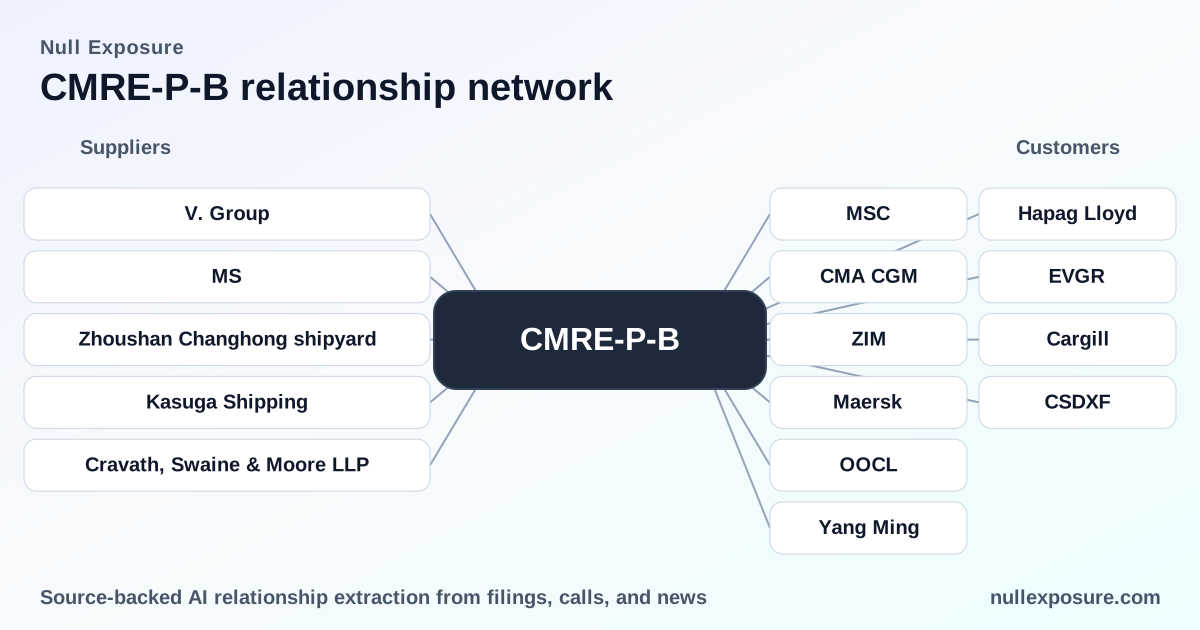
Costamare (CMRE-P-B): Supplier relationships and what they signal for investors
Costamare monetizes a global containership fleet by operating vessels under multi-year time charters to liner operators, renewing and upgrading the fleet through targeted newbuild programs and opportunistic second-hand acquisitions, and supporting corporate actions with external financial and legal advisors; CMRE-P-B is the Perpetual Preferred Stock Series B issued by Costamare, representing a capital-structure claim layered above common equity. For investors and operators, the key drivers are charter durability, third‑party fleet management and shipyard delivery risk, and the company’s use of advisors during restructurings or strategic transactions. Learn more on the company overview at https://nullexposure.com/.
Why these supplier links matter to holders of CMRE-P-B
Costamare’s economics depend on stable charter revenue and disciplined capital allocation. Supplier relationships — from ship managers to shipyards and financial advisors — are operational levers that directly affect uptime, delivery schedules and transaction execution. When management outsources technical management, commits newbuilds or engages marquee advisors, those are business signals: they shape cashflow predictability and downside resilience for preferred claims.
Explore deeper relationship intelligence at https://nullexposure.com/.
The supplier and advisor relationships in the public record
V. Group — ship management across China and Greece (FY2020)
Costamare engaged V. Group to provide a range of ship management and related maritime services from Shanghai and Greece for 41 container ships linked to Costamare, reflecting broad operational outsourcing across geographies. According to a Greek business report from FY2020, V. Group’s footprint covers technical and crew management for a sizeable portion of the fleet. (NewMoney, FY2020 — https://www.newmoney.gr/roh/palmos-oikonomias/business-stories/kostis-konstantakopoulos-kratai-stivara-to-timoni-tis-costamare-pou-giortazi-ta-45-chronia-tis/)
Morgan Stanley & Co. LLC — financial advisor for a spin-off (FY2025)
Morgan Stanley served as Costamare’s financial advisor in connection with the announced spin-off of the dry‑bulk business, signaling use of top-tier investment-bank expertise during corporate reorganizations. StockTitan coverage notes Morgan Stanley’s advisory role in FY2025. (StockTitan / news coverage, FY2025 — https://www.stocktitan.net/news/CMRE/costamare-inc-announces-spin-off-of-its-dry-bulk-awu8rqs97rea.html)
Cravath, Swaine & Moore LLP — legal counsel on corporate transactions (FY2025)
Costamare retained Cravath, Swaine & Moore LLP as legal counsel in the same spin-off process, indicating reliance on elite international legal advice for transactional and governance complexity. This engagement ran alongside Morgan Stanley’s advisory mandate in FY2025. (StockTitan / news coverage, FY2025 — https://www.stocktitan.net/news/CMRE/costamare-inc-announces-spin-off-of-its-dry-bulk-awu8rqs97rea.html)
Zhoushan Changhong Shipyard — newbuild program counterparty (FY2026)
Costamare contracted Zhoushan Changhong shipyard for six 3,100 TEU containership newbuilds scheduled for 2027–28, with deliveries fully secured by eight‑year time charters to a leading liner operator, tying newbuild risk to long-term charter revenue. Intellectia’s FY2026 report captures the newbuilding program and the charter backing. (Intellectia / FY2026 earnings preview — https://intellectia.ai/news/stock/costamare-to-release-q4-2025-earnings-on-february-18-2026)
Kasuga Shipping — second‑hand acquisition counterparty (FY2026)
Costamare agreed to acquire the Koushun, a 2018-built 60,297 dwt ultramax bulk carrier from Japan’s Kasuga Shipping (to be renamed Astros), representing opportunistic asset acquisition activity in the bulk segment as part of fleet renewal. IndexBox reported the purchase and expected first‑half 2026 delivery. (IndexBox / FY2026 fleet renewal coverage — https://www.indexbox.io/blog/costamare-bulkers-acquires-2018-ultramax-sells-two-older-vessels-in-fleet-renewal/)
What these relationships collectively tell investors
- Operational outsourcing is material. The V. Group engagement for 41 vessels signals that Costamare uses third‑party managers for scale and geographic coverage, shifting technical risk to specialists while retaining commercial control.
- Corporate actions are handled by top-tier advisors. The engagement of Morgan Stanley and Cravath for the FY2025 spin-off shows the company pursues high-quality advisory resources when executing complex restructurings — a positive for execution risk management.
- Fleet renewal mixes secured newbuilds and opportunistic buys. Contracting Zhoushan Changhong with time‑charter backing reduces delivery risk for newbuilds, while acquisitions like Kasuga Shipping’s ultramax demonstrate active asset‑level rotation to optimize age and cashflow.
- Counterparty risk is diversified but execution-sensitive. Multiple counterparties across management, shipyards and sellers spread risk, yet each relationship brings discrete delivery, warranty and operational milestones that affect cashflow timing.
For a consolidated look at how these supplier relationships impact capital claims, visit https://nullexposure.com/.
Constraints and operating-model signals (company-level)
Even though there are no formal constraint excerpts in the record, the relationship set produces clear company‑level signals:
- Contracting posture: Costamare uses a mix of long‑duration time charters and external managers, suggesting a preference for predictable, charter-backed cashflows while delegating technical operations.
- Counterparty concentration: Management relationships appear concentrated among leading providers and respected shipyards; concentration reduces onboarding complexity but increases dependency on a small set of counterparties for uptime and delivery.
- Criticality: Shipyard delivery schedules and charter duration are materially critical to near‑term cashflow; delays or counterparty underperformance would affect revenue coverage for preferred dividends.
- Maturity: Engagements with established banks and law firms for structural transactions indicate a mature corporate governance posture and readiness for complex reorganizations.
These signals matter to preferred-stock holders because they influence dividend coverage stability and downside recovery prospects in stressed markets.
Practical takeaways for investors and operators
- Preferred security sensitivity is operationally anchored. Preferred claims like CMRE-P-B benefit when newbuilds are charter‑backed and when technical management is delegated to reputable operators.
- Execution risk is the watch item. Monitor shipyard delivery progress and legal/financial advisory timelines during corporate actions; these are the proximate drivers of balance‑sheet and cashflow outcomes.
- Diversified counterparties but limited slack. A small number of high‑quality suppliers increases execution efficiency but reduces redundancy if one counterparty fails to perform.
If you want to track how supplier and advisor relationships evolve for Costamare and other issuers, start your research at https://nullexposure.com/.
Conclusion: what to watch next
For holders and potential buyers of CMRE-P-B, the operational and advisory footprint is constructive: long-term charters and elite advisors reduce execution risk, while shipyard and acquisition activity demonstrates active fleet management. The principal near‑term risks are shipyard delivery timing and the performance of third‑party managers; both are monitorable and reported in periodic filings and press coverage. For continuous monitoring and supplier‑level signals, visit https://nullexposure.com/ for updates and deeper supplier profiling.