Costamare (CMRE-P-D): supplier relationships that matter to investors
Costamare’s Preferred Series D (CMRE-P-D) represents a capital structure stake in a traditional containership owner that monetizes its fleet through long-duration charters and spot voyages, while extracting margin from disciplined fleet utilization and cost control. As a supplier-focused review, this note outlines the external service partners that underpin vessel operations and what those partnerships imply for cash flow stability, operational continuity, and counterparty concentration. For a full view of related supplier intelligence, visit https://nullexposure.com/.
How Costamare earns and why suppliers matter
Costamare owns and charters containerships to liners and third-party charterers; preferred shares like CMRE-P-D are positioned to capture a relatively stable income stream backed by the company’s fleet economics rather than upside from freight rate cyclicality. Operational reliability depends on third‑party technical management, crewing and on‑shore support—areas where selected suppliers effectively sit between the owner and the vessel’s performance. These supplier agreements are therefore operationally critical and are a non‑trivial driver of service continuity and cost predictability. Learn more at https://nullexposure.com/.
Supplier relationships identified in public coverage
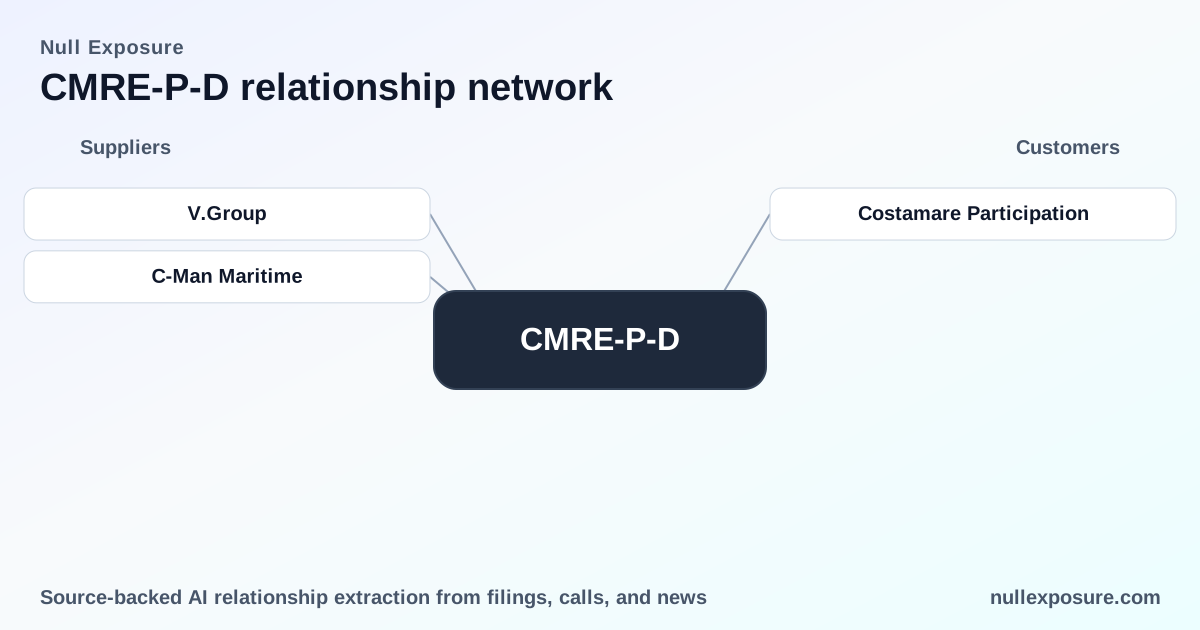
V.Group — strategic technical and fleet-management partner
According to multiple news reports that recount an FY2020 expansion, V.Group was contracted to provide a range of management and marine services from Shanghai and Greece to 41 container vessels linked to Costamare, reflecting a strategic outsourcing of technical and commercial support functions for a significant portion of the fleet (VesselFinder, 2026; Tharros News recounting FY2020). This relationship implies reliance on a large third‑party manager for vessel operations and maintenance, which supports steady uptime but creates counterparty concentration. (VesselFinder: https://www.vesselfinder.com/news/19376-VGroup-and-Costamare-Shipping-Company-SA-expand-existing-strategic-partnership; Tharros News: https://www.tharrosnews.gr/2020/12/o-kostis-konstantakopoulos-krataei-stivara-to-timoni-tis-costamare-pou-giortazei-ta-45-chronia-tis/)
Key takeaway: outsourcing to a global manager like V.Group drives operational scale and standardized practices across ships, but concentrates operational risk with a single manager for many vessels.
C‑Man Maritime — a crewing and manning channel
VesselFinder reported that the V.Group arrangement includes an enhancement of manning services in the Philippines through C‑Man Maritime, with Filipino crew supplied for Costamare‑managed vessels. This is a focused, labor‑supply relationship that underpins day‑to‑day ship operations and compliance with crewing standards (VesselFinder, 2026). (VesselFinder: https://www.vesselfinder.com/news/19376-VGroup-and-Costamare-Shipping-Company-SA-expand-existing-strategic-partnership)
Key takeaway: reliance on regionally concentrated manning providers creates operational dependency on crewing pipelines and regulatory environments in labour source countries.
What the relationships imply about Costamare’s operating model
- Contracting posture: Costamare outsources technical management and crewing to seasoned third‑party specialists rather than vertically integrate these functions, which supports capital efficiency and predictable opex while leaving operational delivery in the hands of vendors.
- Concentration vs. diversification: Assigning management of dozens of vessels to a single global manager creates scale benefits but also counterparty concentration that investors must monitor—particularly for events that could disrupt the manager’s global operations.
- Criticality of suppliers: Technical managers and manning agents are mission‑critical suppliers; failures or disruptions directly affect vessel availability, off‑hire exposure and charter revenue.
- Maturity and sophistication: Partnering with large, established managers and established manning channels signals a mature contracting approach aimed at continuity and regulatory compliance rather than experimental vendor strategies.
Risk profile investors should track
Costamare’s supplier structure focuses risk into a small set of operational providers; investors should actively monitor:
- Counterparty health of major managers (e.g., V.Group) — financial or reputational issues at a manager can have immediate operational consequences.
- Crew supply and labour regulation shifts — changes in crewing law or supply bottlenecks in key jurisdictions (the Philippines in this case) affect voyage schedules and cost.
- Contract terms and exit friction — long‑running, bespoke management agreements can be sticky; investors should watch contract tenors, termination rights and service SLAs.
- Geopolitical and port disruption exposure — managers with regional hubs concentrate operational risk if a hub is affected by sanctions, pandemic measures, or port congestion.
Bold operational risk: supplier concentration increases the likelihood that a single third‑party event results in multi‑vessel impact rather than isolated vessel incidents.
Midway check: if you are evaluating counterparty exposure or preparing a due‑diligence memo, detailed supplier disclosures and contract excerpts are essential—see full supplier analysis tools and dashboards at https://nullexposure.com/.
How to use this supplier information in investment decisions
- Validate cash‑flow assumptions against operational uptime scenarios that incorporate supplier disruption (stress test for 5–15% off‑hire).
- Obtain contract-level summaries: termination rights, performance penalties, and insurance arrangements that allocate liability for operational failures.
- Monitor news flow and vendor financials for signs of deterioration; management commentary that increases outsourcing scope should trigger a reassessment of counterparty concentration.
Bottom line — what CMRE‑P‑D holders should conclude
Costamare’s operating model leans on established external managers and regional manning partners to deliver fleet availability and cost discipline. That model supports predictable preferred‑share income streams but concentrates operational exposure with a few suppliers. For investors in CMRE‑P‑D, the priority is active counterparty monitoring and obtaining contract transparency where possible. For a centralized view of supplier exposure and to subscribe to ongoing updates, visit https://nullexposure.com/.
Action items for investors:
- Request vendor contract summaries during diligence.
- Incorporate supplier concentration into scenario analysis.
- Monitor V.Group and regional manning ecosystems for operational alerts.
Bottom‑line recommendation: treat supplier relationships as first‑tier operational risks that are as material to preferred‑share stability as charter contract duration. For deeper supplier mapping and continuous supplier monitoring, go to https://nullexposure.com/.