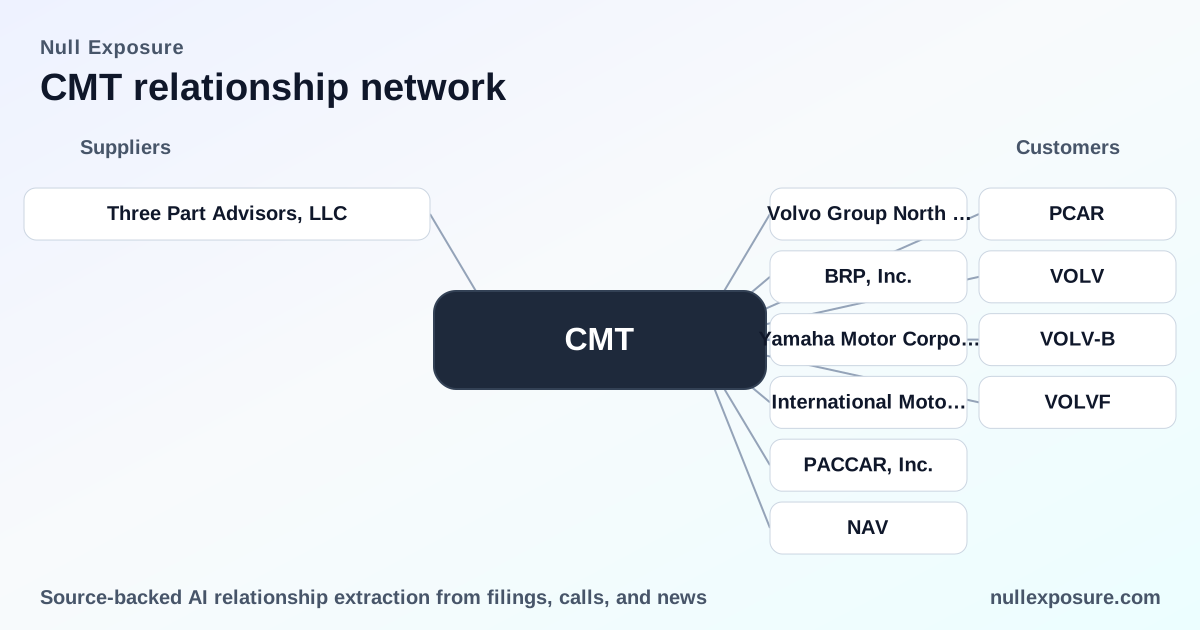
Core Molding Technologies (CMT): Supplier risk and relationship review
Core Molding Technologies manufactures thermoplastic and thermoset structural components and monetizes through contract manufacturing and direct sales of molded parts to OEM and industrial customers; revenue is generated from volume production, tooling and molding services, and aftermarket repeat business. The company’s operating leverage is modest — thin operating margins and material exposure to raw-material inputs define how suppliers and procurement shape financial outcomes. For more structured supplier intelligence on CMT, visit https://nullexposure.com/.
How CMT runs the manufacturing side and why suppliers matter
CMT is a classic specialty-molding operator: capital-intensive tooling and molding lines deliver recurring manufacturing revenue (Revenue TTM: $273.8M), while gross and operating margins are constrained (Gross profit TTM: $47.6M; Operating margin TTM: 4.96%). The business monetizes through per-part manufacturing contracts and aftermarket volumes; that revenue profile makes the company sensitive to raw-material pricing and short-term supply dynamics. According to the latest company data through the quarter ending 2025-12-31, EBITDA is roughly $28.0M and trailing P/E is 15.3, indicating the market prices a moderate profitability baseline against capital intensity and input risk.
What procurement posture looks like in practice
CMT’s supplier relationships are shaped by two operational characteristics: short-term contracting and material exposure to raw-material costs. The company’s public filings and disclosures highlight short-term lease and procurement costs and explicitly note that volatile commodity prices increase supplier reluctance to enter long-term contracts. Those disclosures translate into an operating model where procurement is flexible but also volatile — suppliers price shorter-tenor engagements higher to protect margins, and CMT must manage pass-throughs and working capital to protect profitability.
- Short-term contracting increases negotiating turnover and preserves supplier optionality, but it also raises the company’s exposure to spot commodity swings.
- Materiality of inputs means raw-material availability and price movements are a direct driver of margin variability, not a peripheral issue.
These signals come from company disclosures describing short-term lease costs and direct statements that raw-material availability and price increases could adversely affect operating results.
The single identified external relationship — and what it means
Three Part Advisors, LLC is listed as the investor relations contact for CMT in a company press release announcing fiscal reporting timing. The release identifies Sandy Martin and Steven Hooser as IR contacts and provides direct contact information, indicating that CMT outsources investor communications to a specialist firm for market-facing messaging and earnings cadence (GlobeNewswire, Feb 12, 2026). That relationship is communications-focused rather than procurement-focused, but it is relevant for operators and investors because consistent investor messaging reduces market volatility after earnings and supply shocks (GlobeNewswire press release, Feb 12, 2026).
Source: GlobeNewswire press release on CMT’s fiscal 2025 fourth-quarter and full-year results timing (Feb 12, 2026).
Why the identified relationship matters to suppliers and operators
Although Three Part Advisors is not a supplier of raw materials or tooling, the investor-relations arrangement affects how supply-side risks translate into market signals. Timely, professional investor communications can blunt knee-jerk price reactions to short-term procurement shocks; conversely, weak communications amplify reputational and financing risk. For supplier managers and procurement teams, this means that CMT’s market communications cadence is an operational lever: better external messaging can ease negotiations with financial stakeholders when raw-material volatility hits.
Operational constraints and how they shape business risk
Two company-level constraints surface repeatedly in CMT disclosures:
- Short-term contracting posture (high confidence) — Evidence in filings cites short-term lease costs and supplier reluctance to enter long-term contracts because of commodity-price volatility. This indicates a procurement strategy built on flexibility rather than long-tenor guarantees. For suppliers, that reduces lock-in but increases price renegotiation frequency; for CMT, it raises revenue and margin volatility.
- Material input risk (material) — Filings explicitly warn that availability and price increases of raw materials could adversely affect operating results and financial condition. This is a company-level signal of input criticality: raw materials are a first-order driver of profitability and working-capital cycles.
Do not attribute these constraints to any single external partner — they are broad, company-level characteristics that determine supplier negotiation dynamics, tooling cadence, and inventory policies.
Investment and operational read-throughs investors and operators should weigh
- Margins and valuation: CMT’s operating margin (~4.96%) and profit margin (~4.09%) show constrained profitability against meaningful capital and input costs; EV/EBITDA of 5.59 implies the market values the company at a moderate multiple of cash earnings. Forward P/E of 11.49 reflects expected earnings improvement priced into consensus targets.
- Volatility and growth: Quarterly revenue growth YoY is positive (+19.5%) while quarterly earnings growth is negative (-39.1%), underscoring margin pressure even as top-line activity recovers. That dynamic reinforces the centrality of raw-material pass-through and procurement discipline.
- Ownership and governance signals: Institutional ownership is high (~78.8%), insiders hold ~9.2%, and the company’s beta is low (0.459), which together suggest a shareholder base that tolerates operational cyclicality but expects clear execution on margin mechanics and cash flow.
For supplier managers, these facts mean negotiating levers should focus on indexed pricing provisions, inventory-service trade-offs, and short-cycle flexibility. For strategic investors, the trade is between secular demand for molded components and recurring input-driven margin compression.
If you need a concise supplier risk score or a focused procurement playbook for CMT, explore actionable intelligence at https://nullexposure.com/ — tailored briefings accelerate decision-making.
Key takeaways for operators and investors
- CMT is a volume-driven molder with thin margins and material sensitivity to raw-material prices, which makes supplier relations a direct financial lever.
- Short-term contracting is the default posture; suppliers and CMT both benefit from explicit indexation and inventory arrangements to stabilize costs.
- Investor communications are outsourced to Three Part Advisors, reducing market noise when management discloses supply-side shocks (GlobeNewswire, Feb 12, 2026).
For a deeper supplier risk assessment or to benchmark CMT against peers on contracting practices and materiality exposure, start with a focused briefing at https://nullexposure.com/.