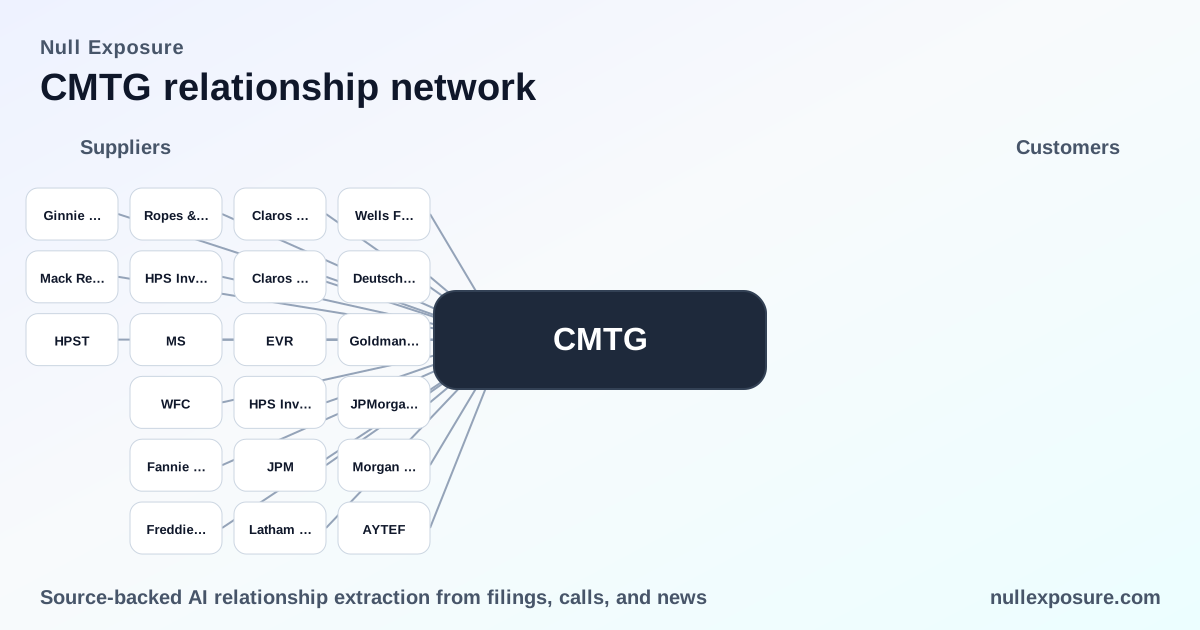
Claros Mortgage Trust (CMTG): who the REIT pays, borrows from, and relies on
Claros Mortgage Trust is an externally managed commercial mortgage REIT that originates, acquires and finances income‑producing mortgage loans and credit‑enhanced agency collateral to generate current income and capital appreciation. The firm monetizes through interest income on its loan portfolio, spread capture via secured financing (repurchase and term facilities), and management fees paid to its external manager, with balance‑sheet leverage a central driver of returns.
For a practical supplier and counterparty view that matters to investors and operators, see more at https://nullexposure.com/.
Quick read: what to know before you dig into the counterparty list
- Capital providers and bank counterparties run the funding engine for CMTG; repurchase agreements and a $500m secured term loan materially shape near‑term liquidity.
- External management is core — Claros REIT Management LP and Claros Mortgage Capital Advisors LLC run sourcing, underwriting and day‑to‑day operations under contractual management arrangements.
- Agency exposure (Ginnie Mae, Fannie Mae, Freddie Mac) underpins a portion of the book, preserving credit quality and easing access to marketable collateral pathways.
Explore the platform and supplier map at https://nullexposure.com/ for a more granular supplier risk view.
Counterparties, advisors and service providers you need on your radar
-
Wells Fargo Bank NA — The FY2024 Form 10‑K references Wells Fargo in connection with repurchase/guarantee agreements and a CECL reserve disclosure; Wells Fargo is a named financing counterparty in CMTG’s master agreements. According to the 2024 10‑K, a specific CECL reserve of $120.9 million is disclosed in aggregate reserves. (CMTG 2024 Form 10‑K)
-
Deutsche Bank AG, New York Branch — The company’s 2024 filing notes that loans securing outstanding borrowings under certain facilities had a weighted average term to maturity of 0.6 to 1.6 years, a maturity profile tied to facilities with counterparties including Deutsche Bank. (CMTG 2024 Form 10‑K)
-
Goldman Sachs Bank USA — CMTG reports master repurchase agreements with five counterparties, which include Goldman Sachs Bank USA as a counterparty to its short‑term financing. (CMTG 2024 Form 10‑K)
-
JPMorgan Chase Bank NA — JPMorgan is listed among master repurchase counterparties in the 10‑K and in subsequent January 2026 amendments aligning covenants with CMTG’s revised capital structure. (CMTG 2024 Form 10‑K; TradingView report Jan 30, 2026)
-
Morgan Stanley Bank NA — Morgan Stanley appears as one of CMTG’s repurchase counterparties and was party to January 30, 2026 amendments that harmonized covenants and capacity. (CMTG 2024 Form 10‑K; TradingView report Jan 30, 2026)
-
Barclays Bank PLC (AYTEF) — The 10‑K describes asset‑specific financing structures including notes payable and syndications of senior participations; Barclays is identified in that context as a financing counterparty. (CMTG 2024 Form 10‑K)
-
Claros Mortgage Capital Advisors LLC — Under an external management agreement, Claros Mortgage Capital Advisors LLC sources, underwrites and services mortgage assets on behalf of CMTG; multiple March 2026 news items reiterate the advisory/management role. (MarketBeat instant alert, March 2026)
-
Claros REIT Management LP — The company is externally managed and advised by Claros REIT Management LP, an affiliate of Mack Real Estate Credit Strategies; this manager executes the investment strategy and collects management and reimbursable fees. (Press releases and trading news, FY2025–FY2026)
-
Evercore (EVR) — Evercore served as CMTG’s lead financial advisor on recent financing activity and capital‑structure matters. (StockTitan / press release coverage, March 2026)
-
HPS Investment Partners, LLC (HPS / HPST) — CMTG closed a $500 million, four‑year senior secured term loan provided by funds managed by HPS; the loan replaced prior Term Loan B and extends maturities to January 2030 per earnings commentary. (Business Wire / StockTitan press release; Q4 2025 earnings call transcript, January 2026)
-
J.P. Morgan — In addition to its bank role, J.P. Morgan served as a financial advisor on the company’s recent financing transactions and was party to repurchase and guarantee agreement amendments. (StockTitan / TradingView — press coverage, March 2026; Jan 30, 2026 amendments)
-
Latham & Watkins LLP — CMTG engaged Latham & Watkins LLP as legal counsel for recent financings and related transactions. (StockTitan / press coverage, March 2026)
-
Ropes & Gray LLP — Ropes & Gray LLP also served as legal counsel alongside Latham & Watkins for CMTG’s financing and advisory work. (StockTitan / press coverage, March 2026)
-
Fannie Mae — CMTG concentrates part of its portfolio on Agency collateral, which includes loans backed or credit‑enhanced by Fannie Mae, providing more predictable credit outcomes for that tranche of assets. (MarketBeat alerts, FY2026)
-
Freddie Mac — Freddie Mac is similarly referenced as part of the company’s Agency collateral focus, contributing to the REIT’s credit‑enhanced exposure. (MarketBeat alerts, FY2026)
-
Ginnie Mae — Ginnie Mae‑backed loans are also cited as Agency collateral in CMTG disclosures, anchoring a portion of the portfolio to government‑guaranteed programs. (MarketBeat alerts, FY2026)
-
Mack Real Estate Credit Strategies — Claros’ external management is affiliated with Mack Real Estate Credit Strategies, and public coverage references the broader platform relationship and shared origination resources. (StockTitan coverage, FY2025)
-
Wells Fargo Bank (variant) — Press coverage in early 2026 notes Wells Fargo remained a counterparty to amended guarantee agreements tied to repurchase facilities as CMTG restructured covenants. (TradingView report Jan 30, 2026)
-
Morgan Stanley Bank (variant) — Separate mentions in trading news document Morgan Stanley Bank’s role in amended master repurchase and guaranty agreements dated Jan 30, 2026. (TradingView report Jan 30, 2026)
This roster aggregates every named counterparty and advisor reported across CMTG’s FY2024 filings and the March 2026 press coverage — each firm plays a discrete role: funding, advice, legal, or management.
What the supplier and financing map tells you about the business model
-
Contracting posture: CMTG operates with a mix of long‑term management contracts (the manager earns a base fee equal to 1.50% per annum of stockholders’ equity under a long‑dated management agreement) and short‑term financing arrangements (repurchase agreements and credit facilities with average initial maturities below one year). This hybrid posture concentrates operational control with the manager while leaving liquidity exposed to market cycles.
-
Concentration and criticality: The company reports $5.5 billion of available repurchase capacity and $3.7 billion outstanding as of year‑end 2024; that scale makes a few bank counterparties and the HPS term loan critical to ongoing origination and balance‑sheet stability. A loss of financing access would force material portfolio actions.
-
Maturity and stability: Short‑tenor repo lines create rolling refinancing risk, partially offset by the January 2026 $500m HPS term loan that extended the secured maturity profile for a material tranche of debt to 2030.
-
Spend and operational economics: Management fees and reimbursable expenses are meaningful — management fees are a steady long‑term cost, while reimbursed manager expenses historically fell in the $1–10 million range annually; aggregate borrowings place CMTG in a >$100 million financing band. These are company‑level cost signals that influence leverage targets and margin volatility.
Key investment takeaways and next steps
- Funding is the primary operational risk and lever. The combination of concentrated repo counterparties and a newly negotiated HPS term loan materially reshapes refinancing risk and cost of capital.
- External management aligns operations but concentrates execution risk in a single manager that receives base fees and performs underwriting and servicing.
- Agency collateral exposure reduces credit volatility for part of the portfolio, but CECL reserves and negative earnings metrics indicate stress in parts of the book.
If you are evaluating CMTG relationships for investment or operational diligence, start with the counterparty amendment filings and the management agreement disclosed in the FY2024 10‑K. For a deeper supplier‑focused map and interactive counterparty analysis, visit https://nullexposure.com/.
For bespoke research or to obtain a detailed counterparty exposure report tailored to your diligence needs, visit https://nullexposure.com/ and request the supplier playbook.