CN Energy Group (CNEY): Placement-Agent Dependence and What It Means for Suppliers and Investors
CN Energy Group Inc. is a China-headquartered specialty-chemicals company that monetizes primarily through product sales and supplements operating cash flow with frequent capital-market transactions (underwritten offerings and warrant inducements) to fund operations. The company’s small market capitalization and persistent operating losses create a sourcing and supplier risk profile that is driven as much by financing relationships as by raw-material supply chains. Learn more about strategic supplier risk profiling at Null Exposure.
Quick investment snapshot: why the capital markets matter here
CN Energy is a micro-cap specialty-chemicals issuer listed on NASDAQ. Key financial signals for investors:
- Revenue TTM: $35.6M with gross profit only $647.6k, indicating thin operating margins.
- EBITDA: -$9.74M and Diluted EPS: -21.46, signaling structural operating losses.
- Market capitalization: $4.88M and low institutional ownership (1.79%), highlighting liquidity and governance constraints. These metrics show reliance on financing rather than internal cash generation for working capital and supplier payments.
Why Aegis shows up in the cap table story
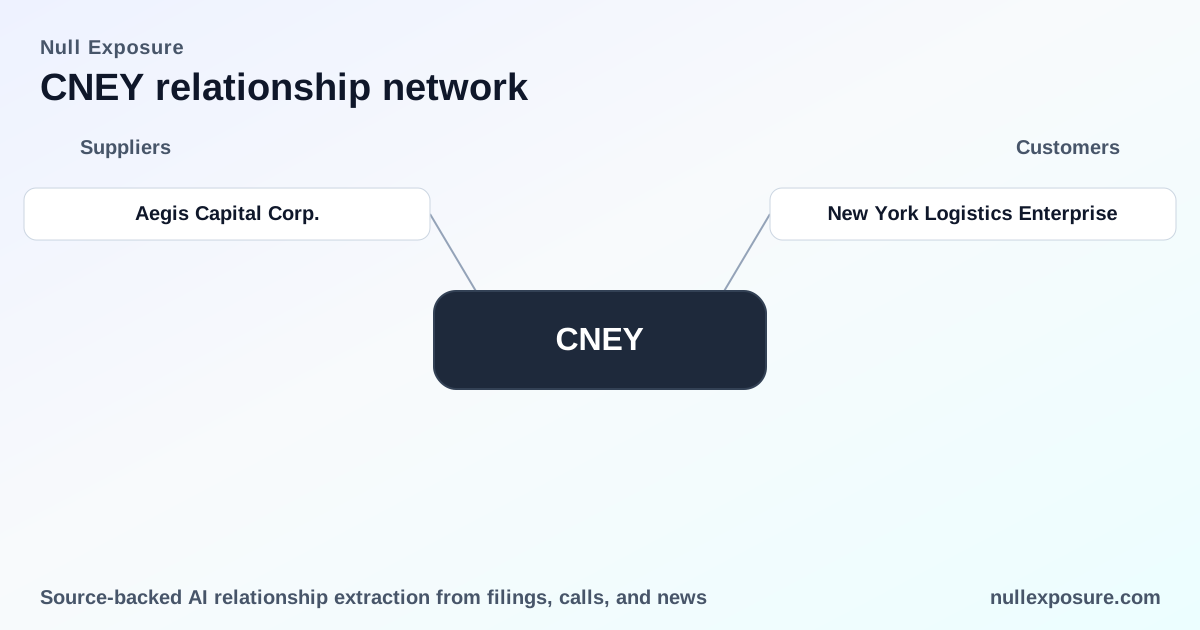
Across multiple recent filings and news items, CN Energy repeatedly uses Aegis Capital Corp. as its placement agent or book-running manager. This repeated engagement is not neutral: it signals a contracting posture that favors capital-market intermediaries to maintain liquidity. The consequence for suppliers is simple and direct — counterparty risk at the contract level is elevated when a small issuer depends on external equity or warrant financings to meet operating obligations.
For a deeper supplier-risk evaluation framework and deal-level context, visit Null Exposure.
The public record: every placement-agent relationship uncovered
Below are all relationships found in the supplied results, with concise descriptions and source references.
FY2023 — Sole book-running manager for $10M underwritten offering
Aegis Capital Corp. served as sole book-running manager for a $10 million underwritten public offering, a transaction used to raise short-term capital (MarketScreener, reporting on the offering). (Source: https://www.marketscreener.com/quote/stock/CN-ENERGY-GROUP-A-118621656/news/CNEY-Announces-Pricing-of-10-Million-Underwritten-Public-Offering-42847660/)
FY2024 — Exclusive placement agent in warrant inducement agreements
Aegis acted as exclusive placement agent in connection with CN Energy’s warrant inducement agreements and related financing steps disclosed in a PR Newswire release covered by The Manila Times in December 2024. The company used the engagement to restructure and incentivize holders via warrants, indicating reliance on capital markets to preserve liquidity. (Source: https://www.manilatimes.net/2024/12/05/tmt-newswire/pr-newswire/cney-entered-into-warrant-inducement-agreements-with-certain-holders/2016863)
FY2025 — Continued exclusive placement-agent engagement
Aegis again served as exclusive placement agent according to a FY2025 news item, showing continuity in the company’s dealer selection and dependence on the same capital markets intermediary across multiple financings. (Source: https://www.stocktitan.net/news/CNEY/)
What these relationships imply about contracting posture and concentration
- Contracting posture: The company uses underwritten offerings and placement-agent relationships as a core element of its liquidity strategy rather than ad hoc or rare events. This is an operational posture that accepts dilution and third-party underwriting as routine.
- Concentration risk: Repeated engagements with Aegis indicate single-counterparty concentration in capital raising — a supplier-like dependency on one intermediary for access to public capital.
- Criticality: For a business with negative EBITDA and thin gross profit, placement-agent relationships are critical to ongoing operations because they provide the capital buffer needed to service suppliers and continue production.
- Maturity and sophistication: The mix of underwritten public offerings and warrant inducements signals a mid-stage financing maturity: the company is able to access public markets but does so in equity- and warrant-based forms rather than stable debt arrangements or internal cash flow.
No supplier-constraint records were captured in the source set; that absence itself is a company-level signal that documented supplier contractual constraints are not prominent in current public disclosures.
Risk implications for investors and operators
- Dilution risk is routine. Repeated underwritten offerings and warrant inducements dilute existing shareholders and can change the alignment of stakeholders; operators negotiating long-term supplier contracts need to factor in potential ownership turnover.
- Single-intermediary dependency elevates execution risk. If Aegis’ terms change or Aegis declines future engagements, CN Energy’s ability to raise funds quickly will be impaired.
- Cash-flow sensitivity to capital markets. With negative operating margins, supplier payments and raw-material procurement become contingent on successful financing windows, increasing the chance of suppliers demanding stricter payment terms or collateral.
Bottom line: CN Energy’s supplier profile is inseparable from its capital-raising profile.
If you manage supplier exposure to small-cap issuers, adopt proactive monitoring and contractual protections — discover recommended workflows at Null Exposure.
Practical next steps for investors and supply-chain operators
- Require disclosure of recent and prospective placement-agent arrangements in counterparty diligence; track agent concentration and recent transaction cadence.
- Include financing-trigger clauses or payment-security provisions in supplier contracts for counterparties with negative EBITDA and small market cap.
- Monitor regulatory filings and press releases for warrant inducement or underwritten offering activity as an early indicator of liquidity stress or dilution events.
Key takeaway: CN Energy’s repeated use of Aegis Capital for multiple financings is a direct indicator that capital-market intermediaries are a structural part of its operating model; that dependency materially increases supplier and investor exposure to funding-cycle risk.
For targeted supplier-risk intelligence and to benchmark capital-raising concentration across counterparties, visit Null Exposure.