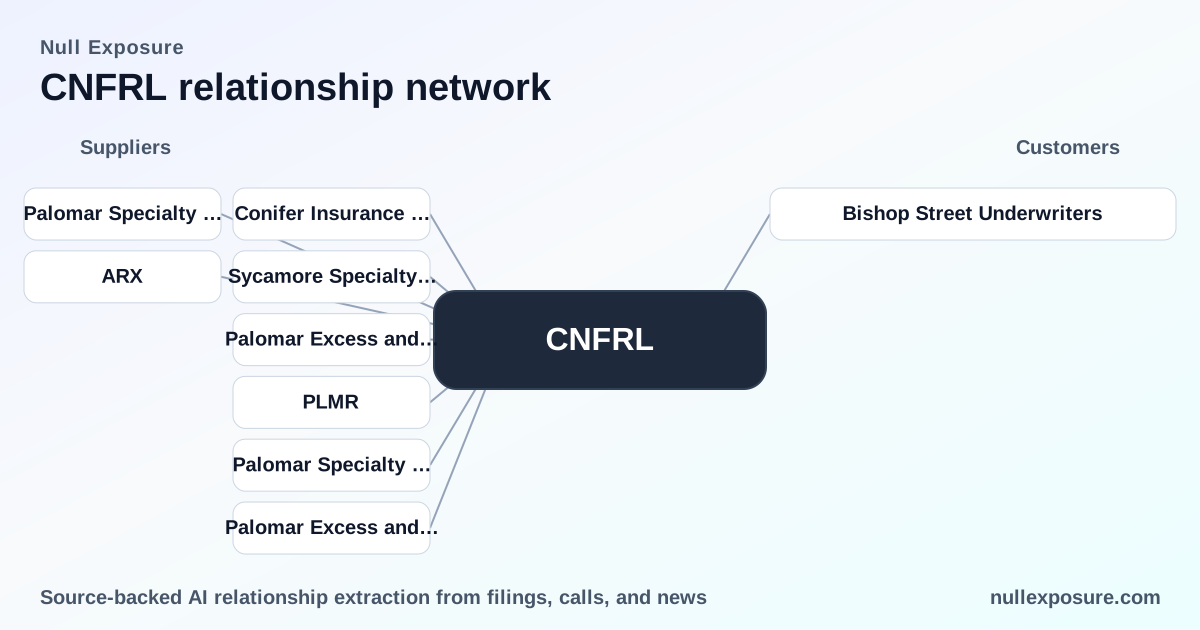
Conifer Holdings (CNFRL) — supplier relationships that define a lean underwriting model
Conifer monetizes by operating as a specialty underwriting platform that increasingly outsources core underwriting, claims handling and IT functions while placing risk on third‑party carrier paper and capacity networks. The company’s revenue mix is driven by fee income from managing and originating specialty commercial lines business and by leveraging partner carriers and capital providers to carry risk. For investors, the critical questions are counterparty concentration, operational outsourcing, and the alignment of capital partners with loss‑bearing outcomes.
Explore a consolidated view of supplier relationships and their implications at https://nullexposure.com/.
What the supplier picture says about how Conifer runs the business
Conifer’s supplier set signals a deliberate, outsourced operating posture: a skeletal internal staff complements external underwriting, claims, and IT vendors while distribution and specialty underwriting are executed through partnerships. This posture reduces fixed overhead but concentrates critical operational dependency on a small number of counterparties. With no explicit constraint excerpts provided in the source collection, treat these characteristics as company‑level operating signals rather than formal contractual constraints. Key operating-level signals:
- Contracting posture: Conifer runs a light‑touch central organization that relies on external vendors and carrier paper to underwrite and service policies.
- Concentration: A small roster of counterparties handling underwriting, claims, and capital provision creates single‑point dependencies that amplify counterparty risk.
- Criticality: Supplier functions cover core execution — underwriting, claims, IT — making those relationships operationally critical.
- Maturity: Use of rated carriers and established capacity marketplaces suggests counterparties are mature and capitalized, reducing capital risk but not operational dependency.
Learn more about supplier exposure and counterparty analysis at https://nullexposure.com/.
Relationship roundup — every counterparty mentioned in the record
Conifer Insurance Services (CIS)
Conifer has effectively outsourced core operations following the sale of CIS, yet continues to rely on the entity for underwriting, claims, and IT services while running a minimal in‑house workforce of about 11 people. According to coverage of Conifer’s FY2025 SEC filing reported on TradingView (March 2026), CIS remains an operational provider even after the transaction.
Sycamore Specialty Underwriters (SSU)
Sycamore is similarly retained as a service provider for underwriting, claims and IT after disposed‑of corporate ownership, reflecting a continued operational relationship that supports Conifer’s lean headcount. This is described in the same FY2025 SEC commentary on TradingView (March 2026).
Palomar Holdings, Inc. (PLMR)
Conifer partnered with Palomar Holdings to offer specialized insurance for the cannabis industry, leveraging Palomar’s underwriting platform to access capacity and regulatory expertise. Program Business and Reinsurance News covered the Palomar partnership as part of Conifer’s FY2024 strategic shift (reports published March 2026).
Palomar Specialty Insurance Company (PSIC)
Coverage authored for certain Conifer lines is placed on PSIC paper, providing admitted/specialty paper for niche commercial lines. Reinsurance News and Program Business note that PSIC is one of the carriers used for Conifer‑originated business in FY2024 reporting (March 2026).
Palomar Excess and Surplus Insurance Company (PESIC)
Conifer writes certain classes of coverage on PESIC paper, which Reinsurance News cites as having an “A‑” (Excellent) A.M. Best financial strength rating — a meaningful signal about counterparty capitalization in FY2024 commentary (March 2026).
Palomar Excess and Surplus Insurance Co. (alternate listing)
Program Business specifically notes that Conifer coverage will be written on Palomar Excess and Surplus Insurance Co. paper as part of the commercial lines shift to an MGA model, reinforcing that Palomar family carriers underlie Conifer’s product distribution (Program Business, FY2024 reporting published March 2026).
Palomar Specialty Insurance Co. (alternate listing)
Program Business further documents that Palomar Specialty Insurance Co. is part of the carrier suite used to underwrite Conifer business, underscoring the structural reliance on Palomar entities for specialty underwriting capacity (Program Business, FY2024 reporting published March 2026).
Palomar Holdings, Inc. (duplicate listing)
Reinsurance News reiterates the strategic partnership and describes the Palomar relationship as central to Conifer’s entry into specialized cannabis coverage, highlighting both product and carrier alignment in FY2024 commentary (March 2026).
Accelerant (ARX)
Conifer established a capacity relationship with Accelerant, a data‑driven risk exchange that connects specialty underwriters with risk capital, indicating the company is tapping alternate capital sources and risk distribution networks as part of its MGA transition (Program Business, FY2024 reporting published March 2026).
How these relationships translate to investor risk and opportunity
The relationship map creates a clear investment thesis: Conifer is a distribution and underwriting manager rather than a large, capital‑heavy insurer. That structure reduces balance‑sheet capital needs and can scale distribution quickly, but it concentrates operational and execution risk externally.
- Upside: Access to rated carrier paper (A‑ rated counterparties cited) and modern capacity networks can accelerate product expansion into specialties like cannabis without large capital deployment.
- Downside: A very small internal headcount and reliance on a few suppliers create operational concentration and single‑vendor risk for underwriting, claims, and IT. A failure or contractual dispute with a key provider would have outsized consequences.
- Capital linkage: Use of capacity marketplaces such as Accelerant diversifies capital sources but ties Conifer’s economics to platform‑level pricing and availability.
What investors and operators should watch next
- Contract terms and service‑level commitments with external providers; clarity on liability allocation in underwriting and claims is essential.
- Dependence metrics: proportion of GWP or fee income routed through each carrier/partner and duration of service contracts.
- Counterparty financial strength trends: maintain focus on A.M. Best and equivalent ratings for carrier partners used to carry risk.
For actionable supplier intelligence and counterparty exposure analytics, visit https://nullexposure.com/.
Bottom line and recommended next steps
Conifer’s model is capital‑light and distribution‑focused, but operationally concentrated. The company can scale specialty offerings by leveraging rated carrier paper and capacity networks, yet that same architecture compresses the margin for vendor failure or contract disputes. Investors should require transparency on contractual protections, service continuity plans, and counterparty concentration metrics before allocating capital.
If you evaluate supplier risk or run partner due diligence, start with a focused review of service agreements and contingency provisions. For deeper analysis and ongoing monitoring of supplier exposure, see https://nullexposure.com/.