CNH Industrial: supplier relationships that shape margins, risk and capital options
CNH Industrial designs, manufactures and finances agricultural and construction equipment and monetizes through equipment sales, aftermarket parts & services, and captive finance. Revenue is driven by hardware sales and increasingly by higher-margin services and connected-vehicle offerings, while financing and periodic capital markets activity support liquidity and cost-of-capital management. For investors evaluating supplier exposure, the key is that CNH combines long-term manufacturing sourcing with recurring service relationships and large underwritten financing transactions that directly influence cash conversion, inventory costs and risk concentration.
Explore CNH supplier intelligence for deeper counterparty analysis.
How CNH’s operating model turns suppliers into value and risk
CNH runs a capital-intensive manufacturing business with a buyer posture for critical components (engines, drivetrains, electronics) and a parallel reliance on financial markets and banks to fund CNH Industrial Capital LLC issuances and receivables transactions. This results in a mix of contractual commitments and transactional deals:
- Long-term supply contracting for core inputs reduces unit-cost volatility but creates concentration risk when a small number of manufacturers dominate engine and powertrain supply.
- Criticality and spend concentration show up in related-party tables: purchases from key partners run in the hundreds of millions annually, directly affecting cost of goods sold.
- Service-provider relationships (IT, insurers, logistics) are operationally important and introduce cyber and continuity exposures.
These operating realities explain why CNH both discloses a ten-year Engine Supply Agreement and structures frequent underwritten offerings through major investment banks: suppliers secure production inputs, while banks and capital markets underwrite CNH’s funding needs.
Constraints and company-level signals that investors should price
The public record contains several company-level signals that constrain CNH’s options and inform counterparty risk assessment:
- Long-term contracting posture: CNH documents a ten-year Engine Supply Agreement for post-demerger engine purchases, signaling multi-year dependence on a manufacturer partner and predictable COGS recognition.
- Critical supplier relationships: CNH explicitly calls supplier relationships “critical to our operational effectiveness,” which elevates operational risk and the value of continuity planning.
- Buyer and manufacturer roles: The company acts primarily as a buyer of engines while its suppliers serve as manufacturers; compliance with emissions regulation is contractually allocated to suppliers for certain products.
- Service-provider exposure: CNH relies on third parties for IT and insurance; those relationships are operationally material and present cybersecurity and continuity channels of risk.
- Active, high-spend relationships: Related-party tables show purchases in the $100m+ band with certain affiliates and partners, indicating both concentration and scale.
Because the Engine Supply Agreement excerpt names Iveco Group, the ten-year ESA and its associated buyer/manufacturer dynamics are attributable to Iveco; other constraints above are company-level signals evident across CNH’s disclosures.
Assess counterparty exposure and scenario impacts for portfolio-level adjustments.
Detailed supplier relationships investors must know
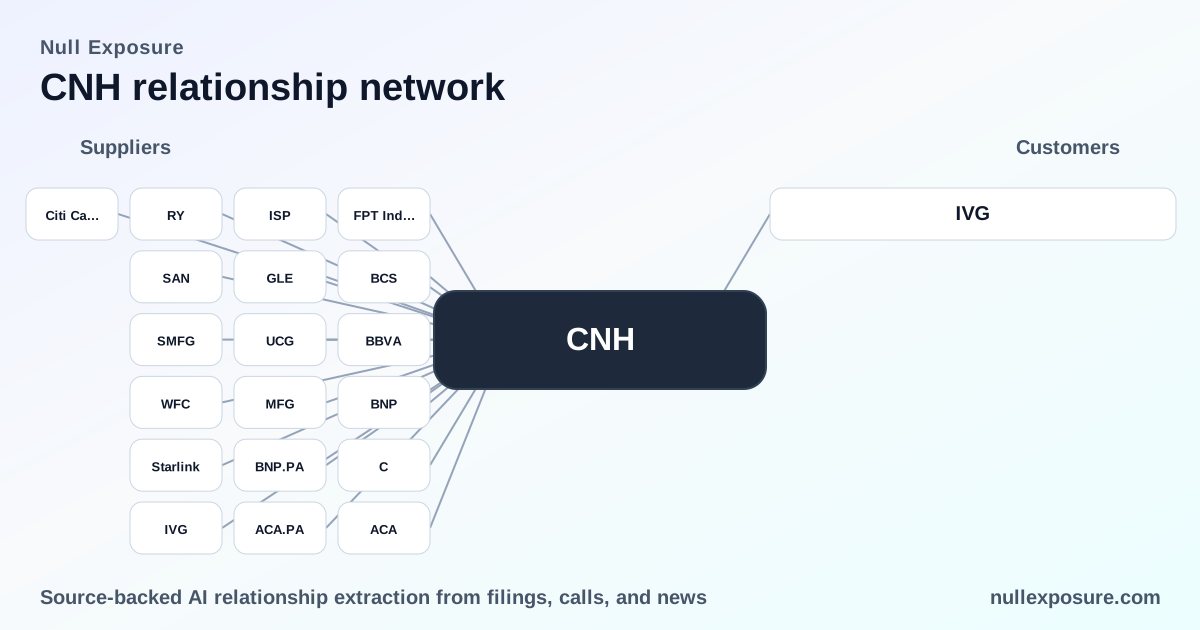
Below are every supplier and underwriter relationship referenced in the collected results, with a concise plain-English summary and the source referenced naturally.
FPT Industrial S.p.A.
CNH reports that internal combustion engines are primarily supplied by FPT Industrial S.p.A., a company controlled by Iveco N.V., establishing FPT as a principal engine manufacturer for CNH’s products. This relationship is documented in CNH’s FY2024 10‑K filing.
Iveco Group N.V.
CNH entered into a ten‑year Engine Supply Agreement with Iveco Group for diesel, CNG and LNG off-road engines and post-sale services, and records material purchases from Iveco in its related‑party tables, underlining both contractual duration and spend concentration (CNH 2024 10‑K and related disclosures).
Citigroup Global Markets Inc.
Citigroup has acted repeatedly as a joint book‑running manager and representative of underwriters on CNH Industrial Capital offerings, including the 2025 and 2026 note pricings reported in GlobeNewswire and other press releases.
BNP Paribas Securities Corp.
BNP Paribas served as a joint book‑running manager on CNH Industrial Capital LLC note offerings and is named among secondary book‑running managers in CNH press releases covering 2025–2026 pricing.
Barclays Capital Inc.
Barclays is listed as a joint book‑running manager and representative of the underwriters for CNH Industrial Capital debt offerings in press coverage of the 2026 issuance.
SG Americas Securities, LLC
SG Americas is named as a joint book‑running manager and representative on CNH note offerings reported in GlobeNewswire and other filings for 2025–2026.
BBVA Securities Inc.
BBVA appears among the joint book‑running managers for underwriting activity tied to CNH Industrial Capital issuances according to 2026 news coverage.
Credit Agricole Securities (USA) Inc.
Credit Agricole is listed as a joint book‑running manager across CNH debt pricings announced in 2025–2026 press releases.
Intesa Sanpaolo IMI Securities Corp.
Intesa Sanpaolo is recorded as a joint book‑running manager on CNH Industrial Capital offerings in the January 2026 pricing release.
UniCredit Capital Markets LLC
UniCredit is included among book‑running managers on CNH offerings disclosed in January 2026 news releases.
Mizuho Securities USA LLC
Mizuho is a joint book‑running manager and representative for CNH’s $500 million notes pricing announced in September 2025 (GlobeNewswire).
RBC Capital Markets, LLC
RBC acted as a joint book‑running manager and representative on CNH Industrial Capital LLC note offerings per GlobeNewswire announcements for 2025.
Wells Fargo Securities, LLC
Wells Fargo is named as a joint book‑running manager and representative for the 2025 CNH note issuance in GlobeNewswire PR.
Santander US Capital Markets LLC
Santander US is listed among the book‑running managers on CNH’s 2025 debt pricing release.
SMBC Nikko Securities America, Inc.
SMBC Nikko is included as a joint book‑running manager on the 2025 pricing disclosure.
Citi Cards Canada Inc.
CNH disclosed an acquisition of a portfolio of revolving charge account receivables from Citibank N.A. and Citi Cards Canada Inc., signaling activity in receivables and financing that impacts CNH’s captive‑finance balance sheet (investor commentary and SimplyWall.St summary).
Citibank N.A.
Citibank participated as the seller of a portfolio of receivables acquired by CNH, a transaction highlighted in company summaries and industry write‑ups for FY2026.
Starlink
Industry commentary and equity research referenced Starlink as a partner in CNH’s connectivity and precision-technology strategy, positioning CNH to monetize recurring software and telematics services via connected hardware and FieldOps integration (Sahm Capital research note, 2026).
What this means for investors: concentration, margins and funding
- Concentration risk is real and measurable. Purchases from Iveco and related affiliates are reported in the hundreds of millions, which makes engine continuity and contract terms a direct driver of COGS and margin variability.
- Capital markets relationships are diversified across major banks, which reduces execution risk on underwritings but keeps CNH tied to market conditions for refinancing and captive-finance liquidity. GlobeNewswire and regulatory press releases list a repeated syndicate of global banks across 2025–2026 offerings.
- Technology partnerships are strategic for margin expansion. The Starlink and FieldOps references signal a deliberate push toward recurring, higher-margin services that complement hardware sales.
Investors should reprice CNH for supplier concentration, the maturity profile of the Engine Supply Agreement, and the company’s ability to convert connected‑services strategies into sustained incremental margin.
Run a supplier concentration stress test and scenario modeling before adjusting exposures.
Bottom line and next steps
CNH’s supplier map combines a long-term, critical engine supply relationship with Iveco/FPT and a broad syndicate of global banks underwriting its debt — a profile that delivers predictable manufacturing inputs but elevates concentration and execution risk. The firm’s pivot into connectivity and receivables transactions introduces upside to recurring revenue but also creates new operational dependencies.
For investors and operators, the imperative is clear: monitor contract milestones with Iveco/FPT, track the cadence and pricing of CNH Industrial Capital offerings, and quantify how connected services penetration could change margins.
Get the complete supplier profile and near‑real‑time updates at Null Exposure.