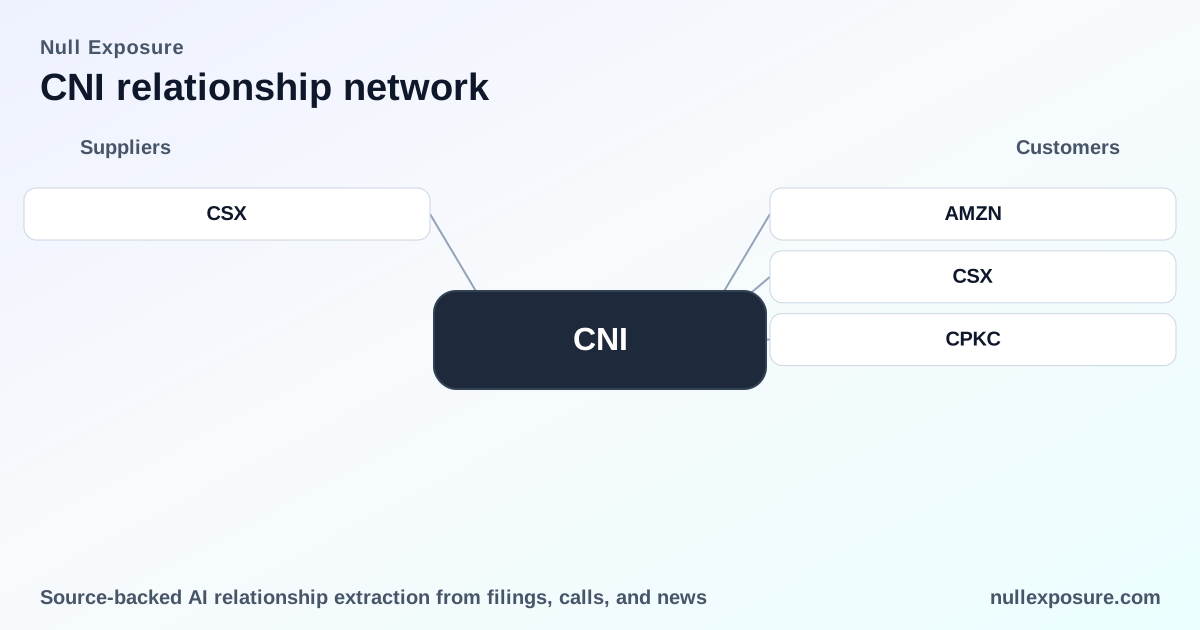
Canadian National (CNI) — Supplier relationships and network control after the CSX transfer
Canadian National Railway Company operates and monetizes a continent-spanning rail network by moving freight for industrial shippers, charging haulage and access fees, and extracting operating leverage from high fixed-cost infrastructure. CN generates durable cash flow through long-haul freight contracts, intermodal services, and strategic asset control of key corridors, while capital allocation (maintenance, targeted acquisitions, dividends) converts that cash flow into investor returns. For investors evaluating supplier and partner exposure, the company’s competitive position is driven as much by network control and interchange economics as by conventional revenue metrics. Learn how these supplier dynamics change the risk profile at the firm level on our homepage: https://nullexposure.com/.
One-line investment thesis and what changed
CN captures value by owning and operating rail assets that reduce interchange complexity and capture incremental margin on traffic that would otherwise require partner handoffs. The recent transaction with CSX that transfers 12.5 track miles in Ontario to CN is a tactical move to consolidate control of a gateway corridor into Windsor and the Detroit–Windsor tunnel, improving throughput and reducing operational friction for cross-border traffic.
- Scale and cash generation: Market cap ~$65B, Revenue TTM ~$17.3B, EBITDA ~$9.06B, and a profit margin around 27% give CN both the balance-sheet capacity and operating maturity to execute rolling-capital plays that expand network control.
The specific supplier/partner move you need to know
CSX Transportation — 12.5 track miles sale in Ontario
CN acquired 12.5 track miles between Chatham and Blenheim, Ontario, from CSX Transportation, giving CN direct control of trackage that connects its network to Windsor yards and the Detroit–Windsor rail tunnel. This transfer reduces dependence on an interchange partner on a strategically important cross-border corridor and strengthens CN’s routing options for traffic entering the Great Lakes/US Midwest markets. Progressive Railroading reported the transaction on March 9, 2026 (https://www.progressiverailroading.com/railPrime/details/CN-to-move-some-CSX-traffic-CSX-to-sell-Ontario-line-to-CN-1312006--76263).
Why this relationship matters to investors and operators
This is not a small piece of track for semantics—it's a tactical control play that reduces interchange risk and increases CN’s optionality on cross-border freight. Operators value continuous control over corridors because every interchange adds dwell time, demurrage risk, and complexity in service commitments. By taking direct ownership of the right-of-way into Windsor, CN secures a choke-point that converts into higher operational reliability and incremental margin on traffic that previously required coordination with CSX.
- Operational impact: Expect improved cycle times on affected flows and fewer scheduling conflicts that historically show up as variability in service metrics.
- Commercial impact: CN can internalize revenue that previously split across carriers, and price more aggressively for guaranteed lanes.
- Strategic impact: Ownership of gateway trackage strengthens CN’s negotiating posture with large shippers and with US carriers for interline moves.
Explore how strategic supplier moves change counterparty risk assessments in our analysis portal: https://nullexposure.com/.
How the transaction fits CN’s broader operating model
CN runs a capital-intensive, asset-heavy business that benefits from long-term customer contracts and high fixed-cost leverage. Several company-level signals explain why this transaction aligns with CN’s business model:
- Contracting posture: CN’s commercial model favors long-haul contracts and corridor ownership rather than spot handoffs—this sale/transfer reinforces a posture of internalizing critical links.
- Concentration and criticality: While CN serves diverse commodity flows across North America, control of specific corridors is highly critical to cross-border and intermodal service quality; securing the Windsor gateway reduces single-point-of-failure exposure on a high-value connector.
- Maturity and capital capacity: With a market cap near $65B, EBITDA of $9.06B, and a dividend yield around 3.4%, CN has the maturity and cash generation to execute targeted rail acquisitions and absorb integration costs without destabilizing core operations.
- Counterparty dynamics: The transfer reduces CN’s operational interdependence with CSX on the corridor in question, shifting the supplier relationship from collaborative interchange to internal control—this changes counterparty risk profiles for both carriers and their large shipper customers.
No explicit constraints against CN’s supplier relationships were flagged in the intelligence reviewed, which is itself a signal: current public tracking does not show regulatory or contractual restrictions limiting CN’s ability to acquire or consolidate trackage in this instance.
What investors should watch next
- Service KPIs on Windsor corridor: Quarterly reports and regional service metrics will show whether dwell times and interchange volumes decline post-transfer.
- Revenue capture and yield: Monitor freight yield per car and revenue per ton-mile on affected lanes to quantify margin improvement from internalized traffic.
- Regulatory and competitive response: Watch for any regulatory filings or competitive routing adjustments from CSX or other carriers reacting to CN’s increased control.
- Capital allocation: Track how CN funds incremental track acquisitions—organic cash versus debt issuance will affect leverage and return profiles.
Relationship-level recap
- CSX Transportation — CN purchased 12.5 track miles between Chatham and Blenheim, Ont., securing trackage to Windsor yards and the Detroit–Windsor tunnel and reducing interchange dependence (Progressive Railroading, March 9, 2026: https://www.progressiverailroading.com/railPrime/details/CN-to-move-some-CSX-traffic-CSX-to-sell-Ontario-line-to-CN-1312006--76263).
Final takeaways and next steps
This transaction is a classic example of a rail operator converting network control into commercial advantage: fewer interchanges, better service consistency, and more direct revenue capture. For investors, the move reinforces CN’s strategy of targeted geographic consolidation to protect yield and service reliability. For operators and counterparties, the change alters routing economics and bargaining leverage in northern cross-border corridors.
If you want deeper counterparty maps and scenario analysis on how corridor acquisitions change supplier risk across portfolios, start here: https://nullexposure.com/. For a tailored briefing on CN and cross-border rail dynamics, request our supplier-risk memo at https://nullexposure.com/.