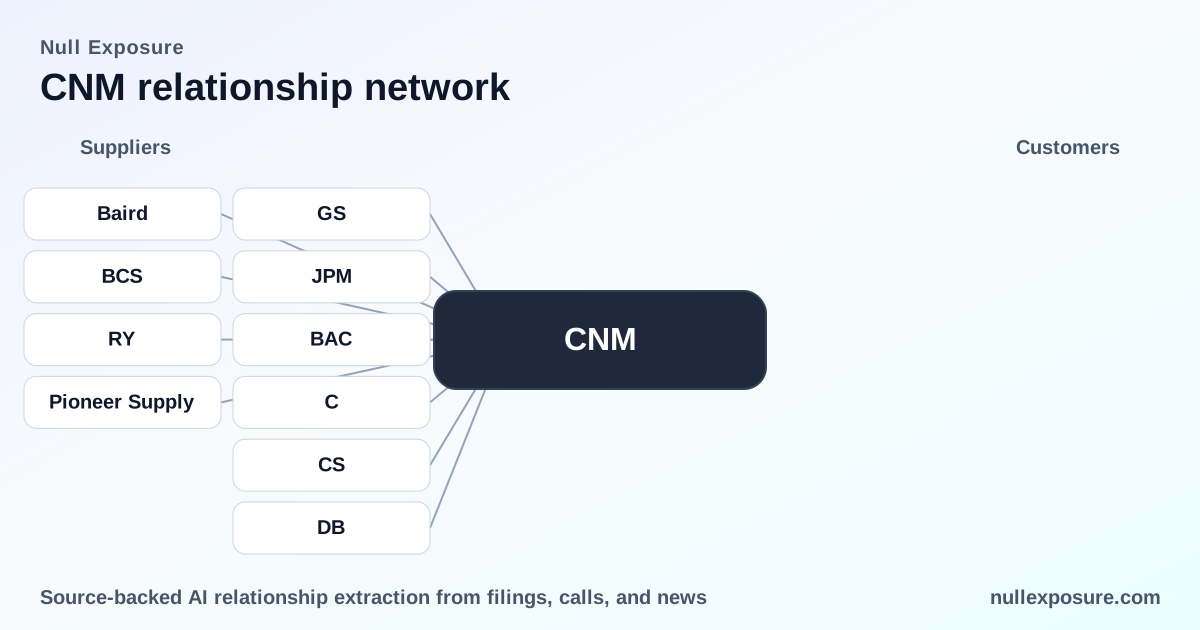
Core & Main (CNM): Supplier relationships that shape execution and risk
Core & Main operates as a national distributor of waterworks, plumbing and stormwater products, monetizing through product sales, localized service, and bolt-on acquisitions that expand geography and category reach. The company extracts margin from scale, logistics efficiency and recurring municipal/contractor demand while levering credit facilities and capital markets activity to fund expansion. For investors assessing counterparty and supplier exposure, the landscape is defined by large-bank underwriting and credit relationships, an active M&A pipeline, and long-dated leasing/contracting posture. Learn more about relationship signals and supplier risk at https://nullexposure.com/.
Why suppliers and financial counterparties matter for a distributor
Core & Main's business model is inventory- and capital-intensive: it requires working capital, branch and warehouse leases, and access to debt and equity markets to fund acquisitions. That combination makes the company sensitive to banking and underwriting relationships, lease commitments, and third-party service providers (notably around cybersecurity and operational continuity). Investors should treat these supplier links as operational levers: they both enable growth and concentrate counterparty risk.
Operating-model constraints that inform supplier risk
- Contracting posture — long-term commitments. The company executes leases with terms typically between three and seven years, with renewal options, establishing multi-year fixed-cost exposure that reduces short-term flexibility but supports stable branch footprints (evidence in public filings).
- Counterparty scale — large financial institutions. Core & Main’s credit documents incorporate major banks, indicating high-touch relationships with large enterprise creditors and underwriters; relevant credit agreements explicitly name banks such as Citibank and JPMorgan in the company’s registration materials.
- Service-provider role and review cadence. The company uses third parties for specialized services — including cybersecurity incident response — and maintains ongoing post-engagement reviews, signaling an active vendor governance posture.
- Relationship maturity — active and monitored. Supplier and service-provider relationships are described as active with continual review, reinforcing a governance regime rather than a set-and-forget outsourcing approach.
These constraints collectively signal a business that trades flexibility for scale: stable branch footprint and capital-market access at the cost of counterparty concentration and lease rigidity.
The partners that matter — every relationship found in the public notices
Goldman Sachs & Co. LLC — Goldman served as a lead book-running manager for Core & Main’s proposed offering, positioning the bank as a key underwriter in the company’s capital markets activity (CDR news, March 9, 2026: https://www.cdr.com/news/core-main-announces-launch-of-initial-public-offering).
J.P. Morgan — J.P. Morgan joined as a lead book-running manager for the same offering, underscoring the firm’s underwriting role and potential ongoing capital markets support (CDR news, March 9, 2026: https://www.cdr.com/news/core-main-announces-launch-of-initial-public-offering).
Credit Suisse — Credit Suisse is listed among the lead book-running managers for Core & Main’s offering, reflecting the company’s reliance on global investment banks for public financings (CDR news, March 9, 2026: https://www.cdr.com/news/core-main-announces-launch-of-initial-public-offering).
BofA Securities — BofA Securities was named as an additional book-running manager on the offering, indicating multi-bank syndication to distribute equity and manage execution risk (CDR news, March 9, 2026: https://www.cdr.com/news/core-main-announces-launch-of-initial-public-offering).
Citigroup — Citigroup participated as an additional book-running manager for the offering, reinforcing the syndicated nature of Core & Main’s capital raises (CDR news, March 9, 2026: https://www.cdr.com/news/core-main-announces-launch-of-initial-public-offering).
Deutsche Bank Securities — Deutsche Bank was listed as an additional book-running manager, contributing to the cross-market distribution strategy for the financing (CDR news, March 9, 2026: https://www.cdr.com/news/core-main-announces-launch-of-initial-public-offering).
Baird — Baird acted as an additional book-running manager on the offering, reflecting participation from both bulge-bracket and regional investment banks in the transaction (CDR news, March 9, 2026: https://www.cdr.com/news/core-main-announces-launch-of-initial-public-offering).
Barclays — Barclays appeared among additional managers for the offering, adding European underwriting capacity to the syndicate (CDR news, March 9, 2026: https://www.cdr.com/news/core-main-announces-launch-of-initial-public-offering).
RBC Capital Markets — RBC Capital Markets was named as an additional book-running manager, broadening institutional distribution and advisory coverage for Core & Main (CDR news, March 9, 2026: https://www.cdr.com/news/core-main-announces-launch-of-initial-public-offering).
Pioneer Supply — Core & Main entered into a definitive agreement to acquire Pioneer Supply, a regional distributor with locations in Moore, Oklahoma, and Weatherford, Texas, representing a local-market bolt-on to expand Core & Main’s footprint in the region (StockTitan report, March 9, 2026: https://www.stocktitan.net/news/CNM/core-main-signs-agreement-to-acquire-pioneer-1xmsjhahszbg.html).
What the relationship map tells investors about strategy and risk
- Capital markets and bank syndication are core execution levers. The concentration of major global and regional banks on equity offerings signals the company’s reliance on underwriters for access to public capital and distribution. That underwriting base supports acquisition-fueled growth but creates a counterparty footprint to monitor.
- M&A is tactical and localized. The Pioneer Supply agreement fits the bolt-on acquisition playbook that expands local branch density and scale benefits in distribution economics; expect similar small regional deals to continue.
- Operational continuity depends on third-party services. Use of external cybersecurity and other specialized service providers means vendor governance is critical; Core & Main’s ongoing review practice mitigates but does not eliminate third-party risk.
For investors who need to dig deeper into counterparties and governance, consider a subscription review at https://nullexposure.com/ — the platform consolidates relationship signals and corporate constraint evidence.
Valuation context and what to watch next
Core & Main trades with a market capitalization near $9.46B, revenue of roughly $7.76B and EBITDA of $922M, yielding an EV/EBITDA of 12.35 (latest available). Margins are healthy for distribution: operating margin ~10.7% and return on equity ~24%, which support a premium over basic wholesale distributors. Quarterly growth is modest (single-digit revenue and earnings growth year-over-year), consistent with a mature, acquisition-driven roll-up strategy.
Key watch items for investors:
- Integration of bolt-on deals such as Pioneer Supply and whether synergies sustain EBITDA margin expansion.
- Lease portfolio rigidity given the 3–7 year typical lease terms; look for branch rationalization or renegotiation flexibility.
- Banking and underwriting relationships ahead of any future public raises or refinancing events.
- Third-party service governance for cybersecurity and critical operations.
Learn more about counterparty exposure and supplier governance at https://nullexposure.com/.
Bottom line
Core & Main’s supplier landscape is dual-headed: a broad underwriting syndicate provides capital-market access while local acquisitions and service providers sustain field execution. That mix fuels growth but concentrates exposure in major banks and long-term lease commitments. Investors should monitor underwriting cadence, lease-footprint flexibility, and the execution of regional acquisitions as the principal drivers of upside and risk.