CONMED (CNMD) — supplier relationships under the microscope
CONMED (CNMD) manufactures and sells surgical devices and related equipment for minimally invasive procedures and monetizes through direct device sales, OEM and distribution agreements, and targeted channel partnerships; distribution rights and third‑party service providers are a direct lever on near‑term revenue and operating leverage. Investors should treat recent contract terminations and supplier/service-provider exposures as first‑order operational risks that reshape the revenue mix and procurement priorities. For a vendor‑risk view across suppliers and contracts, visit https://nullexposure.com/.
What changed and why it matters to investors
CONMED announced a strategic exit from the gastroenterology product suites that accelerates the company’s previously announced wind‑down of certain distribution arrangements. The most consequential change for supplier relationships is the termination and reassignment of CONMED’s U.S. and Canadian distribution rights for the Gore® VIABIL® biliary stent, a product previously sold under a distribution agreement with W.L. Gore & Associates. The shift reduces CONMED’s exposure to gastroenterology channels but also removes a recurring revenue stream tied to a third‑party brand and distribution economics. MassDevice reported the distribution termination as part of the exit plan (March 9, 2026).
For a consolidated supplier risk snapshot and ongoing monitoring, see https://nullexposure.com/.
All reported supplier relationships in the dataset — concise summaries
-
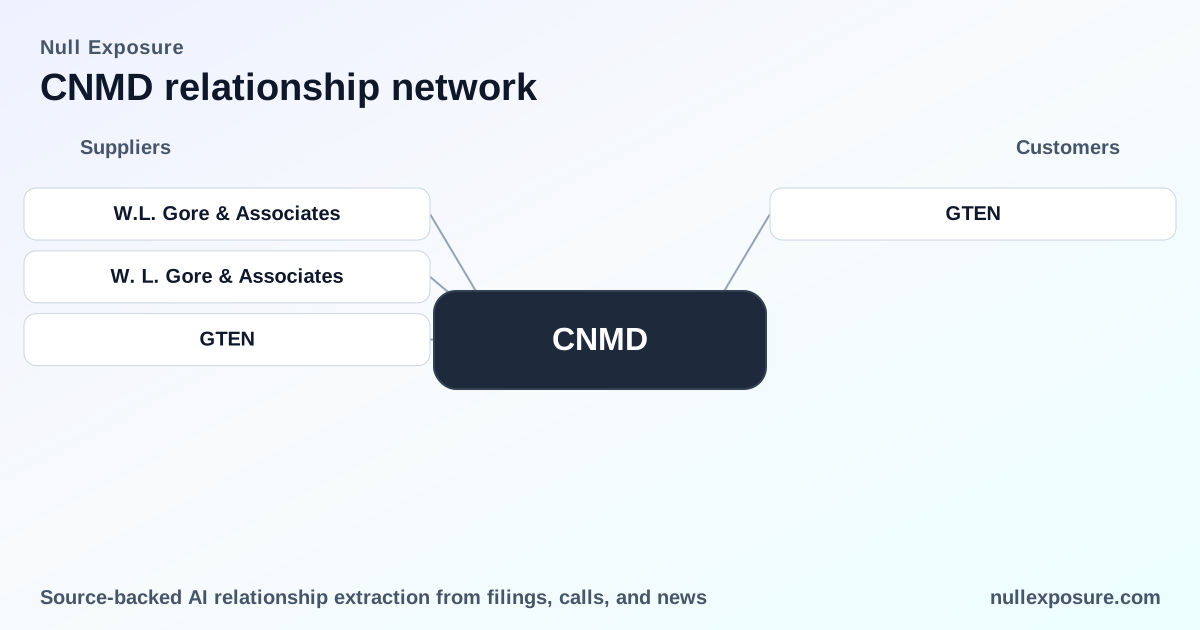
CONMED and W.L. Gore & Associates: MassDevice reported on March 9, 2026 that CONMED’s exit from gastroenterology includes ending its distribution agreement with W.L. Gore & Associates that covered the Gore Viabil biliary endoprosthesis. (MassDevice, Mar 9, 2026)
-
CONMED and W.L. Gore & Associates: MPO reported that CONMED held exclusive U.S. and Canadian distribution rights for the Gore Viabil biliary stent under an agreement with W.L. Gore & Associates, a right that is being relinquished as part of the strategic exit. (MPO, March 2026)
-
CONMED, W. L. Gore & Associates and Olympus: Simply Wall Street reported that in early December 2025 the parties announced U.S. distribution of the GORE VIABIL stent would shift from CONMED to Olympus effective January 1, 2026, accelerating the planned end of CONMED’s Gore distribution agreement. (Simply Wall St., Dec 2025 / reported Mar 9, 2026)
-
CONMED and GORE (GTEN referenced): Simply Wall Street also characterized CONMED’s portfolio reshaping as an acceleration of the GORE VIABIL distribution handoff to Olympus in early 2026 as the company exits gastroenterology. (Simply Wall St., Mar 2026)
-
CONMED and Gore: A TradingView news item reported that CONMED will end distribution of the Gore® VIABIL® stent by January 1, 2026, marking an operational cutover in U.S. distribution channels. (TradingView news, Mar 9, 2026)
-
CONMED and Gore (SEC disclosure referenced): TradingView published language from CONMED’s SEC filing noting the company will not renew its Distribution Agreement for the Gore® VIABIL® device after December 31, 2026, establishing the contract’s non‑renewal window in the company filing. (TradingView / SEC 10‑Q excerpt, FY2025 filing)
These entries collectively document the same commercial relationship—CONMED’s distribution deal for the GORE VIABIL stent—and its transfer or termination across multiple reporting sources and corporate filings.
What the constraint evidence signals about CONMED’s operating model
CONMED discloses that approximately 31% of its products by revenue in 2024 are sterilized by third‑party sterilizers using ethylene oxide, which has raised environmental concerns in parts of the U.S. This disclosure is a company‑level operational signal rather than a supplier‑specific attribution.
-
Contracting posture: CONMED relies on external service providers for critical post‑manufacturing steps (sterilization), indicating a hybrid model that outsources non‑core but mission‑critical operations.
-
Concentration: With nearly a third of products processed by third‑party sterilizers, there is meaningful concentration risk in the sterilization supply chain that can affect production continuity and regulatory compliance.
-
Criticality: Sterilization is operationally critical; service interruptions, regulatory restrictions, or environmental constraints on ethylene oxide would directly constrain revenue delivery for sterilized product lines.
-
Maturity: The use of established third‑party sterilizers reflects mature outsourcing practices, but regulatory and environmental pressure on the sterilization modality represents a latent operational vulnerability that requires either alternative processing capabilities or contractual contingency planning.
Investment implications — what investors and operators should prioritize
The immediate commercial consequence is a reduction in CONMED’s gastroenterology revenue base and associated distribution margin contribution as Gore VIABIL rights transfer to Olympus. That change improves portfolio focus on core surgical devices, but it also removes a channel that generated predictable sales volumes and distribution economics.
Key implications:
-
Revenue mix and guidance sensitivity. Expect near‑term revenue reclassification and possible headwinds in reported surgical/gastroenterology lines as distribution revenue shifts off CONMED’s P&L. Investors should watch quarterly disclosures for the reallocation of revenue and the timing of any transitional sales agreements.
-
Supplier negotiation leverage. CONMED’s decision to accelerate contract terminations signals a move to simplify supplier relationships and concentrate on owned product lines, which reduces reliance on distribution partnerships but increases reliance on internal commercialization and existing contract efficiencies.
-
Operational risk from sterilization exposure. The 31% sterilization third‑party reliance is a high‑impact supply‑chain constraint; procurement and operational teams must prioritize alternative sterilization pathways or locked‑in capacity agreements with multiple providers to mitigate single‑point failures.
For ongoing supplier intelligence and contract monitoring, visit https://nullexposure.com/.
Bottom line: risk rebalanced, vigilance required
CONMED’s strategic exit from gastroenterology and the concurrent termination/transition of its Gore VIABIL distribution rights rebalances commercial risk away from third‑party branded distribution and toward owned surgical product lines. This improves clarity of strategic focus but creates short‑term revenue disruption and increases the importance of in‑house commercialization execution. Separately, the disclosed dependency on third‑party ethylene oxide sterilizers represents a material operational constraint that requires active management.
Investors and procurement leaders should track quarterly filings and transitional revenue disclosures, the company’s plan to replace lost distribution volumes, and remediation actions on sterilization risk. For vendor‑level monitoring and supplier contract intelligence, return to https://nullexposure.com/ for a consolidated view and supplier alerts.