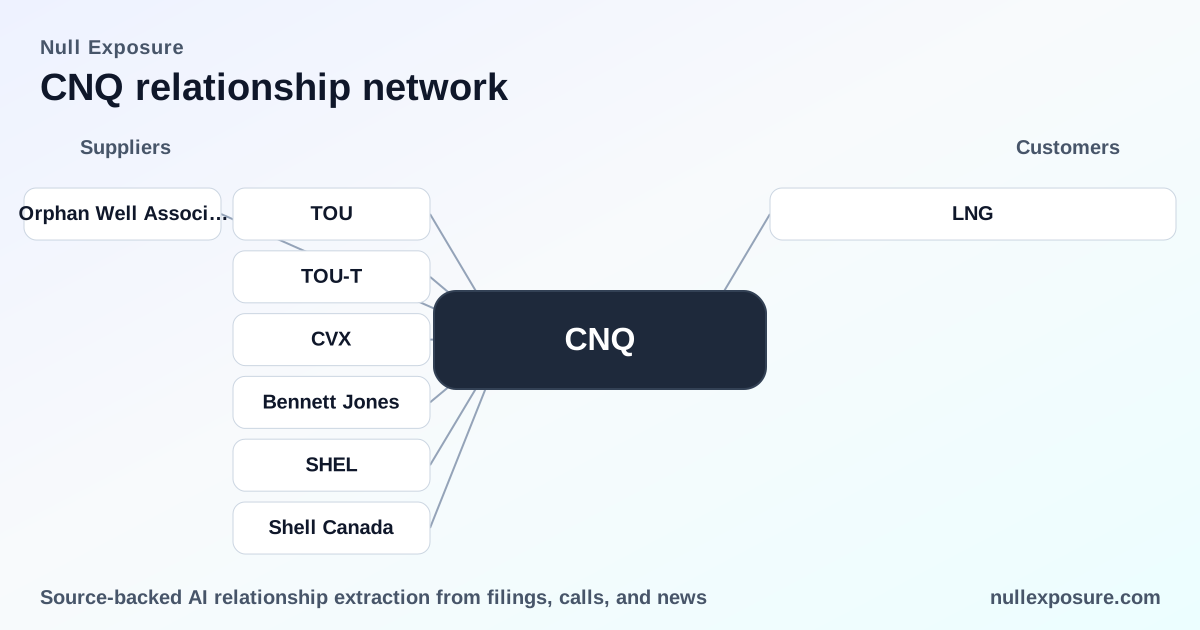
Canadian Natural Resources (CNQ) — supplier relationships and what they imply for investors
Canadian Natural Resources Limited acquires, explores, develops and produces crude oil, natural gas and NGLs, monetizing through commodity sales, strategic asset transactions and a disciplined capital-return program; the company’s financial scale (roughly $101.8 billion market cap and $15.8 billion EBITDA on a trailing basis) gives it both the balance-sheet firepower and the commercial footprint to be an active buyer and operator across Canada’s energy basin. For suppliers and counterparties, CNQ functions as a large, cash-generating operator that executes through asset purchases, swaps and standard advisory/financing relationships — these supplier ties both support growth and transmit concentration and regulatory exposure into the supplier base. For more supplier-level intelligence, see https://nullexposure.com/.
Quick read: what the relationship signals say about CNQ
CNQ’s recent supplier and counterparty mentions cluster around three behaviors: asset acquisitions from peers (Tourmaline, Shell), legal/advisory services for financing (Bennett Jones), and participation in collective industry programs (Orphan Well Association). The deal flow described in the sources shows an operator that is actively consolidating natural gas production while integrating large mining assets from major international partners. These moves increase operating scale but also create short-term capital deployment and integration risk. For deeper supplier mapping and downstream risk scoring, visit https://nullexposure.com/.
Relationship-by-relationship reporting (each source from the dataset)
Tourmaline Oil — Finviz report (first seen Mar 9, 2026, FY2026)
CNQ was reported to be in talks to acquire a portfolio of Alberta natural gas properties from Tourmaline valued at more than $1 billion, signaling targeted inorganic growth in gas supply. Source: Finviz news item referencing March 2026 coverage.
Tourmaline Oil Corp. — The Globe and Mail (Mar 9, 2026, FY2026)
The Globe and Mail described CNQ as poised to buy a $1‑billion-plus set of Alberta gas assets from Tourmaline, underscoring buyer-seller negotiations that increase CNQ’s gas exposure. Source: The Globe and Mail, March 2026.
Tourmaline Oil Corp. — The Globe and Mail investing piece (Mar 9, 2026, FY2026)
CNQ disclosed a subsequent-year purchase of gas properties in the Peace River region that Tourmaline had offered for sale, confirming the transaction’s contribution to near-term production. Source: The Globe and Mail investing coverage, March 2026.
Chevron Corporation — Finviz analysis (Mar 9, 2026, FY2026)
A market note referenced CNQ’s prior 2024 leverage increase to acquire assets from Chevron, demonstrating the company’s historical use of debt-financed asset consolidation to boost output. Source: Finviz analysis citing prior Chevron-related activity.
Tourmaline Oil — Simply Wall St (Mar 9, 2026, FY2026)
Simply Wall St reported CNQ in advanced talks to acquire a major gas asset portfolio from Tourmaline, reinforcing multiple independent reports of the same strategic acquisition push. Source: Simply Wall St, March 2026.
Bennett Jones — Mondaq press release (FY2025)
A press release noted Bennett Jones acted for Canadian Natural on a C$1.65 billion note offering, highlighting CNQ’s use of established legal counsel for capital markets transactions. Source: Mondaq press release concerning FY2025 note issuance.
Shell Plc — Rigzone wire (Feb 20, 2026, FY2026)
Reporting referenced CNQ’s 2017 purchase of Shell’s oil sands mining operations and later transactions, illustrating a multi‑year strategic relationship and scale-up through large swaps. Source: Rigzone wire, February 2026.
Tourmaline Oil Corp. — Bowen Island Undercurrent (Mar 2026, FY2026)
Local press noted CNQ disclosed a purchase of Peace River natural gas assets from Tourmaline for about $765 million, providing a transactional price point and confirming cash deployment. Source: Bowen Island Undercurrent, March 2026.
Tourmaline — Morningstar Global (Mar 9, 2026, FY2026)
Morningstar summarized that CNQ acquired Tourmaline assets and revised production guidance upward as a result, tying the purchase directly to operational output. Source: Morningstar Global, March 2026.
Shell Canada — Simply Wall St (Mar 9, 2026, FY2026)
Simply Wall St called out an asset swap with Shell Canada that improved zero-decline production and mining efficiency, confirming CNQ’s strategy of acquiring steady-producing mining assets. Source: Simply Wall St, March 2026.
Tourmaline Oil Corp. — Airdrie City View (Mar 2026, FY2026)
Regional reporting reiterated the $765 million Peace River asset purchase from Tourmaline, underlining consistent disclosure across outlets. Source: Airdrie City View, March 2026.
Tourmaline Oil Corp. — Finviz / Evercore note reference (Jan–Mar 2026, FY2026)
A Finviz summary of market commentary referenced a Reuters/The Globe report on CNQ talks with Tourmaline, used by Evercore as context for a downgrade about spending and shareholder return pressure. Source: Finviz summarizing Jan–Mar 2026 market notes.
Tourmaline Oil Corp. — The Globe and Mail (transaction confirmation, Mar 2026, FY2026)
The Globe again reported CNQ’s purchase of a set of natural gas properties that Tourmaline marketed in November, reinforcing the timing and origin of the assets. Source: The Globe and Mail, March 2026.
Shell — The Globe and Mail investing report (Mar 9, 2026, FY2026)
The Globe reported that CNQ closed an asset swap with Shell giving CNQ 100% ownership and operation of the Albian oil sands mines, a significant control and operating-responsibility shift. Source: The Globe and Mail investing coverage, March 2026.
Shell — The Globe and Mail corporate coverage (Mar 2026, FY2026)
Corporate reporting reiterated the November 1 closure of the asset swap with Shell, emphasizing the operational consolidation in oil sands mining. Source: The Globe and Mail, March 2026.
Shell Canada — NAI500 investment blog (Feb 2026, FY2026)
An investment blog highlighted that the Shell Canada swap added roughly 31,000 bbl/d of zero-decline production and improved mining efficiency, reinforcing the production-stability argument. Source: NAI500 blog, February 2026.
What the relationship map implies about CNQ’s operating model
- Contracting posture: CNQ operates as an aggressive acquirer and integrator of produced assets — the pattern of purchases and swaps shows it contracts at scale with large peers and uses established external advisers for financing. The Bennett Jones engagement for a note offering illustrates routine use of legal and capital markets suppliers.
- Concentration: Relationships are concentrated around a small number of large counterparties (Tourmaline, Shell, Chevron), indicating high strategic concentration that increases supplier leverage but simplifies integration and operational control.
- Criticality: The asset swaps and outright purchases (Albian oil sands, Peace River gas) make those supplier transactions operationally critical: they transfer production, regulatory responsibility and reclamation liability, increasing supplier importance for ongoing operations.
- Maturity: CNQ’s counterparties include long‑standing majors and established advisers, signaling mature procurement and capital processes rather than ad hoc contracting.
There are no explicit third‑party constraints captured in the relationship payload, which is itself a company‑level signal: no discrete supplier constraints were reported in the sources provided, implying CNQ’s supplier obligations are executed through standard commercial transactions rather than bespoke, restrictive contracts.
For practical supplier intelligence and due diligence workflows, see https://nullexposure.com/ — the platform provides relationship-level provenance and contract flags for operational teams.
Bottom line and recommended actions for investors and operators
Canadian Natural is executing a clear consolidation strategy: buy production, integrate operations, and return capital, with recent purchases from Tourmaline and swaps with Shell materially increasing stable production. That strategy boosts near‑term scale and cash flow but raises integration, capital allocation and regulatory risk for counterparties and suppliers. Investors should monitor realized synergies, any debt movements tied to acquisitions, and the company’s reclamation and OWA exposures; operators and suppliers should prioritize counterparties’ balance‑sheet strength and contract clarity when engaging on assets that carry decommissioning risk.
To map counterparties, track price and counterpart disclosure, and evaluate supplier criticality, visit https://nullexposure.com/ for supplier-level intelligence and relationship provenance.
Contact NullExposure for a tailored supplier review and model-ready relationship report at https://nullexposure.com/.