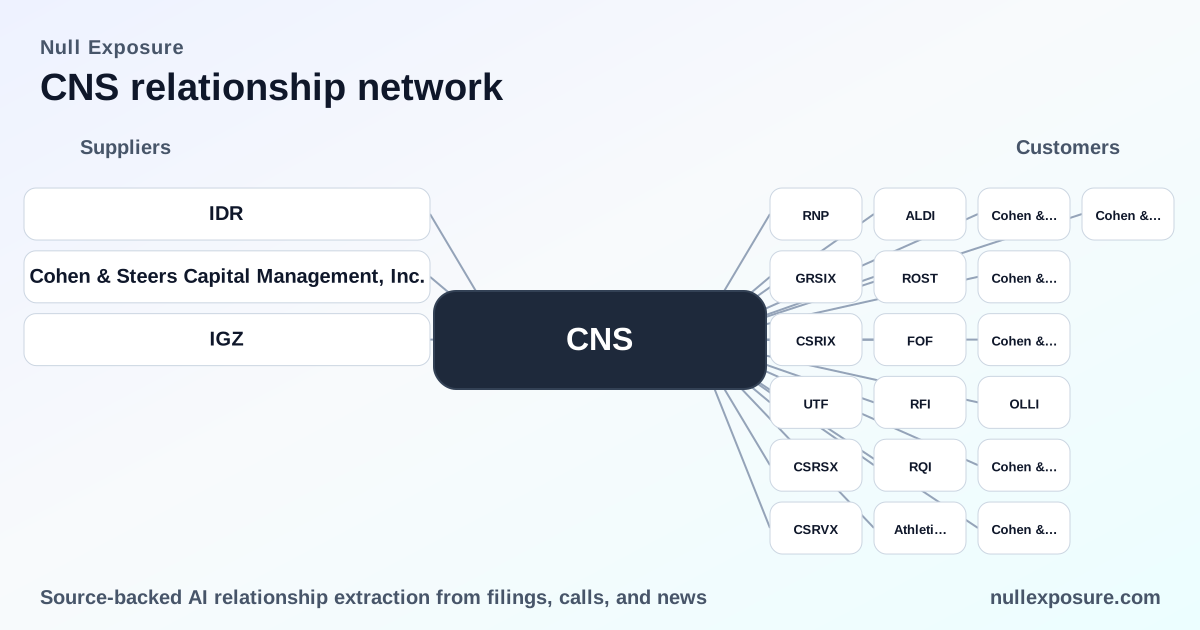
Cohen & Steers (CNS): Supplier relationships that shape a real‑assets boutique’s revenue runway
Cohen & Steers operates as a specialist asset manager focused on real assets, preferred securities, and real estate strategies, monetizing through management fees from mutual funds, ETFs, and externally managed REIT vehicles, plus performance fees where applicable. The firm’s product-led growth — recent active ETF launches and institutional wrappers — creates recurring fee streams tied to assets under management and product distribution, while its external management contracts provide a steadier, contractually defined income line. For investors evaluating supplier exposures, the critical question is how these partner contracts and market distribution channels influence fee stability, concentration risk, and product maturation. For a concise supplier-risk view and relationship mapping, see NullExposure.
How to read the relationships: what matters to investors
Cohen & Steers is not a manufacturing supplier; it is a service supplier to investors and, in some cases, a contracted manager to REITs and institutional vehicles. That business model implies:
- Contracting posture: Contracts range from wholesale fund management agreements to exchange listing relationships; many are standardized management agreements rather than cancellable supply contracts.
- Concentration: Product concentration in real assets and preferred-income niches increases sensitivity to sector flows.
- Criticality: For externally managed vehicles, Cohen & Steers is often the single critical manager whose investment process and distribution sustain the vehicle’s economics.
- Maturity: The firm is mature and public, with FY2025/FY2026 financials reflecting scale (Revenue TTM ~$556m; Market Cap ~$3.25bn), implying established operating infrastructure and distribution.
These are company-level signals derived from financials and product activity rather than contract excerpts. If you want an operationalized supplier-risk dashboard for CNS relationships, visit NullExposure.
Direct relationship rundowns — what the public record shows
IDR: an institutional partner for hybrid real‑estate strategies
According to an earnings call transcript published during the Q4 2025 review, Cohen & Steers launched an institutional vehicle that combines a listed real estate strategy with an indexed approach to core private property funds through partner IDR, indicating a co‑sponsored product aimed at blending public and private real‑estate exposures (InsiderMonkey transcript, Q4 2025 / published Mar 2026). This relationship signals strategic product collaboration to capture institutional flows and broaden fee bases.
Cohen & Steers Capital Management, Inc.: external manager role for CNSREIT
A CityBiz report covering a CNS REIT acquisition notes that CNSREIT is externally managed by Cohen & Steers Capital Management, Inc., a subsidiary of Cohen & Steers, Inc., confirming the firm’s role as the contracted manager for an income‑oriented REIT vehicle (CityBiz, FY2025 reporting). External management contracts such as this create recurring management fees and tie the REIT’s operational continuity and investment approach directly to Cohen & Steers’ capabilities.
NYSE Arca and ETF distribution: new active ETFs trading on an exchange
Multiple press reports in late 2025 and early 2026 document that Cohen & Steers expanded its active ETF lineup with the Cohen & Steers Infrastructure Opportunities Active ETF (CSIO) and the Cohen & Steers Short Duration Preferred and Income Active ETF (CSSD), both now trading on NYSE Arca and targeting infrastructure and preferred securities exposure (SimplyWallStreet and Sahm Capital commentary, FY2025). Listing on NYSE Arca formalizes exchange distribution and positions these ETFs to capture retail and institutional ETF flows — a strategic monetization channel for fee‑bearing products.
Duplicate coverage note (NYSE Arca entries)
Two separate news items echo the same NYSE Arca listing detail (SimplyWallStreet and Sahm Capital, FY2025), reinforcing that the ETF launches were widely covered and represent a meaningful product expansion for the firm’s fee mix.
What these relationships mean for supplier risk and investor strategy
- Revenue diversification through product launches: The NYSE Arca ETF additions broaden the firm’s fee architecture beyond closed‑end funds and separately managed accounts, increasing exposure to ETF flows and their episodic redemptions and inflows. Product launches are a positive diversification vector for fee growth.
- Contracted fee stability from external management: Being the external manager of a REIT creates contractual revenue streams that are highly material to the vehicle, which is positive for fee predictability but concentrates operational risk around Cohen & Steers’ investment and compliance capability.
- Strategic partnerships to access private markets: The IDR partnership to blend listed and core private property funds indicates an institutional push to capture LP and advisory mandates, which can lift AUM quality and fee yield if institutional adoption scales.
Key risks to weigh:
- Fee sensitivity to asset flows in real assets and preferred income (sector concentration).
- Single‑manager reliance for externally managed vehicles increases reputational and operational exposure.
- ETF adoption requires distribution scale; success depends on capturing and retaining passive/active ETF flows in a competitive exchange environment.
Quick bullets for under‑the‑hood diligence
- Examine the external management agreement terms for CNSREIT: termination rights, fee tiering, and indemnities.
- Track AUM flows into the new ETFs (CSIO, CSSD) on NYSE Arca and the institutional vehicle with IDR for early signs of traction or redemption pressure.
- Monitor the firm’s TTM margins and fee revenue cadence to see if product expansion translates into durable fee growth (Revenue TTM ~$556m; Profit Margin ~27.6%).
Constraints and company‑level signals investors need to know
There are no discrete constraint excerpts attached to the relationship records for CNS in this file. As a company‑level signal, the absence of explicit constraints suggests public disclosures and news coverage are the primary sources for mapping supplier exposure rather than contract redlines or regulatory filings embedded in this feed. Investors should treat contracting posture, concentration, criticality, and maturity as inferred operational characteristics — and validate through direct review of management agreements and the firm’s regulatory filings for material terms.
For a structured supplier-risk profile that ties these relationship disclosures to contract terms and market signals, see NullExposure for an actionable view.
Bottom line and investor action points
Cohen & Steers is executing a clear product‑led monetization strategy: ETF launches and institutional partnerships expand fee channels while external management contracts provide recurring income, but the firm also carries concentrated sector exposure to real assets and preferred income niches. Investors and operators evaluating supplier relationships should prioritize contract terms on external management, early flow data for the new ETFs, and the institutional vehicle’s adoption curve with IDR.
To review supplier mappings and construct a monitoring plan for Cohen & Steers’ partner contracts, start at NullExposure.