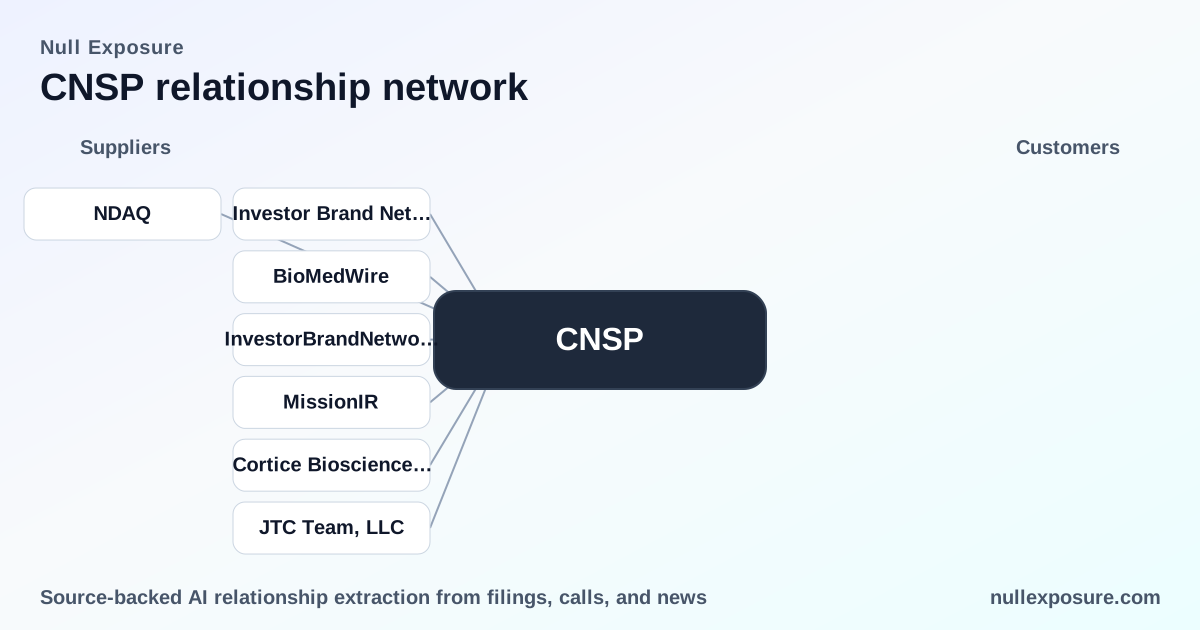
CNS Pharmaceuticals (CNSP): supplier map and what it means for investors
CNS Pharmaceuticals is a clinical-stage biotech focused on therapies for brain and central nervous system tumors, monetizing through advancing clinical candidates, regulatory designations, and eventual licensing or commercialization. The company outsources virtually all clinical operations, manufacturing and investor communications to third parties, making supplier relationships central to execution risk and value realization. For investors evaluating counterparty exposure and operational continuity, the supplier footprint is as material as trial readouts or regulatory milestones. Learn more about supplier intelligence and counterparty risk at https://nullexposure.com/.
Company snapshot: Houston-based, NASDAQ-listed, clinical-stage oncology developer with active programs including TPI-287 and Berubicin; the public record shows heavy reliance on third-party clinical, manufacturing and investor-relations providers.
How CNSP runs its operations and where suppliers matter most
CNSP operates a lean internal organization that contracts out clinical research, manufacturing and many corporate services. That posture produces three immediate characteristics investors should treat as primary lenses:
- Concentration and criticality: Clinical trial delivery — specifically the global trial for Berubicin — depends on one or a small number of CROs; any operational disruption at those vendors has direct program risk.
- Outsourced manufacturing: CNSP explicitly reports it has no in-house manufacturing and therefore delegates production entirely to external manufacturers, which places product supply, quality and regulatory interfaces outside its direct control.
- Information and investor flow: The company consistently uses third-party investor-relations and wire services to distribute news and scientific updates, which shapes market access, messaging cadence and perceived visibility.
These are company-level signals drawn from the firm’s disclosures: the company conducts security reviews of its largest CRO for its global Berubicin trial and confirms all manufacturing is contracted out. This creates operational leverage — both positive (scalability) and negative (vendor concentration risk).
Observed third-party relationships and the public record
Below are every relationship reflected in recent press distributions and media items in the sample set. Each item is a short, plain-English summary with the source context.
Investor Brand Network — Globe and Mail press release (FY2026)
A Globe and Mail press release distributed via Investor Brand Network directed investors to CNSP’s newsroom and outlined a shareholder letter and strategic review; the release served as a formal investor communication channel (FY2026). According to the press release distribution, investors were guided to https://ibn.fm/CNSP for updates.
BioMedWire — CityBuzz feature (FY2025)
An interview published on CityBuzz noted the CEO’s strategy to target glioblastoma by overcoming the blood–brain barrier, and identified BioMedWire (part of MissionIR) as the interview platform (FY2025). The piece reinforces the company’s reliance on specialist health communications channels for clinical narrative.
InvestorBrandNetwork (IBN) — CityBuzz distribution note (FY2025)
The CityBuzz story explicitly states it relied on content distributed by InvestorBrandNetwork (IBN), underscoring IBN’s recurring role in disseminating CNSP announcements (FY2025).
MissionIR — CityBuzz attribution (FY2025)
CityBuzz credited BioMedWire as part of MissionIR, linking CNSP’s CEO interview to MissionIR’s specialized communications network and affirming that the company uses targeted sponsor/distribution platforms to reach healthcare and investor audiences (FY2025).
Cortice Biosciences, Inc. — StockTitan report on Orphan Drug Designation (FY2025)
A StockTitan news item reported that CNSP acquired Orphan Drug Designation for TPI-287 and attributed information to Cortice Biosciences in the distribution — highlighting regulatory progress tied to the TPI-287 program (FY2025).
JTC Team, LLC — various press releases and investor contacts (multiple FYs)
Multiple press items list JTC Team, LLC as the investor-relations contact for CNSP across FY2024–FY2026, including financial results, clinical updates and executive appointments; JTC functions as the external IR firm routing company disclosures to the market (examples across FY2024–FY2026).
- StockTitan noted JTC Team, LLC as the IR contact for the orphan designation announcement and other items (FY2025).
- A Globe and Mail press release also provided JTC contact details in company communications on clinical abstracts and trial updates (FY2025).
- JTC is listed consistently on earnings and corporate updates, supporting the inference that IR is outsourced and centralized through JTC (multiple FY entries).
Nasdaq — reverse stock split / CUSIP update (FY2025)
A Nasdaq-distributed notice reported that beginning February 21, 2025, CNSP’s common stock would trade on a split-adjusted basis under the same symbol but with a new CUSIP number, a technical market-structure update important to custodians and holders (FY2025).
Additional press distributions and clinical updates (various outlets)
Other outlets in the set (StockTitan, AccessNewswire, The Globe and Mail) repeatedly carried CNSP notices — from clinical poster acceptances at the Society for Neuro-Oncology to quarter results and executive hires — all naming external contacts and distribution channels in FY2024–FY2026. These items collectively show a consistent pattern of third-party distribution and IR-managed public disclosure.
What these relationships imply for investor risk and timing
- Execution risk is supplier risk. CNSP’s development timelines and regulatory fortunes are tightly coupled to CRO performance and external manufacturers; the company’s explicit security assessment of its largest CRO for the Berubicin trial is an operational control, but it also flags the criticality of that vendor.
- Communications and market access are outsourced. Consistent use of JTC, IBN, MissionIR and wire outlets creates a predictable information flow, but it concentrates message control with a small set of providers; visibility and narrative framing are therefore vendor-dependent.
- Regulatory progress is a de-risking vector. Publicized items such as Orphan Drug Designation for TPI-287 are value-positive milestones and they rely on external regulatory filing support and scientific documentation from partners. Regulatory designations materially increase optionality for licensing or partnering.
If you want a deeper, transaction-level view of CNSP’s counterparty map and a risk heatmap tied to contract terms and maturity, visit https://nullexposure.com/ for supplier intelligence and actionable reporting.
Recommended investor actions
- Monitor vendor continuity and CRO audit results as leading indicators for trial timeline risk; any supplier disruption is directly material to program delivery.
- Treat IR distributions and wire-service cadence as signals of corporate focus — a flurry of wire items managed by JTC or IBN precedes major regulatory or corporate events.
- Watch regulatory notices (Orphan Drug updates, clinical readouts) for binary value inflection points tied to externally managed programs.
For a tailored supplier-risk briefing tied to CNSP or comparable clinical-stage companies, see our service overview at https://nullexposure.com/.
Bottom line
CNS Pharmaceuticals runs a highly outsourced operating model in which clinical and manufacturing vendors, plus a narrow set of communications partners, are central to the company’s ability to create value. Investors should weight supplier concentration and the continuity of those external relationships alongside clinical and regulatory catalysts when sizing position risk and opportunity. For ongoing supplier monitoring and tailored counterparty analysis, visit https://nullexposure.com/.