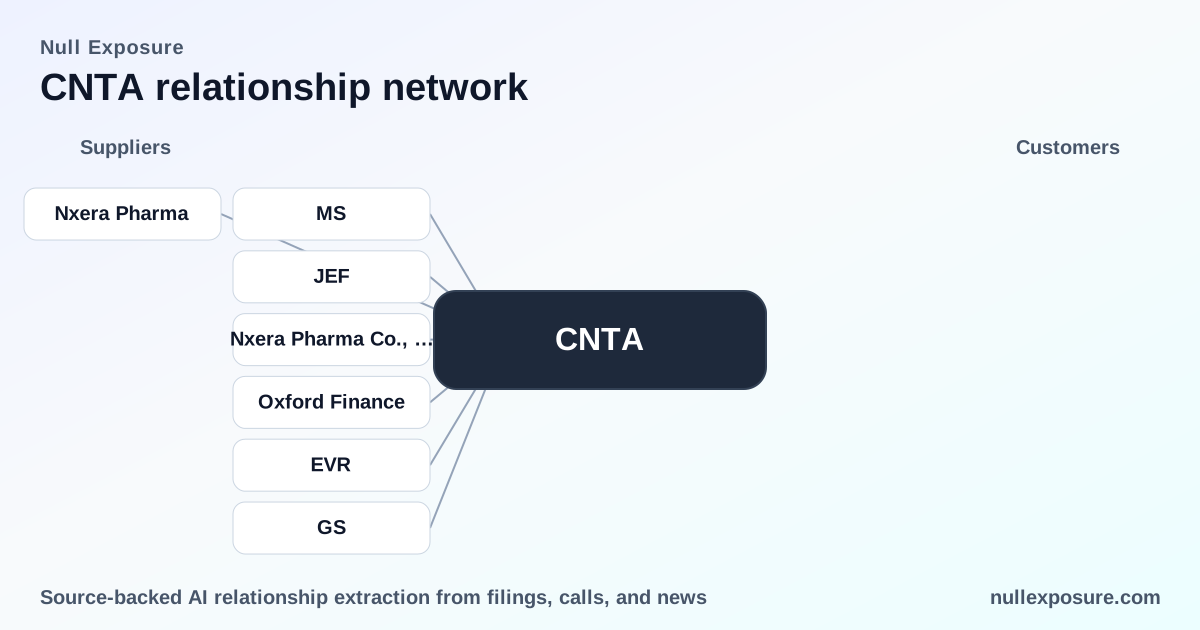
Centessa Pharmaceuticals (CNTA) — supplier relationships, financing partners, and operational constraints investors should track
Centessa Pharmaceuticals operates as a modular drug company that assembles, funds and advances a portfolio of clinical-stage programs developed by internal teams and external collaborators; the company monetizes through equity markets, milestone-driven licensing and collaboration agreements, and anticipated downstream royalties or product revenues if candidates reach commercialization. Centessa’s model is capital-intensive and partnership-dependent: financing and third‑party service agreements are core to its go‑forward plan and to risk allocation across programs. For a concise briefing on supplier and adviser relationships relevant to counterparty risk and portfolio execution, read on — or visit the NullExposure homepage for deeper supplier analytics: https://nullexposure.com/
Quick read: what to watch in Centessa’s supplier map
Centessa runs an outsourced operating model with pronounced dependence on external research, manufacturing and financing partners. Key monitoring priorities for investors are counterparty concentration among CDMOs/CROs, the structure and timing of milestone payments embedded in partnerships, and the sustainability of its financing facilities as the company burns capital through clinical development.
If you want a consolidated supplier risk view and tracking tools, start here: https://nullexposure.com/
Active financing banks and bookrunners (public offering context)
Morgan Stanley (reported via Renaissance Capital, March 2026)
Renaissance Capital’s IPO coverage reported Morgan Stanley was named as one of the joint bookrunners on a Centessa financing, indicating high‑tier capital markets support for the company’s public financing activities. Source: Renaissance Capital IPO Center report, first reported March 9, 2026.
Jefferies (reported via Renaissance Capital, March 2026)
The same Renaissance Capital piece lists Jefferies as a joint bookrunner alongside other global banks, reinforcing Centessa’s strategy of syndicating equity issuance to institutional markets. Source: Renaissance Capital IPO Center report, first reported March 9, 2026.
Evercore ISI (reported via Renaissance Capital, March 2026)
Evercore ISI appears on the joint bookrunner roster in the Renaissance Capital coverage, reflecting Centessa’s use of multiple advisory relationships to underwrite capital raises. Source: Renaissance Capital IPO Center report, first reported March 9, 2026.
Goldman Sachs (reported via Renaissance Capital, March 2026)
Goldman Sachs was named among the joint bookrunners for the transaction reported in Renaissance Capital’s IPO coverage, signaling Centessa’s access to top‑tier distribution channels for equity capital. Source: Renaissance Capital IPO Center report, first reported March 9, 2026.
Lending and financing counterparties supporting trial funding
Oxford Finance (reported via Quiver Quant, FY2025 disclosure)
Centessa disclosed a financing facility with Oxford Finance used to fund planned clinical trials and other expenses, indicating non‑dilutive or structured credit is part of the company’s financing stack for near‑term operational needs. Source: company update cited on Quiver Quant, FY2025.
Research collaboration and milestone payables (small biotech partner)
Nxera Pharma Co., Ltd. — milestone payment of US$4.8 million (reported via Yahoo Finance, FY2025)
A press release reported that Nxera Pharma expected to receive US$4.8 million in milestone payments from Centessa pursuant to their research collaboration, showing Centessa’s program-level obligation profile includes mid‑single‑digit millions in contingent payments. Source: Yahoo Finance press release, reported FY2025.
Nxera Pharma — US$1.8 million milestone (reported via UK Yahoo Finance, FY2026)
A subsequent UK Yahoo Finance item noted a US$1.8 million milestone payment from Centessa, demonstrating multiple discrete triggers in the collaborative agreement over time. Source: UK Yahoo Finance press release, reported FY2026.
Nxera Pharma — US$3.0 million milestone (reported via UK Yahoo Finance, FY2026)
Another related report described a US$3.0 million milestone payment to Nxera pursuant to the research collaboration, confirming staggered milestone mechanics and active cash‑flow obligations to external partners. Source: UK Yahoo Finance press release, reported FY2026.
What the relationships collectively tell an investor
- Capital markets access is diversified among top-tier banks. Centessa used multiple global bookrunners (Morgan Stanley, Goldman Sachs, Jefferies, Evercore ISI) for offerings, which supports distribution but increases underwriting fees and conditional covenants typical of public financings. (Source: Renaissance Capital IPO Center, March 2026.)
- Non‑equity financing is in place to bridge clinical spend. The Oxford Finance facility provides a credit layer to fund trials without immediate dilution, but it introduces repayment and covenant risk if development delays occur. (Source: company disclosure cited on Quiver Quant, FY2025.)
- Program‑level vendor obligations are real and cash‑bearing. The Nxera payments (multiple discrete milestones totalling several million dollars across FY2025–FY2026 announcements) illustrate how Centessa’s collaborations convert R&D progress into fixed cash outflows. (Sources: Yahoo Finance UK and US press items, FY2025–FY2026.)
Operational constraints and company‑level signals investors should catalog
Centessa’s filings surface a consistent operating posture: framework and licensing contracts, heavy reliance on third‑party service providers and CDMOs/CMOs, geographically distributed staff across NA and EMEA, and program spend in the low‑millions per contract. Specific signals from corporate disclosures include:
- Master services and framework agreements exist with affiliated discovery companies (document cites arrangements with entities tied to David Grainger), indicating structured, ongoing supplier relationships rather than ad hoc vendor purchases.
- The company has entered various licensing agreements to secure patent rights for development and commercialization, pointing to a portfolio built through negotiated IP transfers and option structures.
- Centessa depends on external CDMOs/CMOs and CROs for manufacturing and trial execution; the firm does not own manufacturing capacity, making counterparty continuity a critical execution risk.
- Geography: headcount and operations span the U.S., U.K. and EU, consistent with NA and EMEA supplier exposure and corresponding regulatory/compliance footprints.
- Spend and scale: R&D expense reporting shows contract expenses in the $1m–$10m band for specific provider relationships (e.g., $5.36m R&D cost line in 2023), highlighting meaningful program-level cash commitments.
These constraints constitute firm-level signals about concentration, criticality and contractual posture: Centessa operates a networked R&D model with repeated, material payments to external partners and structured financing to bridge clinical development.
If you want a downloadable risk matrix that maps these constraints to counterparties, explore our supplier intelligence hub: https://nullexposure.com/
Investment implications and risk checklist
- Execution risk is counterparty risk. With no internal manufacturing and material milestone obligations, a slowdown or failure at a major CMO/CRO or a breakdown in licensing terms will directly delay timelines and increase cash burn.
- Financing runway is managed through a mixed stack. Equity syndication (multiple bookrunners) and credit facilities (Oxford Finance) lower near‑term dilution but introduce covenant and cash‑flow pressure if clinical readouts slip.
- Program-level cash commitments are predictable and material. The Nxera milestones show Centessa’s obligations crystallize as development progresses; cumulative small‑to‑mid single‑digit million payments add up across a multi‑program portfolio.
For a vendor‑level diligence briefing tied to balance sheet exposure, check our supplier reports: https://nullexposure.com/
Bottom line
Centessa’s operating model is intentionally externalized: its value hinges on portfolio progression but its execution depends on a small network of financial and service suppliers whose continuity and contract terms determine near‑term solvency and long‑term optionality. Investors should prioritize monitoring milestone schedules, counterparty concentration among CMOs/CROs, and the terms of financing facilities when assessing downside risk and upside timing.