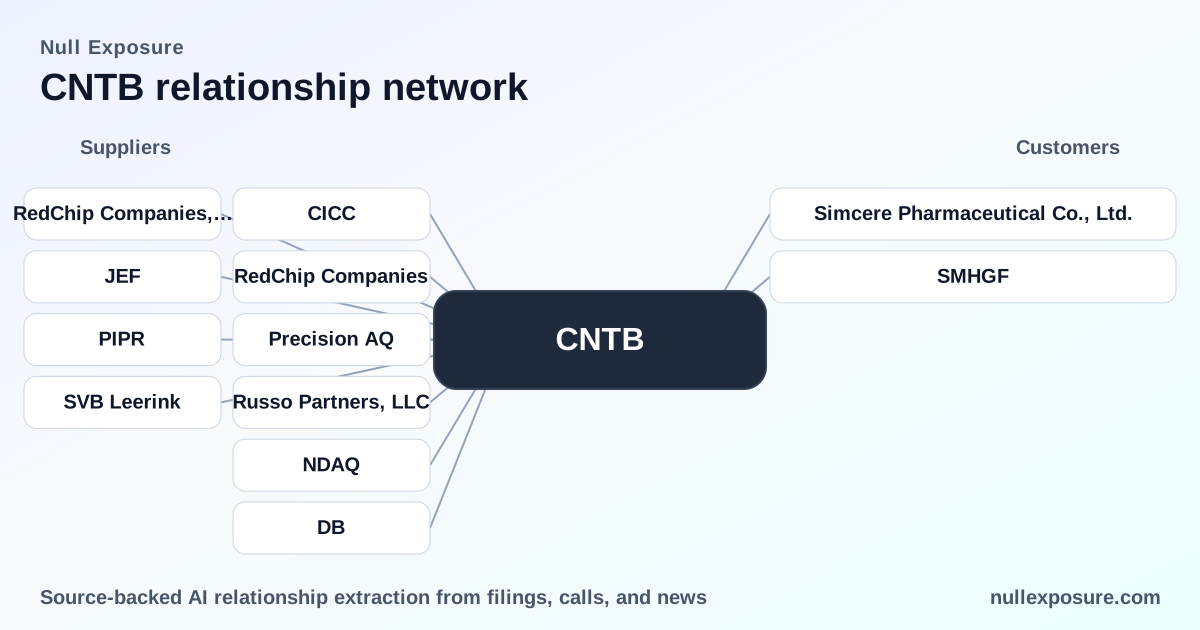
Connect Biopharma (CNTB) — supplier relationships, commercial posture, and operational constraints
Connect Biopharma (NASDAQ: CNTB) is a clinical-stage immunology drug developer that monetizes by advancing proprietary immune-modulating biologics through clinical programs and, ultimately, commercial licensing or direct sales. Revenue today is negligible; value is driven by clinical progress and control of outsourced R&D and manufacturing workflows. For investors and operators evaluating supplier exposure, the company’s public communications reveal a small, focused set of investor‑relations and development partners plus third‑party manufacturing and CRO dependence that collectively determine execution risk. Learn more at https://nullexposure.com/.
How Connect runs its R&D engine and where suppliers sit in the value chain
Connect outsources much of its non‑core activity. The company contracts third parties to manufacture clinical material and to run preclinical and clinical work, while also engaging external investor‑relations and communications firms to manage market visibility. That operating posture places supplier relationships at the center of execution risk — manufacturing approvals or CRO performance will directly affect timelines and potential value realization.
Key operating signals:
- Contract mix and term structure is mixed. The company maintains both short‑term and longer leases for facilities (San Diego lease expiring April 30, 2025; Taicang lease expiring April 30, 2026), indicating a hybrid footprint and flexible footprint posture rather than large proprietary manufacturing capacity. (Company filing language.)
- Manufacturing is material. Regulatory approval of third‑party manufacturing facilities is explicitly flagged as capable of materially affecting development and commercialization. This elevates supplier criticality for investors. (Company filing language.)
- Service provider dependence. Connect states it relies on CROs, independent investigators and CMOs for trials and production, and uses external IR and media shops for investor communications — a typical clinical‑stage biotech model with concentrated external touchpoints. (Company filing language.)
If you want a deeper supplier map for due diligence, visit https://nullexposure.com/ to explore further.
The supplier roster — who Connect cites publicly and what each relationship represents
Below are every relationship referenced in the public items supplied; each entry is a concise, plain‑English summary with a source reference.
-
CICC — CICC acted as a lead manager on Connect’s U.S. offering alongside global banks, indicating investment‑banking support for capital markets transactions. (Renaissance Capital coverage of the deal, FY2021: https://www.renaissancecapital.com/IPO-Center/News/79655/Chinese-inflammatory-disease-biotech-Connect-Biopharma-prices-upsized-US-IP)
-
Jefferies — Jefferies served as a lead manager on the same transaction, providing underwriting and syndicate execution for Connect’s U.S. capital raise. (Renaissance Capital, FY2021: https://www.renaissancecapital.com/IPO-Center/News/79655/Chinese-inflammatory-disease-biotech-Connect-Biopharma-prices-upsized-US-IP)
-
Piper Sandler — Piper Sandler also participated as a lead manager on the offering, contributing placement and distribution capabilities for the equity issuance. (Renaissance Capital, FY2021: https://www.renaissancecapital.com/IPO-Center/News/79655/Chinese-inflammatory-disease-biotech-Connect-Biopharma-prices-upsized-US-IP)
-
SVB Leerink — SVB Leerink is listed among the underwriting syndicate for the same deal, supplying healthcare‑sector research and transaction support. (Renaissance Capital, FY2021: https://www.renaissancecapital.com/IPO-Center/News/79655/Chinese-inflammatory-disease-biotech-Connect-Biopharma-prices-upsized-US-IP)
-
RedChip Companies / RedChip Companies, Inc. — RedChip is a paid investor‑relations and media partner for Connect, hosting webinars and producing broadcast interviews that increase retail and small‑cap visibility. Multiple press releases from late 2025 and early 2026 identify Connect as a RedChip client. (Sample press release, November 3, 2025 webinar notice: https://www.dispatch.com/press-release/story/127792/join-connect-biopharmas-exclusive-live-investor-webinar-and-qampa-session-on-november-3/)
-
Precision AQ — Precision AQ is named as an investor relations contact in press releases, indicating IR support or agency engagement for Connect’s market communications. (Company press release reporting ADR termination, FY2025: https://finance.yahoo.com/news/connect-biopharma-completes-termination-american-120000643.html)
-
Russo Partners, LLC — Russo Partners is listed as a media contact for multiple corporate releases, consistent with retained public‑relations services supporting corporate disclosures and investor events. (GlobeNewswire corporate release, May 15, 2025: https://www.globenewswire.com/news-release/2025/05/15/3082224/0/en/Connect-Biopharma-Reports-First-Quarter-2025-Financial-Results-and-Provides-Business-Update.html)
-
Deutsche Bank Trust Company Americas — Deutsche Bank served as the depositary under the company’s prior ADR program; Connect completed termination of that Deposit Agreement as it migrated to direct Nasdaq listing. That relationship governed ADR custody and transfer mechanics. (Company filing and press releases on ADR termination, FY2025: https://finance.yahoo.com/news/connect-biopharma-completes-termination-american-120000643.html)
-
Nasdaq Global Market (NDAQ) — Connect transitioned to direct listing of ordinary shares on the Nasdaq Global Market under the symbol CNTB, making Nasdaq the trading venue and ecosystem partner for Connect’s public equity. (Press release on listing change, FY2025: https://www.stocktitan.net/news/CNTB/connect-biopharma-completes-termination-of-its-american-depositary-ol0rct537pxn.html)
Each of the items above is drawn from Connect’s public press materials and syndicate coverage; investor relations and communications firms dominate the roster alongside banks and custody agents necessary for U.S. capital markets access.
What these relationships tell an investor about operational risk and concentration
- Externalized R&D and manufacturing: The firm’s reliance on CMOs and CROs creates single‑point execution risk — if a manufacturing facility loses regulatory approval, development timelines and value could be materially impaired. This is a company‑level constraint flagged in filings.
- Capital markets partners are established but standard: Lead managers and the Nasdaq listing validate investor access and liquidity channels, but they do not reduce operational execution risk.
- IR and PR are actively outsourced: Multiple retained agencies (RedChip, Precision AQ, Russo Partners) indicate a proactive market‑outreach strategy appropriate for a small‑cap biotech; this controls narrative but also increases dependence on external messaging.
- Facility and lease structure is mixed maturity: The presence of both short‑term and longer leases suggests flexibility in footprint but also a limited in‑house manufacturing base, reinforcing CMO dependence.
If you are mapping exposure across counterparties and want a consolidated view of supplier criticality, check the supplier intelligence hub at https://nullexposure.com/.
Practical checklist for investor diligence
- Confirm which specific CMOs/CROs carry the rademikibart and other program manufacturing loads and review their regulatory inspection history.
- Track lease expirations and any announced transitions to U.S. CMOs (the company cited transferring the initial manufacturing process to a U.S. CMO).
- Monitor press and filings for any regulatory action tied to third‑party facilities — the company explicitly states loss of facility approval would be materially adverse.
- Assess concentration among IR/PR vendors and whether fees or contractual terms create dependency on a narrow communications set.
Bottom line and recommended next steps
Connect’s supplier profile is typical for a clinical‑stage biotech: high operational leverage to a small set of external manufacturers and service providers, coupled with active use of external IR and banking partners to manage capital markets access. For investors, the primary value drivers are clinical progress and uninterrupted manufacturing supply; both are controlled primarily by third parties. For targeted supplier due diligence and a full counterparty map, visit https://nullexposure.com/ and request the supplier intelligence briefing. For portfolio managers looking to quantify supplier concentration risk ahead of next clinical readouts, review Connect’s third‑party manufacturing contracts and regulatory correspondence as the next priority — you can start that process at https://nullexposure.com/.