CNX Resources: supplier relationships that matter to credit and operations investors
CNX Resources operates as an independent oil and natural gas E&P focused on the Appalachian Basin; it monetizes production through gas sales, midstream services and occasional capital markets activity (debt offerings and tender offers) to manage leverage and liquidity. Revenue is generated from gas production and resale, while financing and legal counterparties materially shape execution of capital transactions. For investors evaluating supplier exposure, the supplier relationships around CNX’s recent note offerings and operational rollouts reveal both funding channels and field-level service dependencies. Learn more and track counterparties at https://nullexposure.com/.
How CNX makes money and why suppliers matter
CNX extracts, gathers, processes and sells natural gas; it also uses third-party pipelines and gathering services to deliver volumes to market. The company’s operating margin and free-cash generation are directly influenced by: contractual access to midstream capacity, the cost and rollout of field services (e.g., flowback automation), and the efficiency of capital markets execution when CNX refinances debt. CNX’s financial profile (approximately $2.07B revenue TTM, market cap ~$5.98B and EBITDA ~$1.46B) underscores a capital-intensive business where supplier arrangement terms translate into unit economics and balance-sheet flexibility.
Who CNX is doing business with right now — relationship-by-relationship
Below I cover every supplier or counterparty flagged in the public reporting and news items for FY2026. Each entry is a plain-English summary with a source.
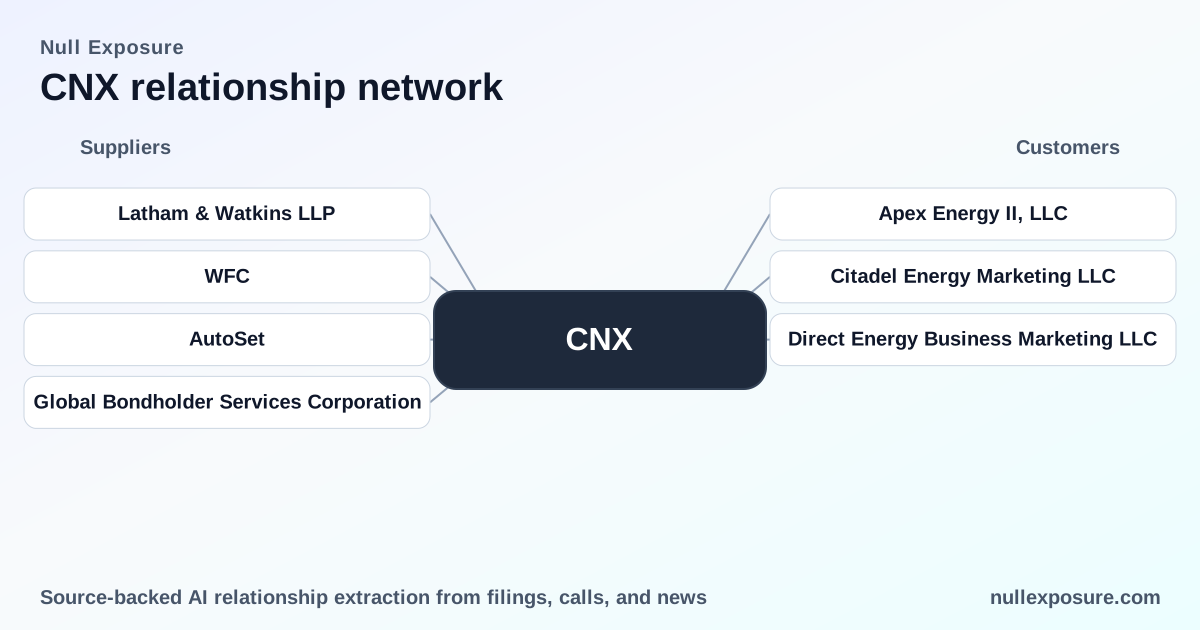
Latham & Watkins LLP — legal counsel on securities work
Latham & Watkins acted as legal advisor to CNX on a senior notes offering and a concurrent tender offer, deploying corporate and capital markets partners to support transaction documentation and regulatory filings. This engagement is documented in a Latham press release tied to CNX’s FY2026 financing activity (https://www.lw.com/en/news/2026/02/latham-advises-cnx-resources-on-senior-notes-offering-and-concurrent-tender-offer).
Wells Fargo Securities, LLC — dealer manager and initial purchaser representative
Wells Fargo operated as Dealer Manager for CNX’s tender offer and also served as the representative of the initial purchasers in a private placement of $500 million of 5.875% senior notes due 2034, handling both distribution and placement mechanics. PR Newswire and market reports confirm Wells Fargo’s dual role in the tender and private offering in FY2026 (PR Newswire: https://www.prnewswire.com/news-releases/cnx-resources-corporation-announces-final-results-and-expiration-of-tender-offer-for-its-6-000-senior-notes-due-2029--302695145.html; TradingView coverage: https://www.tradingview.com/news/tradingview:906e96db545d2:0-cnx-resources-lines-up-500-million-5-875-senior-notes-due-2034-closing-expected-feb-26/).
Global Bondholder Services Corporation — tender agent and information agent
Global Bondholder Services acted as the tender agent and information agent for CNX’s tender offer, managing communications and processing for noteholders during the offer window. This role is described in the company’s tender-offer announcement (PR Newswire, FY2026 — https://www.prnewswire.com/news-releases/cnx-resources-corporation-announces-final-results-and-expiration-of-tender-offer-for-its-6-000-senior-notes-due-2029--302695145.html).
AutoSet — field service technology used on flowbacks
CNX has internalized and adopted AutoSet technology for flowbacks to achieve cost, environmental and safety improvements; operational execution is outsourced to an oilfield-services partner that is deploying AutoSet across Appalachia. The Q4 2025 earnings call transcript references AutoSet adoption and the outsourcing model (InsiderMonkey, Q4 2025 earnings call transcript — https://www.insidermonkey.com/blog/cnx-resources-corporation-nysecnx-q4-2025-earnings-call-transcript-1685266/).
What these relationships tell investors about CNX’s operating model
CNX’s supplier footprint in the disclosed items shows a hybrid operating posture: heavy reliance on capital markets intermediaries for financing and a mix of internalized technology with outsourced field execution. From the constraints and relationship evidence, investors should treat the following as company-level signals rather than counterparty-specific claims:
- Contracting posture: long-term commitments are embedded. CNX discloses long-term unconditional purchase obligations for equipment, firm transportation and drilling services, indicating multi-year supplier commitments that lock in capacity and capital spend profiles.
- Operational criticality: midstream dependency is material. Although CNX owns midstream assets, the company depends on third-party gathering, processing and pipeline capacity to deliver volumes; disruptions to these networks would force production curtailments or higher replacement costs, directly pressuring margins.
- Buyer and service-provider roles coexist. CNX acts both as a buyer of services and capacity (gathering, transportation, equipment) and as a principal seller/marketer of environmental attributes via third-party service providers who generate and market credits on its behalf.
- Relationship maturity and stage: active, ongoing operational contracts. The company reports active third-party gathering arrangements and long-term purchase obligations that reflect mature supplier relationships rather than short-term spot sourcing.
These signals combine to present a business that trades operational flexibility for cost certainty via long-term contracts while relying on capital markets relationships to manage the liability profile.
Strategic and risk implications investors should watch
- Counterparty concentration in capital markets execution is notable: major underwriters and dealer managers execute CNX’s debt transactions, and any disruption in access to these services would slow refinancing or tender activity.
- Midstream service dependency is a single-point operational risk that can translate quickly into volume and revenue volatility if pipelines or processing capacity are constrained.
- Operational tech rollout is a path to lower unit costs, evidenced by AutoSet adoption; successful scaling reduces opex and enhances environmental credentials, but rollout requires reliable third-party OFS execution.
If you are analyzing credit or supplier exposure, stress scenarios should include midstream outage, increased service pricing under long-term obligations, and contested access to capital markets during adverse credit cycles.
For a complete picture of counterparties and to model counterparty exposure across suppliers, visit https://nullexposure.com/ for deeper tracking and sourcing.
Bottom line and recommended next steps
CNX’s public supplier signals show a company balancing long-term operational contracts with targeted capital markets activity. Key leverage points for investors are midstream access and the company’s ability to execute structured debt transactions. Monitor: (1) announcements from major dealers (Wells Fargo) and tender agents, (2) operational notices from gathering partners, and (3) progress on field automation rollouts such as AutoSet.
If you evaluate supplier risk or build counterparty-adjusted forecasts, start with the servicing and midstream contracts and overlay the timing of planned financing windows. For ongoing monitoring and comprehensive supplier intelligence, check https://nullexposure.com/.
Contact your coverage team or use the Nullexposure platform to map these relationships into your investment or operational models and to receive alerts on changes to counterparty roles.