Vita Coco (COCO): Supply relationships, concentration points, and what investors should price in
Vita Coco operates an asset‑light beverage business that sources coconut water from a global network of independent factories and monetizes through branded retail and direct‑to‑consumer sales of packaged coconut water and related products. The company relies on contract manufacturers and third‑party logistics to scale distribution while preserving a low fixed‑asset base; revenue comes from branded product sales across the U.S., Canada, Europe, Middle East and Asia Pacific. Profitability and growth therefore hinge on supply continuity, packaging partners, and the efficiency of third‑party co‑packers. To review supplier risk with the full context of relationships and disclosures, see https://nullexposure.com/.
Quick take: one supplier is disproportionately important
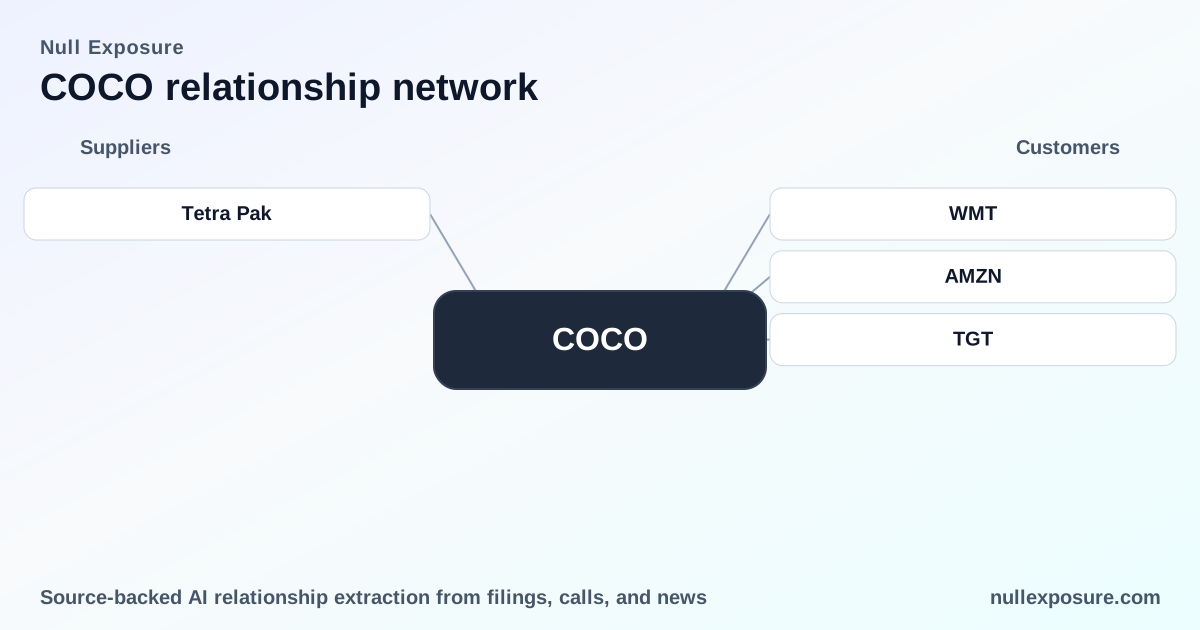
Vita Coco discloses that the majority of its products are produced and packaged using materials from a single supplier, Tetra Pak, creating a concentration in packaging inputs that is critical to operations. According to TradingView’s report on Vita Coco’s SEC filing (10‑K) in FY2026, the company identifies dependence on Tetra Pak for packaging materials. This single‑supplier posture is a strategic efficiency but also a single point of failure that investors must price into the stock.
- Key business driver: asset‑light manufacturing via contract manufacturers and co‑packers across 17 factories in seven countries gives geographic supply diversification for raw coconut water.
- Key risk driver: centralized packaging sourcing with Tetra Pak increases supplier concentration risk and operational leverage to packaging availability and pricing.
Explore supplier relationships and risk signals in more depth at https://nullexposure.com/.
How the supply chain is structured and why it matters
Vita Coco’s model is explicitly outsourcing‑oriented: the company sources raw product from a diversified global network of 17 factories across seven countries supported by thousands of coconut farmers, but does not own these factories. This is a deliberate contracting posture: low fixed assets, greater flexibility, and dependence on third parties for manufacturing scale. Company disclosures list the Philippines, Indonesia, Malaysia, Thailand, Sri Lanka, Brazil, and Vietnam among sourcing and processing geographies, underscoring a meaningful APAC footprint complemented by other regions.
Because packaging flow is centralized through a dominant supplier relationship, the supply chain combines global raw-material diversity with packaging concentration—a hybrid that reduces agricultural exposure while concentrating operational risk in the packaging layer. Company filings and the FY2026 10‑K language support this characterization.
Relationship breakdown: Tetra Pak
Tetra Pak — Vita Coco depends on Tetra Pak for packaging materials and related efficiencies in exporting and sustainability efforts. According to TradingView’s write‑up of Vita Coco’s FY2026 SEC 10‑K, the company states it “depends on a single supplier, Tetra Pak, for packaging materials.” This supplier is described as integral to packaging near source and enabling responsible sourcing and export logistics (TradingView report on Vita Coco 10‑K, FY2026).
- Tetra Pak is critical for packaging: the company cites Tetra Pak as the primary source of packaging materials across products, which provides efficiency but concentrates risk (TradingView summary of the company’s FY2026 10‑K).
- The company frames that relationship as supporting sustainability and packaging‑near‑source, indicating both operational benefits and strategic alignment with sustainability goals (company filing language cited in FY2026 disclosures).
Company‑level constraints that shape partner risk and maturity
Several constraints and signals from the company’s disclosures provide the broader context investors need to evaluate supplier exposure:
- Global sourcing with regional concentration in APAC. Vita Coco’s sourcing spans multiple countries and 17 factories, indicating operational maturity in establishing supplier networks and farmer relationships across geographies, particularly in Asia‑Pacific (company disclosure).
- Contract manufacturing posture. Vita Coco expressly uses contract manufacturers, co‑packers, and third‑party logistics rather than owning production assets, which creates flexibility but increases dependence on commercial contracts and counterparty performance (company filing language).
- Materiality and criticality. The company characterizes the packaging relationship with Tetra Pak as material and critical because packaging is central to product export and sustainability commitments; this is a company‑level signal that justifies higher operational monitoring (company disclosure).
- Service relationships and limited spend lines. Vita Coco also discloses a distribution/service arrangement involving a stockholder where the company shared in compensation costs for an employee managing the China market, recording $181, $151 and $234 in selling, general and administrative expenses for the years ended December 31, 2024, 2023 and 2022, respectively, which shows some small but recurring contractual service spend (company filing).
These constraints indicate a mature, outsourced operating model with clear concentration in packaging but diversified raw sourcing; investors should therefore evaluate counterparty stability and contract terms rather than raw supplier count alone.
What investors should watch next
- Contract terms with Tetra Pak. Confirm the tenor, exclusivity, and fallback provisions of any packaging agreements—shorter contracts or clauses allowing rapid supplier substitution reduce risk; long, exclusive partnerships increase it.
- Packaging capacity and pricing dynamics. Monitor global packaging commodity and capacity trends, as disruptions or price inflation in carton packaging will flow directly to Vita Coco’s cost of goods sold and margins.
- Manufacturing footprint resilience. The 17‑factory network is an important buffer, so track any factory closures, consolidation among co‑packers or geopolitical disruptions in APAC that could impair throughput.
- Disclosure of contingency planning. Investors should press for disclosure on dual‑sourcing strategies, alternative packaging qualification plans, and inventory buffers that mitigate single‑supplier risk.
If you want a structured supplier risk brief or ongoing monitoring of Vita Coco’s partner exposures, visit https://nullexposure.com/ for tailored supplier‑risk intelligence.
Investment implication and action checklist
In practice, Vita Coco’s profile is growth‑oriented with concentrated operational risk. The combination of strong brand economics and packaging concentration produces both upside (brand premium, margin expansion) and downside (single‑point packaging disruption). For investors:
- Evaluate valuation vs. scenario analyses that stress packaging disruptions and margin compression.
- Engage management or review investor materials for clarity on Tetra Pak contract terms and contingency measures.
- Monitor reported SG&A lines tied to third‑party service arrangements for signs of changing commercial relationships.
For a deeper, ongoing supplier risk view that integrates filings and market signals, see https://nullexposure.com/.
Bottom line
Vita Coco’s asset‑light, contract‑centric business drives scalable revenue but concentrates execution risk in packaging through a single supplier relationship with Tetra Pak—a material and operationally critical dependency disclosed in the company’s FY2026 SEC filing. Investors should balance the company’s global sourcing diversity and brand strength against this packaging concentration when modeling downside scenarios and in any engagement with management.