Compass Diversified (CODI): supplier posture, manager links, and what investors should price in
Compass Diversified (CODI) operates as a publicly traded holder of middle‑market businesses across consumer, industrial, and outdoor sectors, monetizing through portfolio-level cash flows, realized proceeds from divestitures and a traditional external management arrangement that collects a quarterly management fee from the LLC. CODI’s economics are driven by active portfolio management, selective leverage and an external manager relationship that is contractually compensated, creating a predictable base of operating expense for portfolio companies while concentrating operational execution through third‑party managers. For a deeper supplier-risk view linked to CODI’s operating model, visit https://nullexposure.com/.
How CODI runs the portfolio and where supplier risk sits
CODI is structured to centralize capital and governance while leaving day‑to‑day operations with its portfolio companies and, importantly, with an external manager. The company overview identifies CODI as a conglomerate-style private equity vehicle listed on the NYSE; its public metrics show meaningful revenues but episodic profitability, reinforcing the importance of cash generation at the portfolio-company level.
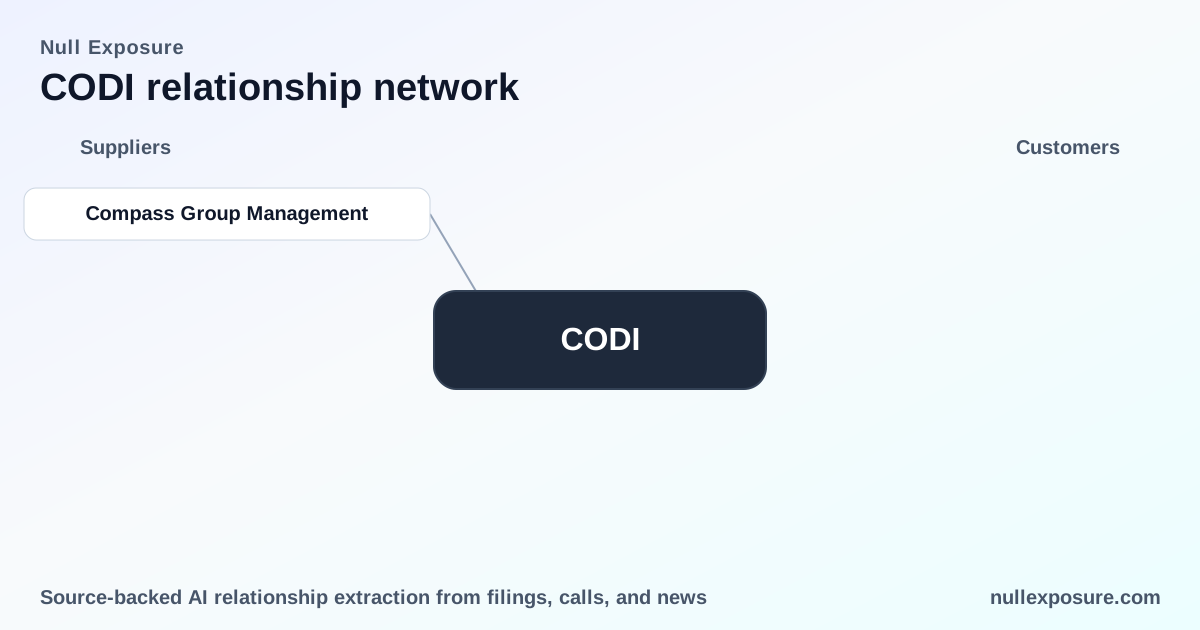
- External management is explicit and contractually set: the LLC’s Master Services Agreement (MSA) with Compass Group Management (CGM) — effective May 16, 2006 — obligates CGM to provide management services for a quarterly fee equal to 0.5% of the LLC’s adjusted net assets, embedding a recurring cost into CODI’s governance structure.
- Supplier exposures are heterogeneous across portfolio companies: CODI’s operating companies demonstrate a mix of asset‑lite supply models and concentrated single‑vendor dependencies, producing different supplier-risk profiles across the portfolio.
For more context on how supplier relationships map back to portfolio value and where to focus diligence, see https://nullexposure.com/.
Supplier constraints that shape CODI’s exposure
The available evidence produces company‑level signals that investors should interpret as structural constraints on CODI’s operating model and sourcing risk:
- Contracting posture — framework agreements are common. Evidence shows portfolio companies use framework supply agreements and renegotiated terms to scale volumes and manage lead times; this suggests a preference for stable, long‑duration supplier relationships rather than spot sourcing.
- Geographic footprint — global but North America‑centered. Multiple excerpts indicate North America as the primary headquarter and sourcing region, with APAC and EMEA present for manufacturing and raw materials — an operational mix that creates both near‑market advantages and offshore manufacturing dependencies.
- Concentration and criticality vary by business. Some portfolio companies rely on a sole supplier for critical components (for example, a supplier accounting for ~70% of a company’s purchases), while others maintain diversified vendor bases where no single vendor exceeds 10% of spend.
- Maturity and relationship stage range from mature, decade‑long partnerships to active supplier networks. Where relationships are mature, switching costs and vendor lock‑in amplify execution risk; where active networks exist, scalability and contingency capacity are the focus.
- Spend bands indicate material mid‑market outlays. Purchase histories show transactions spanning $1m–$10m and $10m–$100m annually with individual suppliers, reinforcing that supplier disruptions can be financially meaningful to portfolio companies.
These constraints are presented as company-level signals unless a constraint excerpt explicitly names a relationship.
What we found on Compass Group Management — primary relationship entries
The research returns two distinct references to Compass Group Management; both reference the same organizational update around CODI’s earnings commentary.
- An Insidermonkey transcript of CODI’s Q3 2025 earnings call noted organizational changes at Compass Group Management, described during management remarks on March 9, 2026. The mention highlights CGM’s ongoing role as CODI’s external manager and signals active governance adjustments at the manager level (Insidermonkey, Q3 2025 / first seen Mar 9, 2026).
- A Globe and Mail/Motley Fool transcript of the same CODI earnings call reiterated the same update on organizational changes at Compass Group Management, reflecting consistent public disclosure across outlets on March 9, 2026. The duplicate coverage confirms that CGM’s structure and leadership were material to the quarter’s commentary (Globe and Mail / Motley Fool, Q3 2025 earnings transcript, Mar 9, 2026).
In addition to the call coverage, the LLC’s MSA with CGM is a contractual fact: the MSA, effective May 16, 2006 and as amended, requires CGM to perform management services for a quarterly fee equal to 0.5% of the LLC’s adjusted net assets, directly tying manager compensation to the asset base.
Why these relationships and constraints matter to investors and operators
CODI’s value hinges on execution at the portfolio-company level and the stability of supplier and manager arrangements that deliver that execution. Key implications:
- Manager alignment and fixed-cost leakage. The MSA’s 0.5% quarterly fee is an embedded cost that persists through market cycles, creating a predictable but nontrivial expense line that investors should quantify when modeling distributable cash flow.
- Concentration risk can be binary. At portfolio companies with sole-source suppliers supplying up to ~70% of a category, a supply disruption would translate directly into realized EBITDA pressure; conversely, businesses with diversified vendor bases dilute single‑supplier risk.
- Geographic mix drives both margin and fragility. Heavy APAC production for apparel and component-intensive businesses reduces unit costs but increases exposure to trade, labor and logistics volatility.
- Contracting posture shapes optionality. Framework agreements and mature supplier relationships increase predictability but also raise switching costs; investors should favor companies that use frameworks to extract operational leverage rather than to lock in supplier premiums.
Quick takeaways for diligence and portfolio management
- Validate the external manager economics. Model the 0.5% MSA fee against adjusted net assets to understand its drag on returns.
- Map single‑supplier dependencies at the portfolio level. Identify suppliers contributing >20% of a business’s purchases and assess contingency plans.
- Stress-test geographic production scenarios. Simulate APAC disruptions and their impact on working capital and margins.
- Benchmark contracting terms across the portfolio. Determine where framework agreements deliver scale benefits versus where they create lock‑in risk.
For investors and operators seeking an actionable supplier-risk profile tied to CODI’s portfolio, start with an integrated supplier map at the portfolio-company level — more resources are available at https://nullexposure.com/.
Next steps: where to focus capital and operational attention
CODI’s thesis depends on disciplined portfolio management, stable external management arrangements and mitigating supplier concentration where it threatens cash flow. Priorities for active investors are material exposure reduction on sole‑source relationships, close scrutiny of CGM’s governance changes, and scenario planning for APAC production shocks. For operators, renegotiating framework terms for contingency and capacity flexibility should be urgent where supplier spend is large.
If you want a structured supplier-risk assessment tied to CODI’s public disclosures and portfolio characteristics, visit https://nullexposure.com/ to commission a focused review and benchmarking package.