CODI-P-B: What investors and operators need to know about Compass Diversified’s supplier footprint
Compass Diversified Holdings issues the 7.875% Series B fixed-to-floating cumulative preferred shares to raise durable capital while it sources, acquires, and manages a portfolio of middle‑market businesses across consumer and industrial sectors. CODI monetizes through active ownership of operating companies, extracting cash flow via dividends, asset sales, and operational improvements; the preferred shares deliver a high-coupon claim with cumulative protection for income-focused holders. For investors and operating partners, the two supplier‑facing items surfaced in public reporting this cycle — an acquisition and a governance/audit review — are the clearest, actionable signals about near‑term operational priorities. For deeper supplier‑relationship intelligence, visit https://nullexposure.com/.
The headline relationships: acquisition and audit, stated plainly
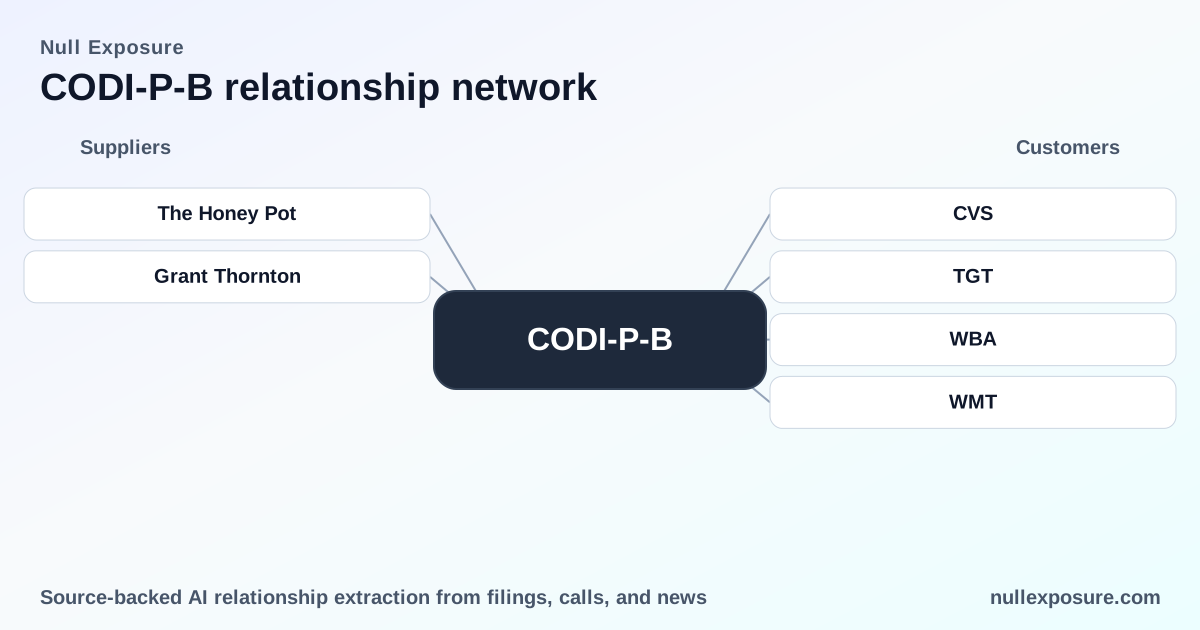
These are the two supplier‑scope relationships surfaced in public filings and press coverage. Each is summarized below in plain English with the reporting source.
The Honey Pot — a meaningful add to CODI’s consumer roster
Compass Diversified acquired a majority stake in personal care brand The Honey Pot for $380 million, a large consumer acquisition that expands CODI’s exposure to direct‑to‑consumer personal care and brand‑driven retail. According to Fortune (reporting on FY2024 activity), the transaction is positioned as a growth bolt‑on to CODI’s consumer portfolio and represents material capital deployment into brand assets.
Grant Thornton — independent review tied to financial statements and forbearance
A Compass Diversified press release referenced the timing and conclusions of a Grant Thornton review concerning an investigation and CODI’s financial statements, linked to an extended forbearance arrangement announced in 2025. The GlobeNewswire filing (July 2025) connects the external auditor’s review timeline to CODI’s covenant negotiations and lender communications, elevating governance and reporting into the front‑line supplier‑risk conversation.
Why these relationships matter to investors and operators
Both items operate as more than news headlines; they translate directly into capital allocation, governance focus, and counterparty execution that affect preferred‑share holders and portfolio operators.
- Acquisition impacts supplier networks and integration demands. Large consumer add‑ons like The Honey Pot require rapid supplier sourcing, contract rewriting, and channel integration. Procurement teams at CODI portfolio companies will experience concentrated activity and shifting supplier negotiating leverage as the acquirer standardizes contracts and consolidates vendors.
- Audit reviews change the contracting and disclosure posture. The Grant Thornton review, tied to an extended forbearance, signals elevated scrutiny on financial control, audit trails, and public disclosures. That governance focus becomes a non‑financial supplier constraint: third‑party providers of accounting, IT, and compliance services will face tighter documentation and faster turnaround requirements.
For operators, these developments translate into specific operational asks: accelerated vendor onboarding, clearer SLAs for inventory and logistics partners, and immediate readiness to support auditors with transactional evidence.
(If you want a consolidated supplier profile and monitoring plan for CODI’s counterparties, explore our platform at https://nullexposure.com/.)
Company‑level operating model signals and constraints
The data payload contains no explicit supplier constraints; presentationally, the constraints array is empty. Treat that absence as a company‑level signal: there are no structured, machine‑stated supplier constraints in the public feed for CODI‑P‑B, but the qualitative events above imply operating characteristics investors should model.
- Contracting posture — CODI operates as an acquirer and portfolio manager, which produces a mix of transactional supplier contracts (for discrete acquisitions) and strategic, longer‑term vendor arrangements for scaled portfolio companies. Expect hybrid contracting: aggressive short‑term procurement during integration, with subsequent standardization for scale.
- Concentration — CODI’s business model is diversified across assets, but large single acquisitions (e.g., $380m Honey Pot deal) create episodic concentration risk where a single brand or supply chain can materially impact near‑term cash flow and operational bandwidth.
- Criticality — Governance suppliers (external auditors, compliance advisors, lenders) become critical when financial statement reviews and forbearance arrangements are active. The Grant Thornton review anchors a period where these third parties hold outsized influence over CODI’s covenant and liquidity trajectory.
- Maturity — CODI is an established owner‑operator issuing preferred capital with cumulative rights, implying a stable capital stack preference for predictable distributions; supplier relationships must therefore support consistent cash conversion and disciplined capex.
These signals should be treated as strategic posture, not discrete metric outputs.
Risks and actionables for portfolio operators and preferred‑share investors
The combination of a large consumer acquisition and an auditor review produces a clustered set of risks and required actions:
- Integration risk: The Honey Pot acquisition demands supplier consolidation, faster payment cycles to transition partners, and potential renegotiations. Operators should inventory critical suppliers and prioritize contingency plans.
- Reporting and covenant risk: The Grant Thornton review coincides with forbearance language in CODI filings, making timely audit support and transparent supplier records a priority to avoid covenant triggers.
- Cash flow priority: Preferred shares are cumulative; management of working capital and supplier payment timing will determine dividend coverage economics for holders. Monitor supplier payment days and inventory turns as leading indicators.
Practical next steps:
- For operators: prepare documented proof packs for auditors, map supplier contracts with termination and change‑of‑control clauses, and flag suppliers dependent on single sites or SKUs.
- For investors: monitor audit statements and forbearance updates, track integration milestones for The Honey Pot, and evaluate how supplier consolidation could compress margins or create synergies.
If you want ongoing monitoring of CODI’s supplier exposures and governance events, start here: https://nullexposure.com/.
Bottom line: what to watch and why it matters
The two relationships disclosed — a large brand acquisition and an auditor review tied to a forbearance — are the clearest operational signals investors will use to recalibrate risk and return for CODI’s preferred shares. Acquisition activity drives supplier execution risk and integration costs; audit and governance developments govern covenant flexibility and disclosure risk. For operators inside CODI’s ecosystem, these items translate to immediate procurement and compliance priorities. For preferred‑share investors, the cumulative dividend protection is important, but cash‑flow integrity and audit outcomes will determine real‑time credit exposure.
Monitor the next auditor communications and integration milestones for The Honey Pot as the two most predictive indicators of near‑term supplier stress or payoff. For tailored supplier intelligence and continuous event tracking, visit https://nullexposure.com/ and sign up for alerts.