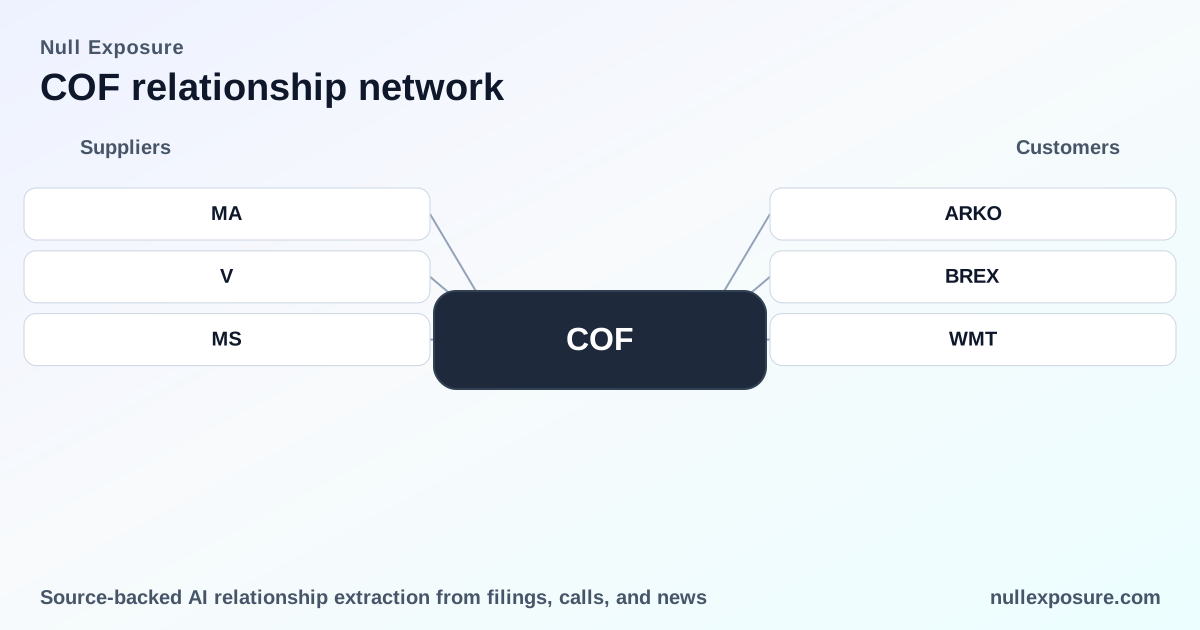
Capital One (COF) — supplier footprint and what it means for investors
Capital One is a credit-centric bank holding company that monetizes primarily through interest income and fee revenue from credit cards, auto lending, and deposit products, using a mix of retail deposits and capital markets funding to finance loans. Its strategic asset — the Discover network — gives the firm operational leverage and regulatory benefits that change the profile of third-party supplier relationships and network dependencies. For investors evaluating supplier risk and counterparty exposure, the balance between in-house capabilities (Discover) and continued reliance on external processors and distribution partners is the central theme. Visit the NullExposure homepage for deeper supplier mappings and tailored diligence: https://nullexposure.com/
Why supplier mapping matters for Capital One investors
Capital One’s business model is operationally dependent: transaction routing, card processing, cloud infrastructure, and distribution channels are core inputs that affect revenue capture and cost structure. Supplier disruption, concentration, or an adverse contracting posture for key vendors would directly affect card servicing and retail deposit flows. Conversely, the company’s partial vertical integration via the Discover network reduces some network dependencies and creates regulatory advantages in the payments stack — a structural change for monetization.
Explore supplier-level signals and analyst workstreams at NullExposure: https://nullexposure.com/
Relationships called out in public filings and coverage
Mastercard Incorporated (MA)
Capital One’s public commentary and market analysis highlight the firm’s pursuit of greater vertical integration through its own card network, which reduces reliance on networks like Mastercard for some product flows. That shift changes the economics of interchange and gives Capital One more control over routing and merchant acceptance dynamics. Source: Finviz news analysis, March 9, 2026.
Visa Inc. (V)
Similar to Mastercard, Visa is identified in coverage as a third-party network that Capital One is selectively distancing itself from as Discover takes on a larger role; this alters long-term network counterparty risk and fee exposure for card products. Source: Finviz news analysis, March 9, 2026.
Morgan Stanley Smith Barney LLC
A recent SEC filing notes common stock sold through Morgan Stanley Smith Barney LLC, reflecting an active capital markets and distribution relationship for Capital One’s equity. This is a traditional broker-dealer distribution channel rather than an operations supplier, and it matters for liquidity and institutional placement activity. Source: SEC filing as posted via StockTitan, March 9, 2026.
What the constraint signals tell investors about operating posture
The extracted constraints provide company-level signals that explain how Capital One contracts and operates with external parties:
-
Primary funding source is retail deposits (counterparty_type: individual). This indicates a funding mix with a significant retail-deposit base, implying sensitivity to consumer rates, deposit retention, and product pricing. The deposit-first posture reduces wholesale funding dependency and shifts liquidity risk toward retail behavior.
-
Material reliance on third‑party service providers (relationship_role: service_provider). Capital One explicitly lists vendors such as Amazon Web Services (AWS) for cloud infrastructure, Total System Services (TSYS) for card processing, and Fidelity Information Services (FIS) for banking systems as part of its operational fabric. This is a deliberate contracting posture: the firm blends in-house capabilities (Discover) with outsourced specialist providers to optimize cost and speed-to-market.
-
Relationships are active and operationally significant (relationship_stage: active). The active stage signal indicates these are not exploratory pilots but production-level relationships that support day-to-day operations and require robust governance, continuity planning, and contractual protections.
From these signals we can infer four practical characteristics of Capital One’s supplier model:
- Contracting posture: selective outsourcing, where core control (payments routing via Discover) is retained while commodity and scale services (cloud, processing, legacy banking systems) are outsourced to large incumbents.
- Concentration: moderate to high, because a handful of large suppliers (AWS, TSYS, FIS) perform critical functions.
- Criticality: very high for named providers — cloud and processing services are mission-critical for card authorization, servicing, and customer experience.
- Maturity: established and operational — the relationships are production-level and reflected in regulatory filings and disclosures.
Investment implications and risk checklist
- Operational risk is concentrated. Heavy dependence on AWS, TSYS, and FIS creates single‑point-of-service considerations; any supplier outage or contract dispute would have immediate downstream effects on card authorizations and customer servicing.
- Network independence shifts economics. Using Discover as a proprietary network reduces interchange leakage to Visa/Mastercard and yields regulatory advantages (e.g., Durbin-related posture), improving long-term margin potential on card portfolios.
- Funding composition reduces wholesale sensitivity. A retail-deposit-heavy funding base lowers exposure to short-term capital markets stress, but increases sensitivity to consumer rate competition and deposit flows.
- Capital markets relationships remain active. Broker-dealer distribution channels like Morgan Stanley Smith Barney matter for equity liquidity and capital actions, which has implications for shareholder liquidity events and block trades.
Bullet checklist for diligence:
- Confirm contract length, SLA penalties, and termination rights with cloud and processing vendors.
- Assess operational redundancy and runbooks for network routing (Discover fallback to third-party networks).
- Monitor deposit beta and retention metrics to understand liquidity sensitivity.
- Review merchant acceptance coverage and any bilateral settlement or interchange changes stemming from Discover expansion.
Access a structured supplier risk framework at NullExposure if you want model-ready diligence and vendor scoring: https://nullexposure.com/
Bottom line — where supplier signals feed valuation and governance
Capital One runs a hybrid operating model: a strategic push toward vertical integration in payments via Discover combined with continued operational outsourcing to scale vendors. For investors, supplier analysis is not a peripheral exercise; it is central to forecasting margins, operational resilience, and regulatory positioning. Key risks are supplier concentration and deposit economics; key upside is improved interchange capture via network control.
For a deeper supplier relationship breakdown or to commission tailored counterparty due diligence, visit NullExposure: https://nullexposure.com/
Investors should incorporate supplier contract terms, operational SLAs, and deposit behavior into valuation sensitivity scenarios rather than assuming a purely internal or purely outsourced cost base. Capital One’s mix of in-house network control and selected third-party outsourcing is a deliberate strategic choice that materially shapes future cash flow and operational risk.