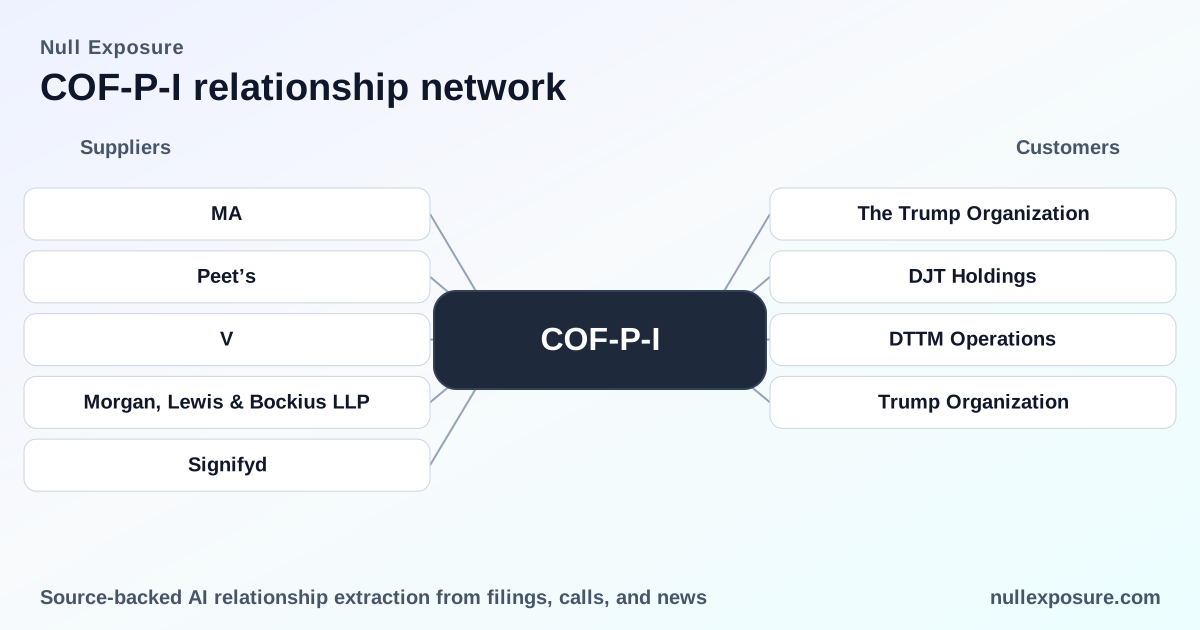
Capital One (COF‑P‑I) — Supplier Map and Investor Implications
Capital One Financial Corporation is a diversified U.S. bank holding company that monetizes through credit-card underwriting and interchange, consumer and commercial lending (notably auto loans), and deposit gathering, with retail and experiential channels (Capital One Cafés) that support customer acquisition and branding. For holders and evaluators of the COF‑P‑I preferred instrument, supplier relationships matter because they underpin customer-facing benefits, payment rails, fraud controls, and legal risk exposure—each of which can influence margin stability and reputational capital.
Discover a concise supplier view and practical investor actions at https://nullexposure.com/.
Executive takeaway: what these suppliers mean for COF‑P‑I holders
Capital One’s supplier footprint in the available signals is concentrated in payment network access (Visa, Mastercard), customer experience partners (Peet’s for café offerings), legal representation in litigation (Morgan, Lewis & Bockius LLP), and specialist fraud technology (Signifyd). Payment rails and fraud infrastructure are operationally critical, while café partnerships are strategically valuable for customer engagement but materially less critical to core lending economics. Legal counsel relationships signal active governance of litigation exposure. Investors should read these relationships as operational necessities that support revenue flows and protect loss rates.
Explore supplier intelligence and due-diligence tools at https://nullexposure.com/.
Supplier relationships we found and what each means
Mastercard (MA)
Capital One lists Mastercard as a provider of card benefits for some products, indicating use of Mastercard’s network and branded benefits in the bank’s card portfolio. According to CardRates’ coverage of Capital One Café redesign (CardRates, March 2026), some product benefits are provided by Mastercard and vary by product.
Visa (V)
Visa is likewise cited as a benefits provider for certain Capital One products, reflecting dual-network card issuance strategy that supports product segmentation and distribution across the two dominant payment networks. CardRates’ March 2026 reporting notes that Visa-provided benefits are part of the card-product value proposition.
Peet’s
Capital One Café visitors receive Peet’s coffee and tea, demonstrating a retail partnership to drive branch traffic and brand engagement rather than a core financial-service dependency. CardRates’ article on the Café redesign (March 2026) describes Peet’s inclusion as part of the in‑branch experience.
Morgan, Lewis & Bockius LLP
Morgan Lewis is identified as defense counsel in a matter involving Capital One (related to a 401(k) forfeiture case), highlighting ongoing legal and regulatory workstreams that require specialized external counsel. Plansponsor’s reporting on Capital One’s settlement (PlanSponsor, March 2026) references Morgan Lewis appearing for the defendants in FY2025.
Signifyd
Capital One has entered a partnership to deploy Signifyd’s Authorization Rate Optimization solution into its payments ecosystem, signaling third‑party augmentation of fraud prevention and authorization decisioning aimed at improving authorization rates and reducing chargebacks. Finovate coverage of the partnership (Finovate, March 2026) frames this as a FY2024 initiative to tighten payment lifecycle outcomes.
What the signals say about Capital One’s operating model
Although the dataset did not capture explicit supplier constraints, the relationship list generates clear company‑level signals about operating posture and business model characteristics:
- Contracting posture: Strategic, multi‑year alliances are implied with card networks and fraud specialists; these are long‑term, standards‑driven relationships rather than one‑off vendor buys. This posture favors negotiated commercial terms and operational integration.
- Concentration: Payments dependency is concentrated among the two dominant networks (Visa, Mastercard), which creates concentrated counterparty exposure for authorization and interchange routing decisions.
- Criticality: Payment networks and fraud decisioning are mission‑critical to card issuance economics and loss control; disruptions or degraded performance would directly affect revenue capture and chargeoff incidence. Café partners are non‑critical but material for customer acquisition and brand.
- Maturity and sophistication: The choice of established networks, large law firms, and specialist fraud providers indicates high vendor maturity and a preference for enterprise-grade supply partners.
Because no supplier constraints were captured in the supplied material, there is no available evidence of restrictive contractual clauses, termination cliffs, or single-source exclusivities surfaced in the signals; absence of captured constraints should not be treated as absence of risk, only as lack of documented constraints in this feed.
Risk implications investors should track
- Network concentration risk: Continued reliance on Visa and Mastercard requires monitoring of interchange economics, network fee changes, and bilateral terms—any adverse change affects card profitability.
- Operational dependency on fraud tech: Outsourcing or partnering for authorization optimization shifts some control to vendors; measure vendor SLAs and success metrics to ensure improved authorization rates translate to net revenue, not increased loss.
- Legal exposure: Engagement of major defense counsel signals active litigation management; track settlement outcomes and reserve adjustments that can impact capital and cash flow.
- Reputational execution: Retail partnerships like Peet’s enhance customer experience but carry brand and operating cost tradeoffs that influence acquisition economics.
Investor actions and operator playbook
- Request and review contractual terms and termination mechanics for payment-network agreements and Signifyd engagement; confirm contingency plans for network or vendor outages.
- Demand quantitative SLAs for authorization optimization and fraud outcomes (e.g., false‑positive reduction, authorization uplift) and monitor those KPIs monthly.
- Monitor legal disclosures and filings for reserve changes tied to litigation where external counsel is engaged; evaluate potential balance‑sheet impacts ahead of earnings.
- Stress‑test customer‑acquisition economics that include café partnerships; ensure the cost per new funded account aligns with lifetime-value assumptions.
Final view and recommended next steps
Capital One’s supplier set reflected here is pragmatic and reflects the structure of modern card issuers: dominant network access, specialist fraud partners, brand-oriented retail engagements, and heavyweight legal counsel. For COF‑P‑I investors, the key exposures are operational—payments and fraud—backed by mature suppliers, and strategic—brand partnerships that support growth. Maintain active vendor diligence and confirm governance over third‑party performance and legal contingencies.
For deeper supplier analytics and targeted due diligence playbooks for preferred‑share holders, visit https://nullexposure.com/.
If you would like a tailored supplier-risk briefing for COF‑P‑I or a watchlist that monitors vendor‑related disclosures and news, start here: https://nullexposure.com/.